Explaining the mathematics of cryptography
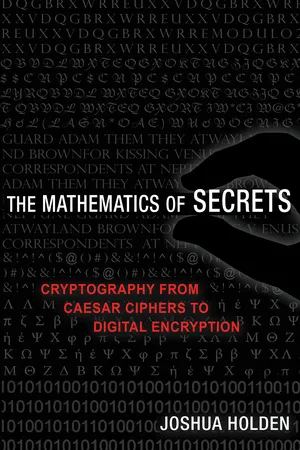
The Mathematics of Secrets takes readers on a fascinating tour of the mathematics behind cryptography—the science of sending secret messages. Using a wide range of historical anecdotes and real-world examples, Joshua Holden shows how mathematical principles underpin the ways that different codes and ciphers work. He focuses on both code making and code breaking and discusses most of the ancient and modern ciphers that are currently known. He begins by looking at substitution ciphers, and then discusses how to introduce flexibility and additional notation. Holden goes on to explore polyalphabetic substitution ciphers, transposition ciphers, connections between ciphers and computer encryption, stream ciphers, public-key ciphers, and ciphers involving exponentiation. He concludes by looking at the future of ciphers and where cryptography might be headed. The Mathematics of Secrets reveals the mathematics working stealthily in the science of coded messages.
A blog describing new developments and historical discoveries in cryptography related to the material in this book is accessible at http://press.princeton.edu/titles/10826.html.
eBook - PDF
The Mathematics of Secrets
Cryptography from Caesar Ciphers to Digital Encryption
- 391 pages
- English
- PDF
- Available on iOS & Android
eBook - PDF
About this book
Information
Publisher
Princeton University PressYear
2018Print ISBN
9780691183312
9780691141756
eBook ISBN
9780691184555
Table of contents
- Cover
- Title
- Copyright
- Dedication
- CONTENTS
- Preface
- Acknowledgments
- 1 Introduction to Ciphers and Substitution
- 2 Polyalphabetic Substitution Ciphers
- 3 Transposition Ciphers
- 4 Ciphers and Computers
- 5 Stream Ciphers
- 6 Ciphers Involving Exponentiation
- 7 Public-Key Ciphers
- 8 Other Public-Key Systems
- 9 The Future of Cryptography
- List of Symbols
- Notes
- Suggestions for Further Reading
- Bibliography
- Index
Trusted by 375,005 students
Access to over 1.5 million titles for a fair monthly price.
Study more efficiently using our study tools.
Frequently asked questions
Yes, you can cancel anytime from the Subscription tab in your account settings on the Perlego website. Your subscription will stay active until the end of your current billing period. Learn how to cancel your subscription
No, books cannot be downloaded as external files, such as PDFs, for use outside of Perlego. However, you can download books within the Perlego app for offline reading on mobile or tablet. Learn how to download books offline
Perlego offers two plans: Essential and Complete
- Essential is ideal for learners and professionals who enjoy exploring a wide range of subjects. Access the Essential Library with 800,000+ trusted titles and best-sellers across business, personal growth, and the humanities. Includes unlimited reading time and Standard Read Aloud voice.
- Complete: Perfect for advanced learners and researchers needing full, unrestricted access. Unlock 1.5M+ books across hundreds of subjects, including academic and specialized titles. The Complete Plan also includes advanced features like Premium Read Aloud and Research Assistant.
We are an online textbook subscription service, where you can get access to an entire online library for less than the price of a single book per month. With over 1.5 million books across 990+ topics, we’ve got you covered! Learn about our mission
Look out for the read-aloud symbol on your next book to see if you can listen to it. The read-aloud tool reads text aloud for you, highlighting the text as it is being read. You can pause it, speed it up and slow it down. Learn more about Read Aloud
Yes! You can use the Perlego app on both iOS and Android devices to read anytime, anywhere — even offline. Perfect for commutes or when you’re on the go.
Please note we cannot support devices running on iOS 13 and Android 7 or earlier. Learn more about using the app
Please note we cannot support devices running on iOS 13 and Android 7 or earlier. Learn more about using the app
Yes, you can access The Mathematics of Secrets by Joshua Holden in PDF and/or ePUB format, as well as other popular books in Computer Science & Cryptography. We have over 1.5 million books available in our catalogue for you to explore.