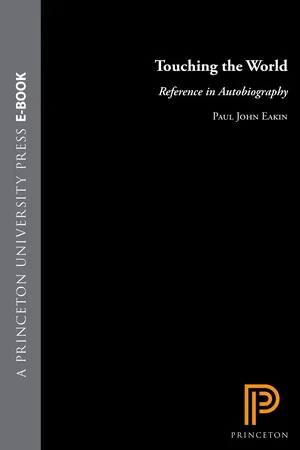
Paul John Eakin's earlier work Fictions in Autobiography is a key text in autobiography studies. In it he proposed that the self that finds expression in autobiography is in fundamental ways a kind of fictive construct, a fiction articulated in a fiction. In this new book Eakin turns his attention to what he sees as the defining assumption of autobiography: that the story of the self does refer to a world of biographical and historical fact. Here he shows that people write autobiography not in some private realm of the autonomous self but rather in strenuous engagement with the pressures that life in culture entails. In so demonstrating, he offers fresh readings of autobiographies by Roland Barthes, Nathalie Sarraute, William Maxwell, Henry James, Ronald Fraser, Richard Rodriguez, Henry Adams, Patricia Hampl, John Updike, James McConkey, and Lillian Hellman. In the introduction Eakin makes a case for reopening the file on reference in autobiography, and in the first chapter he establishes the complexity of the referential aesthetic of the genre, the intricate interplay of fact and fiction in such texts. In subsequent chapters he explores some of the major contexts of reference in autobiography: the biographical, the social and cultural, the historical, and finally, underlying all the rest, the somatic and temporal dimensions of the lived experience of identity. In his discussion of contemporary theories of the self, Eakin draws especially on cultural anthropology and developmental psychology.
- 268 pages
- English
- ePUB (mobile friendly)
- Available on iOS & Android
eBook - ePub
About this book
Information
Table of contents
- Cover Page
- Title Page
- Copyright Page
- Dedication
- Contents
- Acknowledgments
- Introduction
- Chapter One: The Referential Aesthetic of Autobiography
- Chapter Two: Henry James’s “Obscure Hurt”: Can Autobiography Serve Biography?
- Chapter Three: Self and Culture in Autobiography: Models of Identity and the Limits of Language
- Chapter Four: Living in History
- Chapter Five: Autobiography and the Structures of Experience
- Works Cited
- Index
Trusted by 375,005 students
Access to over 1.5 million titles for a fair monthly price.
Study more efficiently using our study tools.
Frequently asked questions
Yes, you can cancel anytime from the Subscription tab in your account settings on the Perlego website. Your subscription will stay active until the end of your current billing period. Learn how to cancel your subscription
No, books cannot be downloaded as external files, such as PDFs, for use outside of Perlego. However, you can download books within the Perlego app for offline reading on mobile or tablet. Learn how to download books offline
We are an online textbook subscription service, where you can get access to an entire online library for less than the price of a single book per month. With over 1.5 million books across 990+ topics, we’ve got you covered! Learn about our mission
Look out for the read-aloud symbol on your next book to see if you can listen to it. The read-aloud tool reads text aloud for you, highlighting the text as it is being read. You can pause it, speed it up and slow it down. Learn more about Read Aloud
Yes! You can use the Perlego app on both iOS and Android devices to read anytime, anywhere — even offline. Perfect for commutes or when you’re on the go.
Please note we cannot support devices running on iOS 13 and Android 7 or earlier. Learn more about using the app
Please note we cannot support devices running on iOS 13 and Android 7 or earlier. Learn more about using the app
Yes, you can access Touching the World by Paul John Eakin in PDF and/or ePUB format, as well as other popular books in Literature & North American Literary Criticism. We have over 1.5 million books available in our catalogue for you to explore.