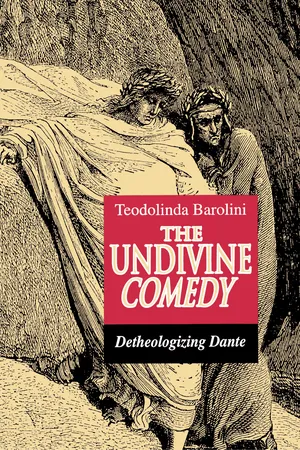
Accepting Dante's prophetic truth claims on their own terms, Teodolinda Barolini proposes a "detheologized" reading as a global new approach to the Divine Comedy. Not aimed at excising theological concerns from Dante, this approach instead attempts to break out of the hermeneutic guidelines that Dante structured into his poem and that have resulted in theologized readings whose outcomes have been overdetermined by the poet. By detheologizing, the reader can emerge from this poet's hall of mirrors and discover the narrative techniques that enabled Dante to forge a true fiction. Foregrounding the formal exigencies that Dante masked as ideology, Barolini moves from the problems of beginning to those of closure, focusing always on the narrative journey. Her investigation--which treats such topics as the visionary and the poet, the One and the many, narrative and time--reveals some of the transgressive paths trodden by a master of mimesis, some of the ways in which Dante's poetic adventuring is indeed, according to his own lights, Ulyssean.
- 369 pages
- English
- PDF
- Available on iOS & Android
eBook - PDF
About this book
Information
Publisher
Princeton University PressYear
1992Print ISBN
9780691015286
9780691069531
eBook ISBN
9781400820764
Table of contents
- Book Cover
- Title
- Copyright
- CONTENTS
Trusted by 375,005 students
Access to over 1.5 million titles for a fair monthly price.
Study more efficiently using our study tools.
Frequently asked questions
Yes, you can cancel anytime from the Subscription tab in your account settings on the Perlego website. Your subscription will stay active until the end of your current billing period. Learn how to cancel your subscription
No, books cannot be downloaded as external files, such as PDFs, for use outside of Perlego. However, you can download books within the Perlego app for offline reading on mobile or tablet. Learn how to download books offline
We are an online textbook subscription service, where you can get access to an entire online library for less than the price of a single book per month. With over 1.5 million books across 990+ topics, we’ve got you covered! Learn about our mission
Look out for the read-aloud symbol on your next book to see if you can listen to it. The read-aloud tool reads text aloud for you, highlighting the text as it is being read. You can pause it, speed it up and slow it down. Learn more about Read Aloud
Yes! You can use the Perlego app on both iOS and Android devices to read anytime, anywhere — even offline. Perfect for commutes or when you’re on the go.
Please note we cannot support devices running on iOS 13 and Android 7 or earlier. Learn more about using the app
Please note we cannot support devices running on iOS 13 and Android 7 or earlier. Learn more about using the app
Yes, you can access The Undivine Comedy by Teodolinda Barolini in PDF and/or ePUB format, as well as other popular books in Literature & Italian Literary Criticism. We have over 1.5 million books available in our catalogue for you to explore.