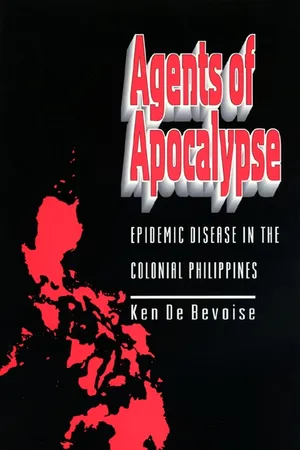
As waves of epidemic disease swept the Philippines in the late nineteenth century, some colonial physicians began to fear that the indigenous population would be wiped out. Many Filipinos interpreted the contagions as a harbinger of the Biblical Apocalypse. Though the direct forebodings went unfulfilled, Philippine morbidity and mortality rates were the world's highest during the period 1883-1903. In Agents of Apocalypse, Ken De Bevoise shows that those "mourning years" resulted from a conjunction of demographic, economic, technological, cultural, and political processes that had been building for centuries. The story is one of unintended consequences, fraught with tragic irony.
De Bevoise uses the Philippine case study to explore the extent to which humans participate in creating their epidemics. Interpreting the archival record with conceptual guidance from the health sciences, he sets tropical disease in a historical framework that views people as interacting with, rather than acting within, their total environment. The complexity of cause-effect and agency-structure relationships is thereby highlighted. Readers from fields as diverse as Spanish, American, and Philippine history, medical anthropology, colonialism, international relations, Asian studies, and ecology will benefit from De Bevoise's insights into the interdynamics of historical processes that connect humans and their diseases.
- 328 pages
- English
- ePUB (mobile friendly)
- Available on iOS & Android
eBook - ePub
About this book
Information
CHAPTER 1
Probability of Contact
CLASSIC epidemiological theory holds that the patterns of disease in any population group depend on factors that determine the probability of contact between an infectious agent and a susceptible host. That formulation still helps us understand the occurrence of the infectious diseases that weighed so heavily on late-nineteenth-century Filipinos, but it needs updating to account for patterns of others, the most important of which was beriberi, a noninfectious deficiency disease. Accordingly, an agent is understood in its current sense as “an organism, substance, or force whose relative presence or relative absence is necessary for a particular disease process to occur.” In addition, the theory must be buttressed by a broadened awareness of critical host factors, especially immunologic states, as well as by an appreciation of the totality of the environment in which contact took place. Setting aside the susceptibility component of the model for now, this chapter considers the historical process that so dramatically increased the probability of contact between Filipinos and infection.1
The Filipino population as a whole was not at serious demographic risk from widespread epidemic disease before the mid-nineteenth century. Basic epidemiological principles explain why. Frank Fenner says that “the most important single parameter, from the point of infectious diseases, is the alteration in the size of the aggregates of men and the communications within and between these aggregates.” No infection requiring transfers between human hosts for survival can maintain itself above the fade-out threshold for long in a static and dispersed population group where the probability of personal interaction is low. Diseases can neither be endemic (constantly present) nor epidemic (excessively prevalent) in a community whose members come in contact too infrequently to keep the chain of transmission alive. Mortality rates from infectious disease among such groups will be relatively low as a consequence.2
Relative size and isolation can also determine the extent of infectious disease within a community, as Fenner’s statement of the principle suggests. Even where population density and interpersonal contact are sufficient to allow rapid diffusion, endemicity of many diseases is impossible in population groups below a critical size. As infection spreads, the remaining pool of susceptibles is quickly reduced below the level at which transmission can be sustained. Contact with an external population center where the infection is endemic or has been recently introduced is necessary for reintroduction of the disease, and a new epidemic must await the replenishment of the pool of susceptible hosts. Death rates will be high in small, isolated communities under epidemic conditions, but whether or not mortality is excessive over the longer term depends on the frequency with which the infection is imported. That frequency depends in turn on the size of the small community, its distance from the external reservoir, and the efficiency of the transportation network binding them. As a general rule, the smaller and more remote a community, the more irregular and discontinuous epidemic waves will be. Overall mortality is likely to be lower as well.3
The physical and cultural environments of the Philippine Islands set a relatively low limit on the probability of contact with infection from outside reservoirs. The archipelago seems to have been designed to encourage regional separateness and to inhibit extralocal human interaction. It comprises about seven thousand mostly tiny and uninhabitable islands, which are the unsubmerged portions of four major Southeast Asian tectonic provinces running roughly parallel to each other in a north-south configuration. The islands dot a half-million square miles of ocean, their total land area taking up somewhat more than one-fifth of that expanse. Four distinct climatological zones cut more or less longitudinally through the archipelago, bringing widely varying amounts of rainfall to different areas in distinct seasonal patterns. The various climates and geological histories have produced a corresponding diversity of soils, vegetation, and topography, though most of the larger islands are banded by a narrow and usually discontinuous coastal plain that rises abruptly to interior upland regions that are often mountainous and almost impenetrable. Physical barriers, poor roads, and rainy-season conditions have always made overland movement difficult and sometimes virtually impossible.4
At the time of Spanish intervention in 1565, which marks the start of recorded history in the Philippines, the archipelago was lightly populated. Probably no more than 1.2 million Filipinos inhabited up to a thousand islands for an average density of about ten persons per square mile. It would be seriously misleading to picture Filipinos living in “aseptic isolation” at any time, but from the epidemiological perspective, traditional settlement patterns were relatively small, dispersed, static, and isolated. Those qualifications are important because from another viewpoint, preconquest Filipinos were, in William Henry Scott’s words, “a vigorous and mobile population adjusting to every environment in the archipelago, creatively producing variations in response to resources, opportunities and culture contacts, able to trade and raid, feed and defend themselves.” Despite the sense of motion and interaction Scott conveys so well, the Philippine island world comprised archipelagos within an archipelago, islands within islands. That world was hardly impermeable to infection, and it became markedly less so over time, but imported disease from within and without tended to be localized and self-limiting until about a century and a half ago.5
Lowland settlement was generally based on the barangay, a kinship grouping of perhaps 20 to 100 families, most of whom lived in a primary village comprising an elongated cluster of houses several deep and ten to sixty long that hugged the shoreline or a river bank. (Cebu, Manila, Vigan, and a few others were exceptional, comprising as many as 2,000 families.) Shifting and seasonal cultivation produced a pattern of dispersed houses and hamlets scattered at some distance from the base village throughout its territory. The people harvested the fishing grounds in the shallow waters surrounding most of the islands and engaged in subsistence agricultural and handicraft activities ashore. Relations with other independent communities “whether of the same language or different, varied from isolation to cooperation or conflict according to circumstances,” according to Scott. Miguel de Loarca noted the complexity of relationships between lowland and highland groups in 1582, remarking that although they “are almost always enemies,” some peace was necessary because “those of the mountains cannot live without the fish and salt and other things and jars and plates which come from other parts, nor can those on the coast live without the rice and cotton which the mountaineers have.”6
Since physical and cultural barriers to extensive overland contacts were so formidable, the sea presented the easiest route for diffusion of disease among the island populations. Scott explains that interisland waters were not a barrier but “the means of connecting Filipinos and culture exchange.” The volume of interisland trade, and hence infectious agents as well, was sensitive to the difficulties presented by distance, contrary monsoon winds, and pirates, but evidence abounds of a vigorous commerce, especially in rice. Cebu, for instance, was the redistribution center for the Visayas at the time of conquest, receiving shipments from Panay and the east coast of Mindanao. Catanduanes shipbuilders went hundreds of miles to sell various types of sailcraft to barangay on Mindoro and southern Luzon, and the trade in porcelains extended to virtually every part of the archipelago and beyond. Slave raiding was even more important epidemiologically because of its capacity to terrorize the population and to disrupt normal living patterns. Power and prestige was based on control of slave labor, so attacks were continual and could come from any point on the compass. Scott points out that in Jesuit Father Francisco Alcina’s day (mid-seventeenth century) “Bohol raids as far afield as Ternate [in the Moluccas] were still living memories, and he knew Samar parishioners who were the descendants of captives taken on the coasts of Luzon.”7
Longer-range trade linked the various disease environments of insular Southeast Asia and the mainland to some extent. The Borneo-Luzon-Fujian (Fukien) route was perhaps the most active, but traces of Filipinos and their ships survive in virtually every part of the region. However, the relatively slow, small sailcraft held down the potential for the introduction of infectious disease into the Philippine Islands—the longer the travel time (the 640 miles between the Chinese mainland and Manila was an eight-day voyage in the sixteenth century) and the smaller the crew size, the greater the likelihood that the chain of transmission would be broken en route. The most accessible outside reservoirs of infection lay to the south. As trading sailcraft coming from Borneo, the Celebes, or the Moluccas hopped from island to island, the various populations served as “boosters” for new cases to be carried on to the southern reaches of the archipelago. Such disease as did arrive undoubtedly resulted in high levels of local mortality, but the potential for widespread dispersion was circumscribed.8
Although initial Spanish contacts did not wreak wholesale epidemiological havoc throughout the archipelago as in the Americas, the “pacification” (to use Philip II’s euphemism) caused substantial death and suffering in many barangay. In 1571 Miguel López de Legazpi began the distribution of land and Filipinos among his soldiers by introducing the encomienda system, which Angel Martínez Cuesta has described as “a contract between the King, the encomendero and the natives to which only the King and the encomendero freely consented.” Each encomienda holder received the right to collect the annual tribute from a specified group of Filipinos. In return he was to pacify them and procure their submission to the Crown, resettle them into townships, protect them from danger, and provide religious instruction. Detachments of soldiers went from community to community “tell[ing] the townspeople that if they want to be friends of the Spaniards they must pay the tribute at once.” Those who refused or prepared to defend themselves were “killed or made prisoners, and their houses plundered and burned,” according to the Augustinian friar Diego de Herrera. Even in “friendly towns” many of the common people were so poor that they destroyed their houses and hid in the hills for a few months rather than pay. Everything we know about the interaction of war and disease indicates that the “pain, tears, and blood” of the military conquest must have been accompanied by abnormal mortality.9
Administrative convenience, the imperatives of Christianization, and Spanish notions of civilization required a concentration of the population in the base villages so as to bring everyone “under the bells” of the church. That process of consolidation continued without abatement or complete success for more than three centuries. Ongoing resistance by Filipinos to leaving their fields and accepting “a way of life that was either unknown to them or which in the past had not pleased them” forced church and state to compromise. In the settlement pattern that evolved, the población (the administrative center of a pueblo containing the market, church, town hall, and major houses) acted as a magnet to the people in progressively smaller and distant satellite settlements known as barrios, sitios, and rancherias. The Spanish administration always despaired of its inability to induce more Filipinos to live in poblaciones, but substantial local population shifts took place wherever colonial rule took hold. Since disease inevitably accompanies dislocation and crowding, it is no surprise to find late-sixteenth-century missionaries in Cagayan reporting that greater exposure to pestilence was among the factors causing people to avoid resettlement. A century and a half later, Anton Malinski said that even “the rumor of a disease” caused the newly resettled hill people on Negros to “flee back into their forests.” Others stayed and died, like those who had been forcibly resettled in the organized towns of Father Francisco Antolín’s mission in north-central Luzon. About 1789 he wrote that many of them quickly became ill and expired. They “wasted away, weakened … and few could be kept alive.”10
Sketchy evidence is accumulating of a demographic crisis that began near the end of the sixteenth century and extended through the first half of the next. A number of determining factors can be identified. The pacification and consolidation of Spanish control over Luzon and the Visayas coincided with the wars against the Dutch (1609–1648) for commercial supremacy in the region centering on the spice-rich Moluccas. It has long been recognized that the war years were extraordinarily hard. The colonial administration could not pay for the fighting, so it was prosecuted on the backs of the people. The polo (compulsory labor) and the vandala (compulsory sale of products to the government) were the most onerous means, as Horacio de la Costa has explained: “It was the forced-labor contingents drafted year after year from the provinces near Manila that felled the timber, built the ships, sailed them and manned their guns. It was the supplies requisitioned by the government from the same provinces that fed, clothed and armed their crews.”11
At the same time, changed patterns of interisland raiding destabilized life in the Visayas. Forays by Christian Filipinos had ended, but Moro (Muslim Filipino) raids from Mindanao and the Sulu Archipelago in the south persisted and increased, eventually reaching their greatest extent in the third quarter of the eighteenth century. Father Rodrigo de Aganduru Moriz reported in 1632 on the sudden reversal of roles. Visayans told him that formerly “they would go to Mindanao where they took many captives, and terrified them; and now it is the opposite, because they are Christians and it is not licit for them to make those raids, and they are disarmed, they are paying for what they did then.” The negative effects of the raids on public health and population growth should not be minimized. Moro incursions could destabilize a community as completely as American army depredations would centuries later. Raiders beseiged Ilog, Negros, for a month in 1722, finally destroying everything. Pedro Fariz reported that they burned all the houses in the town and fields as well as the growing rice. “As for plants, fruit trees and coconuts, they cut them down. They set fire to all the fields and killed all the pigs, cattle, fowl, dogs, and carabaos so that Ilog was completely razed.” Raids took the form of frontal attacks against poblaciones on Samar, with seiges lasting as long as five weeks. One priest described the consequences: “When the Moros besiege the town, as they usually do, the people are subject to epidemics … despairing unto [the point of] surrender in order to eat since their fields and hills where there is plenty of food are far away.”12
The colonial economy suffered during the years of the Dutch wars as well. It depended heavily on the transshipment of Chinese goods to New Spain (Mexico) in the Manila Galleon, especially since the Spaniards had closed all ports to direct outside commerce except Manila, where European vessels (other than Spanish and Portuguese) were banned. According to John L. Phelan the “string of calamities” that periodically interrupted the galleon trade during the war years “only aggravated an already desperate situation.” Norman G. Owen has looked at the scant population data that exist and has derived figures for seven different years between 1586 and 1742 of persons from whom the colonial administration claimed tribute (tax and labor services). (The number of tributes can be multiplied by a number corresponding to presumed average family size, usually between four and five, to get a rough count of the population under Spanish control.) The numbers suggest the following rates of average annual population growth or loss during the period: +2.75 percent (1586–1591), −1.47 percent (1591–1608), +0.34 percent (1608–1621), −0.51 percent (1621–1655), +0.38 percent (1655–1686), and +0.94 percent (1686–1742). Anthony Reid has argued that the 35.1 percent decline in tributes between 1591 (166,903) and 1655 (108,277) is far too large to be explained solely by people fleeing to the hills to avoid colonial exactions. He links the apparent demographic loss not only to warfare but to the general seventeenth-century crisis, whose repercussions were felt in Southeast Asia as well. In addition, he cites climatological evidence (tree rings from Java and reports of drought elsewhere) indicating that the entire region experienced abnormally low levels of rainfall from 1600 to 1660, which he says would have induced famines and increased mortality from disease throughout Southeast Asia.13
Contemporary observers described the hardships of pacification, external war, polos and vandalas, and Moro raids but left no measurements of changes in precipitation, diet, or morbidity and mortality from disease. It will never be possible to reconstruct what happened with any certainty, but it is at least clear that the overall Philippine demographic downturn ended about the time the war did. What we do not know is how much of the rapid population growth thereafter was attributable to lower mortality (and from what causes) and how much to a higher birth rate. It may be that the latter factor was significant. The government had met its wartime need for labor and supplies by letting cabezas de barangay (local chieftains) force the people who could not meet polo or vandala obligations into debt peonage. We can safely presume elevated levels of morbidity and mortality under such conditions. With the return of peace in 1648, the cabezas lost that source of enrichment. New forms of onerous private labor arrangements founded on dependency relationships, like sharecropping evolved, but the worst of the misery must have eased. Levels of undernourishment and disease undoubtedly diminished, and as life became less precarious, the birth rate would have recovered quickly, especially in the provinces on Luzon that had supplied timber and foodstuffs during the wars. Earlier marriage may have become more common as well. When towns were organized in the Batanes Islands at a later date, the friars made sure that “the custom of not marrying before the age of thirty was eliminated [because] it held back the increase of population,” according to Ana ...
Table of contents
- Cover Page
- Title Page
- Copyright Page
- Dedication Page
- Contents
- Preface
- Acknowledgments
- Map of Asia and the East Indies, 1875
- Introduction: Dimensions of the Crisis
- Part One
- Part Two
- Conclusion: Intervention and Disease
- Abbreviations Used in the Notes
- Notes
- Bibliography
- Index
Trusted by 375,005 students
Access to over 1.5 million titles for a fair monthly price.
Study more efficiently using our study tools.
Frequently asked questions
Yes, you can cancel anytime from the Subscription tab in your account settings on the Perlego website. Your subscription will stay active until the end of your current billing period. Learn how to cancel your subscription
No, books cannot be downloaded as external files, such as PDFs, for use outside of Perlego. However, you can download books within the Perlego app for offline reading on mobile or tablet. Learn how to download books offline
Perlego offers two plans: Essential and Complete
- Essential is ideal for learners and professionals who enjoy exploring a wide range of subjects. Access the Essential Library with 800,000+ trusted titles and best-sellers across business, personal growth, and the humanities. Includes unlimited reading time and Standard Read Aloud voice.
- Complete: Perfect for advanced learners and researchers needing full, unrestricted access. Unlock 1.5M+ books across hundreds of subjects, including academic and specialized titles. The Complete Plan also includes advanced features like Premium Read Aloud and Research Assistant.
We are an online textbook subscription service, where you can get access to an entire online library for less than the price of a single book per month. With over 1.5 million books across 990+ topics, we’ve got you covered! Learn about our mission
Look out for the read-aloud symbol on your next book to see if you can listen to it. The read-aloud tool reads text aloud for you, highlighting the text as it is being read. You can pause it, speed it up and slow it down. Learn more about Read Aloud
Yes! You can use the Perlego app on both iOS and Android devices to read anytime, anywhere — even offline. Perfect for commutes or when you’re on the go.
Please note we cannot support devices running on iOS 13 and Android 7 or earlier. Learn more about using the app
Please note we cannot support devices running on iOS 13 and Android 7 or earlier. Learn more about using the app
Yes, you can access Agents of Apocalypse by Ken De Bevoise in PDF and/or ePUB format, as well as other popular books in History & Asian History. We have over 1.5 million books available in our catalogue for you to explore.