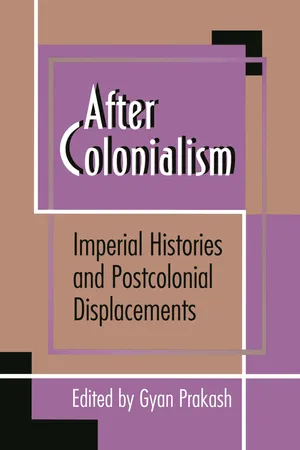
After Colonialism offers a fresh look at the history of colonialism and the changes in knowledge, disciplines, and identities produced by the imperial experience. Ranging across disciplines--from history to anthropology to literary studies--and across regions--from India to Palestine to Latin America to Europe--the essays in this volume reexamine colonialism and its aftermath. Leading literary scholars, historians, and anthropologists engage with recent theories and perspectives in their specific studies, showing the centrality of colonialism in the making of the modern world and offering postcolonial reflections on the effects and experience of empire.
The contributions cross historical analysis of texts with textual examination of historical records and situate metropolitan cultural practices in engagements with non-metropolitan locations. Interdisciplinarity here means exploring and realigning disciplinary boundaries. Contributors to After Colonialism include Edward Said, Steven Feierman, Joan Dayan, Ruth Phillips, Anthony Pagden, Leonard Blussé, Gauri Viswanathan, Zachary Lockman, Jorge Klor de Alva, Irene Silverblatt, Emily Apter, and Homi Bhabha.
- 336 pages
- English
- ePUB (mobile friendly)
- Available on iOS & Android
eBook - ePub
About this book
Information
Publisher
Princeton University PressYear
1994Print ISBN
9780691037424
9780691037431
eBook ISBN
9781400821440
_________________________________ Part One _________________________________
COLONIALISM AND THE DISCIPLINES
_________________________________ CHAPTER 1 _________________________________
Secular Interpretation, the Geographical Element, and the Methodology of Imperialism
EDWARD SAID
FROM LONG BEFORE World War Two until the early 1970s, the main tradition of comparative-literature studies in Europe and the United States was heavily dominated by a style of scholarship that has now almost disappeared. The main feature of this older style was that it was scholarship principally, and not what we have come to call criticism. No one today is trained as were Erich Auerbach and Leo Spitzer, two of the greatest German comparatists who found refuge in the United States as a result of fascism: this is as much a quantitative as a qualitative fact. Whereas today’s comparatist will present his or her qualifications in Romanticism between 1795 and 1830 in France, England, and Germany, yesterday’s comparatist was more likely, first, to have studied an earlier period; second, to have done a long apprenticeship with various philological and scholarly experts in various universities in various fields over many years; third, to have a secure grounding in all or most of the classical languages, the early European vernaculars, and their literatures. The early-twentieth-century comparatist was a philolog who, as Francis Fergusson put it in a review of Auerbach’s Mimesis, was so learned and had so much stamina as to make “our most intransigent ‘scholars’—those who pretend with the straightest faces to scientific rigor and exhaustiveness—[appear to be] timid and relaxed.”1
Behind such scholars was an even longer tradition of humanistic learning that derived from that efflorescence of secular anthropology—which included a revolution in the philological disciplines—we associate with the late eighteenth century and with such figures as Vico, Herder, Rousseau, and the brothers Schlegel. And underlying their work was the belief that mankind formed a marvelous, almost symphonic whole whose progress and formations, again as a whole, could be studied exclusively as a concerted and secular historical experience, not as an exemplification of the divine. Because “man” has made history, there was a special hermeneutical way of studying history that differed in intent as well as method from the natural sciences. These great Enlightenment insights became widespread, and were accepted in Germany, France, Italy, Russia, Switzerland, and, subsequently, England.
It is not a vulgarization of history to remark that a major reason why such a view of human culture became current in Europe and America in several forms during the two centuries between 1745 and 1945 was the striking rise of nationalism during the same period. The interrelations between scholarship (or literature, for that matter) and the institutions of nationalism have not been as seriously studied as they should, but it is nevertheless evident that when most European thinkers celebrated humanity or culture they were principally celebrating ideas and values they ascribed to their own national culture, or to Europe as distinct from the Orient, Africa, and even the Americas. What partly animated my study of Orientalism was my critique of the way in which the alleged universalism of fields such as the classics (not to mention historiography, anthropology, and sociology) was Eurocentric in the extreme, as if other literatures and societies had either an inferior or transcended value. (Even the comparatists trained in the dignified tradition that produced Curtius and Auerbach showed little interest in Asian, African, or Latin American texts.) And as the national and international competition between European countries increased during the nineteenth century, so too did the level of intensity in competition between one national scholarly interpretative tradition and another. Ernest Renan’s polemics on Germany and the Jewish tradition are a well-known example of this.
Yet this narrow, often strident nationalism was in fact counteracted by a more generous cultural vision represented by the intellectual ancestors of Curtius and Auerbach, scholars whose ideas emerged in pre-imperial Germany (perhaps as compensation for the political unification eluding the country), and, a little later, in France. These thinkers took nationalism to be a transitory, finally secondary matter: what mattered far more was the concert of peoples and spirits that transcended the shabby political realm of bureaucracy, armies, customs barriers, and xenophobia. Out of this catholic tradition, to which European (as opposed to national) thinkers appealed in times of severe conflict, came the idea that the comparative study of literature could furnish a trans-national, even trans-human perspective on literary performance. Thus the idea of comparative literature not only expressed universality and the kind of understanding gained by philologists about language families, but also symbolized the crisis-free serenity of an almost ideal realm. Standing above small-minded political affairs were both a kind of anthropological Eden in which men and women happily produced something called literature, and a world that Matthew Arnold and his disciples designated as that of “culture,” where only “the best that is thought and known” could be admitted.
Goethe’s idea of Weltliteratur—a concept that waffled between the notion of “great books” and a vague synthesis of all the world’s literatures—was very important to professional scholars of comparative literature in the early twentieth century. But still, as I have suggested, its practical meaning and operating ideology were that, so far as literature and culture were concerned, Europe led the way and was the main subject of interest. In the world of great scholars such as Karl Vossler and De Sanctis, it is most specifically Romania that makes intelligible and provides a center for the enormous grouping of literatures produced world-wide; Romania underpins Europe, just as (in a curiously regressive way) the Church and the Holy Roman Empire guarantee the integrity of the core European literatures. At a still deeper level, it is from the Christian Incarnation that Western realistic literature as we know it emerges. This tenaciously advanced thesis explained Dante’s supreme importance to Auerbach, Curtius, Vossler, and Spitzer.
To speak of comparative literature therefore was to speak of the interaction of world literatures with one another, but the field was epistemologically organized as a sort of hierarchy, with Europe and its Latin Christian literatures at its center and top. When Auerbach, in a justly famous essay entitled “Philologie der Weltliteratur,” written after World War Two, takes note of how many “other” literary languages and literatures seemed to have emerged (as if from nowhere: he makes no mention of either colonialism or decolonization), he expresses more anguish and fear than pleasure at the prospect of what he seems so reluctant to acknowledge. Romania is under threat.2
Certainly American practitioners and academic departments found this European pattern a congenial one to emulate. The first American department of comparative literature was established in 1891 at Columbia University, as was the first journal of comparative literature. Consider what George Edward Woodberry—the department’s first chaired professor—had to say about his field:
The parts of the world draw together, and with them the parts of knowledge, slowly knitting into that one intellectual state which, above the sphere of politics and with no more institutional machinery than tribunals of jurists and congresses of gentlemen, will be at last the true bond of all the world. The modern scholar shares more than other citizens in the benefits of this enlargement and intercommunication, this age equally of expansion and concentration on the vast scale, this infinitely extended and intimate commingling of nations with one another and with the past; his ordinary mental experience includes more of race-memory and of race-imagination than belonged to his predecessors, and his outlook before and after is on greater horizons; he lives in a larger world—is, in fact, born no longer to the freedom of a city merely, however noble, but to that new citizenship in the rising state which—the obscurer or brighter dream of all great scholars from Plato to Goethe—is without frontiers or race or force, but there is reason supreme. The emergence and growth of the new study known as Comparative Literature are incidental to the coming of this larger world and the entrance of scholars upon its work: the study will run its course, and together with other converging elements goes to its goal in the unity of mankind found in the spiritual unities of science, art and love.3
Such rhetoric uncomplicatedly and naively resonates with the influence of Croce and De Sanctis, and also with the earlier ideas of Wilhelm von Humboldt. But there is a certain quaintness in Woodberry’s “tribunals of jurists and congresses of gentlemen,” more than a little belied by the actualities of life in the “larger world” he speaks of. In a time of the greatest Western imperial hegemony in history, Woodberry manages to overlook that dominating form of political unity in order to celebrate a still higher, strictly ideal unity. He is unclear about how “the spiritual unities of science, art and love” are to deal with less pleasant realities, much less how “spiritual unities” can be expected to overcome the facts of materiality, power, and political division.
Academic work in comparative literature carried with it the notion that Europe and the United States together were the center of the world, not simply by virtue of their political positions, but also because their literatures were the ones most worth studying. When Europe succumbed to fascism and when the United States benefited so richly from the many emigré scholars who came to it, understandably little of their sense of crisis took root with them. Mimesis, for example, written while Auerbach was in exile from Nazi Europe in Istanbul, was not simply an exercise in textual explication, but—he says in his 1952 essay to which I have just referred—an act of civilizational survival. It had seemed to him that his mission as a comparatist was to present, perhaps for the last time, the complex evolution of European literature in all its variety from Homer to Virginia Woolf. Curtius’s book on the Latin Middle Ages was composed out of the same driven fear. Yet how little of that spirit survived in the thousands of academic literary scholars who were influenced by these two books! Mimesis was praised for being a remarkable work of rich analysis, but the sense of its mission died in the often trivial uses made of it.4 Finally in the late 1950s Sputnik came along, and transformed the study of foreign languages—and of comparative literature—into fields directly affecting national security. The National Defense Education Act5 promoted the field and, with it, alas, an even more complacent ethnocentrism and covert Cold Warriorism than Woodberry could have imagined.
As Mimesis immediately reveals, however, the notion of Western literature that lies at the very core of comparative study centrally highlights, dramatizes, and celebrates a certain idea of history, and at the same time obscures the fundamental geographical and political reality empowering that idea. The idea of European or Western literary history contained in it and the other scholarly works of comparative literature is essentially idealistic and, in an unsystematic way, Hegelian. Thus the principle of development by which Romania is said to have acquired dominance is incorporative and synthetic. More and more reality is included in a literature that expands and elaborates from the medieval chronicles to the great edifices of nineteenth-century narrative fiction—in the works of Stendhal, Balzac, Zola, Dickens, Proust. Each work in the progression represents a synthesis of problematic elements that disturb the basic Christian order so memorably laid out in the Divine Comedy. Class, political upheavals, shifts in economic patterns and organization, war: all these subjects, for great authors like Cervantes, Shakespeare, Montaigne, as well as a host of lesser writers, are enfolded within recurringly renewed structures, visions, stabilities, all of them attesting to the abiding dialectical order represented by Europe itself.
The salutary vision of a “world literature” that acquired a redemptive status in the twentieth century coincides with what theorists of colonial geography also articulated. In the writings of Halford Mackinder, George Chisolm, Georges Hardy, Leroy-Beaulieu, and Lucien Fevre, a much franker appraisal of the world system appears, equally metrocentric and imperial; but instead of history alone, now both empire and actual geographical space collaborate to produce a “world-empire” commanded by Europe. But in this geographically articulated vision (much of it based, as Paul Carter shows in The Road to Botany Bay, on the cartographic results of actual geographical exploration and conquest) there is no less strong a commitment to the belief that European pre-eminence is natural, the culmination of what Chisolm calls various “historical advantages” that allowed Europe to override the “natural advantages” of the more fertile, wealthy, and accessible regions it controlled.6 Fevre’s La Terre et l’évolution humaine (1922), a vigorous and integral encyclopedia, matches Woodberry for its scope and utopianism.
To their audience in the late nineteenth and early twentieth centuries, the great geographical synthesizers offered technical explanations for ready political actualities. Europe did command the world; the imperial map did license the cultural vision. To us, a century later, the coincidence or similarity between one vision of a world system an...
Table of contents
- Cover Page
- Title Page
- Copyright Page
- Contents
- Preface
- Introduction: After Colonialism
- Part One: Colonialism and the Disciplines
- Part Two: Colonialism and Cultural Difference
- Part Three: Colonial Discourse and Its Displacements
- Notes on the Contibutors
- Index
Trusted by 375,005 students
Access to over 1.5 million titles for a fair monthly price.
Study more efficiently using our study tools.
Frequently asked questions
Yes, you can cancel anytime from the Subscription tab in your account settings on the Perlego website. Your subscription will stay active until the end of your current billing period. Learn how to cancel your subscription
No, books cannot be downloaded as external files, such as PDFs, for use outside of Perlego. However, you can download books within the Perlego app for offline reading on mobile or tablet. Learn how to download books offline
We are an online textbook subscription service, where you can get access to an entire online library for less than the price of a single book per month. With over 1.5 million books across 990+ topics, we’ve got you covered! Learn about our mission
Look out for the read-aloud symbol on your next book to see if you can listen to it. The read-aloud tool reads text aloud for you, highlighting the text as it is being read. You can pause it, speed it up and slow it down. Learn more about Read Aloud
Yes! You can use the Perlego app on both iOS and Android devices to read anytime, anywhere — even offline. Perfect for commutes or when you’re on the go.
Please note we cannot support devices running on iOS 13 and Android 7 or earlier. Learn more about using the app
Please note we cannot support devices running on iOS 13 and Android 7 or earlier. Learn more about using the app
Yes, you can access After Colonialism by Gyan Prakash in PDF and/or ePUB format, as well as other popular books in History & Indian & South Asian History. We have over 1.5 million books available in our catalogue for you to explore.