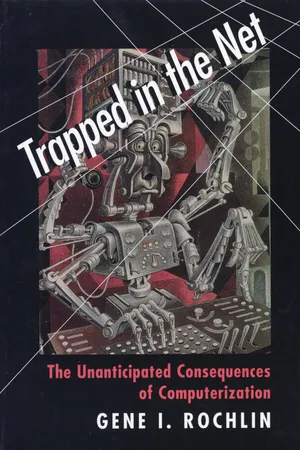
Voice mail. E-mail. Bar codes. Desktops. Laptops. Networks. The Web. In this exciting book, Gene Rochlin takes a closer look at how these familiar and pervasive productions of computerization have become embedded in all our lives, forcing us to narrow the scope of our choices, our modes of control, and our experiences with the real world. Drawing on fascinating narratives from fields that range from military command, air traffic control, and international fund transfers to library cataloging and supermarket checkouts, Rochlin shows that we are rapidly making irreversible and at times harmful changes in our business, social, and personal lives to comply with the formalities and restrictions of information systems.
The threat is not the direct one once framed by the idea of insane robots or runaway mainframes usurping human functions for their own purposes, but the gradual loss of control over hardware, software, and function through networks of interconnection and dependence. What Rochlin calls the computer trap has four parts: the lure, the snare, the costs, and the long-term consequences. The lure is obvious: the promise of ever more powerful and adaptable tools with simpler and more human-centered interfaces. The snare is what usually ensues. Once heavily invested in the use of computers to perform central tasks, organizations and individuals alike are committed to new capacities and potentials, whether they eventually find them rewarding or not. The varied costs include a dependency on the manufacturers of hardware and software--and a seemingly pathological scramble to keep up with an incredible rate of sometimes unnecessary technological change. Finally, a lack of redundancy and an incredible speed of response make human intervention or control difficult at best when (and not if) something goes wrong. As Rochlin points out, this is particularly true for those systems whose interconnections and mechanisms are so deeply concealed in the computers that no human being fully understands them.
- 310 pages
- English
- ePUB (mobile friendly)
- Available on iOS & Android
eBook - ePub
About this book
Information
Publisher
Princeton University PressYear
2012Print ISBN
9780691002477
9780691010809
eBook ISBN
9781400822263
1.
Introduction
Prologue
This morning I got a call from a computer. The local telephone company had just repaired a defective line, and its computer was calling me to ask how satisfied I had been with the service. Somewhat amused by the role reversal, I dutifully punched the buttons of my touch-tone phone when requested, evaluating the promptness, efficiency, and quality of the work done. Only after I hung up did I realize that the reversal of roles had only been symbolic. It didn’t matter whether I called the computer or it called me. In either case, I have learned to adapt my behavior to comply with the electronic menu, to conform to the specifications of a machine.
As the electronic digital computer and the networks it supports become ever more deeply embedded as constituent elements of life in modern industrial societies, stories about the frustrations and problems of dealing with computers, from automated voice mail to airline reservation systems, have become increasingly common. But even when really amusing, such stories generally deal with the roughness of the human-machine interface and the inherent inability of preprogrammed, automated systems, however clever, to deal effectively with the variety and unpredictability of human beings.
There are other, more consequential stories that are hardly ever told. When my travel agent was unable to book a flight that I wanted because her flexibility and range of choice were subordinated to the nationwide Sabre system, and the local airline office could not because it was blocked by arbitrary but firmly programmed rules, I was able to do so on my own by calling the frequent flier desk of the airline and speaking with a young woman to whom the booking computer was an accessory and an aid, not a confining and superordinating system.1
When the library at my university installed a bar-coded checkout system for books, they also put into place a supermarket-like inventory control system that automatically identifies books not recently checked out and sends them to storage. But university libraries are not supermarkets, university collections are not used in the same way as public libraries, and not all scholarly fields are equally time-bound, or heavily populated. One of the unintended consequences of the new system is that many important books in the more leisurely or esoteric fields of traditional scholarship (e.g., medieval studies) were moved to a remote warehouse, where access was difficult and the chance of finding them by walking the shelves remote.2
When my wife could not find a particular journal series on medieval English indexed on the library’s elaborate computer system, she was told that the index was purchased from a commercial supplier, who tended to correlate the depth and detail of indexing with the laws of supply and demand. This privileges users in engineering and the sciences over scholars of literature and history, whose demand is smaller and less coherent in space or time.
These examples illustrate the long-term and indirect costs of preprogrammed automation and computerized efficiency. The more powerful a data management program, the greater the requirement that data be entered in certain specific and structured ways; what does not fit must be reshaped or discarded. The more structured the data entry, the more confining the rules and possibilities for searching. The larger and more established the database and its rules, the more difficult to modify or extend them. Eventually, the machine’s rules reign.
The adoption of computers to organize, manage, integrate, and coordinate a wide variety of human activities has greatly augmented human capabilities and increased the scope and connectivity of human activities. But at what cost to resiliency and adaptability? Office networking allows considerable interactive flexibility, as do market transfer systems, electronic banking, and the Internet, but the requirements for compliance and strict adherence to standards and protocols are stringent. Just-in-time industrial systems offer great flexibility in manufacturing, but, as was discovered in the recent Kobe earthquake, they are essentially inoperable if the electronic system that coordinates and schedules the required network of tightly coupled activities is damaged or destroyed.
Enter the Computer
The argument of this book is that the complacent acceptance of the desktop “personal” computer in almost every aspect of modern life is masking the degree to which computerization and computer networking are transforming not just the activities and instruments of human affairs, but also their structure and practice. As they become familiar, indeed ubiquitous components of appliances, communication, work processes, organization, and management, computers are increasingly regarded as no more than exceedingly capable and complex tools. And humans seem always to regard what they have made as something that they can therefore control.3 That our history has been shaped by the form and use of our tools in ways totally unanticipated by their inventors is, as always, conveniently forgotten.
It is not surprising that the ordinary person hardly pauses to reflect on the rapidity and scope of the transformation of social structures and culture that are resulting from the widespread acceptance of the digital computer. There seems to be little doubt about the value of collecting and indexing more information than any one of us could possibly scan, let alone digest, in a lifetime; of instant and virtually unimpeded global communication; or of automating difficult and complex industrial operations. Modern societies have made a totem of their hardware, cloaking dependence by transforming what it is necessary to own into what it is merely desirable to have, and disguising the imperatives of compliance as no more than a set of operating rules.
As the computer has passed from novelty to ubiquity, one of the most identifiable characteristics of its reconstruction of the human world has been a flood of accompanying propaganda that verges on adoration. Newsstands are filled with magazines tutoring us on the latest trend in software, the most appropriate hardware, the latest modes of interconnection, while newspapers report with breathless earnestness the new levels of empowerment to be reached with the technological breakthrough of the week. Their idols, and perhaps ours, are the visionaries of Intel, of Xerox PARC and Apple, of Lotus and the Internet, who pulled the digital computer out of their technological temples and onto the desktop. And floating above it all, you find the techno-metaphysicians in search of a larger, more profound meaning to it all: the Tofflers and their “third wave” and the “informatic society,”4 Bruce Mazlish and the “fourth discontinuity,”5 and the wizards of the world of artificial intelligence in peripatetic pursuit of a machine “who” really thinks.6
The remarkable clockwork automata of the eighteenth century were capable of inspiring a fascination bordering on awe in a mechanical age when even the human body was regarded as perhaps little more than an elaborate machine.7 And in a later age of electronics and information, so were the huge mainframes of the early days of computing—remote, forbidding, and, perhaps, capable of taking over human societies through their superior intelligence and calculated rationality.
The early fear of computers was focused on the idea of large, discrete, immensely powerful thinking mechanisms, run by mysterious engineers in white coats, capable of becoming autonomous decision makers if not closely watched and supervised, and possibly of acting through our centralized and hierarchical institutions to take control of human affairs. What was not anticipated was that simplified robots would be employed everywhere as standard production machines, and that smaller, cheaper, more flexible, and more adaptable electronic digital computers—more powerful and more intricately networked than their inventors could ever have imagined—would be common tools in every business and office, moving into almost every school, and familiar, if not present, in almost every home.
Large, centralized computers are now on their way to becoming specialized rarities, and it is the movement of smaller, more adaptable, and far less expensive “computers” onto desktops and into increasingly smart “machines” (seemingly harmless and hardly remarked upon) that is becoming the agent of transformation, altering not only the range and scope of decisions and choices but the methods and processes by which they are made.
Of even greater importance is the rapid growth of interconnecting networks of communication and information, created by the new capabilities and supported by them, which are bypassing both the structure of centralized institutions and the controls, internal and external, that developed to direct, manage, and regulate them.
What makes the process so elusive to characterize and difficult to analyze is that the conquest of human decision processes and procedures is taking place through the transformation of the means and representation of interaction rather than through the more direct and potentially adversarial processes of displacement of authority or assertion of control. Indeed, some of the harshest critics of traditional industrial societies, of the “modernist” vision of industrialization and development, are found among the enthusiasts of modern computerization and networking, arguing that individual computing is not just a useful, but a necessary resource, an indispensable tool not just for dealing with the forbidding complexity of modern society but also as a means for gaining access to the explosive growth in human knowledge.
The consequences of the increased social reliance, and, in many cases, dependence, on computerized information systems, computerized data processing, and computer-aided decision making are therefore likely to be neither direct nor obvious. There is no sign that computers are, in the sense of directly controlling our lives, “taking over” the conduct of human affairs either autonomously or as agents of human organization. Instead, they are creating patterns of reliance and dependency through which our lives will be indirectly and irrevocably reshaped.
Compliance and Control
For the greater part of this century, the search for efficiency and rational organization of space and time was the essence of modernity. Synchronicity, the rational ordering and coordination of work by planning and authority, was to be established through the planning of work and the formal centralization and hierarchical ordering both of the workplace itself and of its management and administration. The gains in efficiency from coordinated production and standardization and rationalization of the workplace were set against the presumably wasteful and disorganized artisanal and small-shop experience of the past. Efficiency losses caused by alienation, deskilling, and lack of flexibility and adaptability were by comparison judged to be small. The first, mainframe computers were admirably suited to that environment and, if anything, increased the centralization of administration, management, and control.
The introduction of the small digital computer, whether as a dedicated mid-frame for business or as desktop personal computers and individual workstations, was promoted as a form of electronic liberation from the powerful and centralized computer center. One of the most persistent arguments for social benefits of the introduction of computers and computer-aided machinery revolves around the argument that the personal computer is an instrument of social (and perhaps political) democratization, a means for providing a flexible, adaptable work environment more like the historical assemblage of craft workers that made up early factories than the mega-production lines of mid-century.
But historical artisan and craft production took place in an environment in which information was difficult to obtain and slow to propagate. The introduction of the computer into business and industry also provided the firm with far greater capacity to gather, order, and disseminate information, almost without practical limit. The era of the free-standing personal workstation lasted only a few years before the usual arguments for efficiency, coordination, and synchronization led to their interconnection, creating networks whose connectivity and flexibility far overshadow the simple hierarchical structure of the mainframe. As a result, it is now possible to control and coordinate process and production without imposing the static and mechanized form of organization of workplace and administration that so characterized the synchronistic approach.
What the computer transformation of business and industry has done is to maintain the appearance of continuing the trend toward decentralization, to further reduce the visible hierarchy and formal structures of authoritarian control while effectively and structurally reversing it. Instead of the traditional means of formalization, fixed and orderly rules, procedures, and regulations, the modern firm uses its authority over information and network communications to put into place an embedded spider web of control that is as rigorous and demanding as the more traditional and visible hierarchy. Because of its power and flexibility, the new control mechanism can afford to encourage “empowerment” of the individual, to allow more individual discretion and freedom of action at the work site, and still retain the power to enforce the adjustments that ensure the efficiency of the system as a whole.
If democracy truly depends upon free and ready access to information and unfettered interpersonal communication, the social effects of recent developments in computer networks have indeed been democratizing, in the sense of empowering individuals to make better judgments and arrive at better decisions—at least for those with sufficient training, experience, and education to use them for social development, interaction, and personal growth rather than for conversation and entertainment. But the unit of analysis for this argument is the individual, and the social context is one in which the individual has the power to put the information, and the communication, to effective use.
If democracy is instead defined in terms of power, of the balance between individual autonomy and centralized coordination, the results are at best mixed. In the personal and traditional (public) political realms, the computer is a potentially useful tool, both for avoiding coercion or deception by others seeking power and for enabling better action by groups as well as individuals. But the myth of democratizing technologies developed first and foremost for the introduction of “intelligent” machines into the workplace has been applied more forcefully for the introduction of computers than for any other historical case. Promoters argue that both workers and managers will have better information, more autonomy, more flexibility, and greater control.8
This is neither a unique claim nor a modern one. The historical record of the introduction of new techniques, and new technical systems, into factories, offices, and other workplaces is full of parallels that suggest that the democratizing claim is frequently made, and the democratizing effect does indeed frequently manifest itself during the early phases of introduction. But the democratizing phase is just that, a transient phase in the evolution of the introduction of new technology that eventually gives way to a more stable configuration in which workers and managers find their discretion reduced, their autonomy more constrained rather than less, their knowledge more fragmented, and their work load increased—with an added burden of acquiring and maintaining a larger and more complex body of required knowledge.
Whatever the initial distribution of power or authority, redistribution rarely diffuses any of it to those at the bottom of the organizational hierarchy. The price of increased worker autonomy has always been either to contract and forego the protective net of insurance and retirement that support regular employees, or to accept new rules that strictly bound and shape the range and character of the new domain of “autonomous” behavior. As computerization penetrates business and other organizations, those rules and bounds are increasingly imposed by technical rather than operational cadres, by middle managers more skil...
Table of contents
- Cover
- Title
- Copyright
- Contents
- Preface
- Acknowledgments
- 1. Introduction
- 2. Autogamous Technology
- 3. Networks of Connectivity: Webs of Dependence
- 4. Taylorism Redux?
- 5. Computer Trading
- 6. Jacking into the Market
- 7. Expert Operators and Critical Tasks
- 8. Smart Weapons, Smart Soldiers
- 9. Unfriendly Fire
- 10. The Logistics of Techno-War
- 11. C3I in Cyberspace
- 12. Invisible Idiots
- Notes
- Bibliography
- Index
Trusted by 375,005 students
Access to over 1.5 million titles for a fair monthly price.
Study more efficiently using our study tools.
Frequently asked questions
Yes, you can cancel anytime from the Subscription tab in your account settings on the Perlego website. Your subscription will stay active until the end of your current billing period. Learn how to cancel your subscription
No, books cannot be downloaded as external files, such as PDFs, for use outside of Perlego. However, you can download books within the Perlego app for offline reading on mobile or tablet. Learn how to download books offline
Perlego offers two plans: Essential and Complete
- Essential is ideal for learners and professionals who enjoy exploring a wide range of subjects. Access the Essential Library with 800,000+ trusted titles and best-sellers across business, personal growth, and the humanities. Includes unlimited reading time and Standard Read Aloud voice.
- Complete: Perfect for advanced learners and researchers needing full, unrestricted access. Unlock 1.5M+ books across hundreds of subjects, including academic and specialized titles. The Complete Plan also includes advanced features like Premium Read Aloud and Research Assistant.
We are an online textbook subscription service, where you can get access to an entire online library for less than the price of a single book per month. With over 1.5 million books across 990+ topics, we’ve got you covered! Learn about our mission
Look out for the read-aloud symbol on your next book to see if you can listen to it. The read-aloud tool reads text aloud for you, highlighting the text as it is being read. You can pause it, speed it up and slow it down. Learn more about Read Aloud
Yes! You can use the Perlego app on both iOS and Android devices to read anytime, anywhere — even offline. Perfect for commutes or when you’re on the go.
Please note we cannot support devices running on iOS 13 and Android 7 or earlier. Learn more about using the app
Please note we cannot support devices running on iOS 13 and Android 7 or earlier. Learn more about using the app
Yes, you can access Trapped in the Net by Gene I. Rochlin in PDF and/or ePUB format, as well as other popular books in Computer Science & Computer Science General. We have over 1.5 million books available in our catalogue for you to explore.