By the end of World War II, religion appeared to be on the decline throughout the United States and Europe. Recent world events had cast doubt on the relevance of religious belief, and modernizing trends made religious rituals look out of place. It was in this atmosphere that the careers of Scholem, Eliade, and Corbin--the twentieth century's legendary scholars in the respective fields of Judaism, History of Religions, and Islam--converged and ultimately revolutionized how people thought about religion. Between 1949 and 1978, all three lectured to Carl Jung's famous Eranos circle in Ascona, Switzerland, where each in his own way came to identify the symbolism of mystical experience as a central element of his monotheistic tradition. In this, the first book ever to compare the paths taken by these thinkers, Steven Wasserstrom explores how they overturned traditional approaches to studying religion by de-emphasizing law, ritual, and social history and by extolling the role of myth and mysticism. The most controversial aspect of their theory of religion, Wasserstrom argues, is that it minimized the binding character of moral law associated with monotheism.
The author focuses on the lectures delivered by Scholem, Eliade, and Corbin to the Eranos participants, but also shows how these scholars generated broader interest in their ideas through radio talks, poetry, novels, short stories, autobiographies, and interviews. He analyzes their conception of religion from a broadly integrated, comparative perspective, sets their distinctive thinking into historical and intellectual context, and interprets the striking success of their approaches.
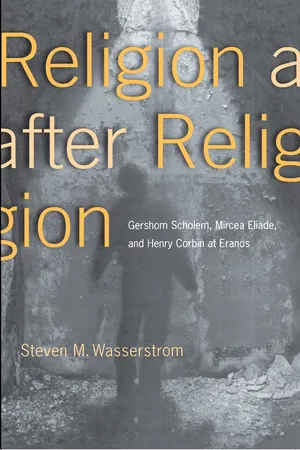
eBook - PDF
Religion after Religion
Gershom Scholem, Mircea Eliade, and Henry Corbin at Eranos
- 381 pages
- English
- PDF
- Available on iOS & Android
eBook - PDF
Religion after Religion
Gershom Scholem, Mircea Eliade, and Henry Corbin at Eranos
About this book
Information
Publisher
Princeton University PressYear
1999Print ISBN
9780691005409
9780691005393
eBook ISBN
9781400823178
Topic
Theology & ReligionSubtopic
History of ReligionTable of contents
- Cover
- Contents
- Preface and Acknowledgments
- Author's Note
- Introduction
- PART I: Religion after Religion
- PART II: Poetics
- PART III: Politics
- PART IV: History
- PART V: Ethics
- Conclusion
- Abbreviations Used in the Notes
- Notes
- Index
Trusted by 375,005 students
Access to over 1.5 million titles for a fair monthly price.
Study more efficiently using our study tools.
Frequently asked questions
Yes, you can cancel anytime from the Subscription tab in your account settings on the Perlego website. Your subscription will stay active until the end of your current billing period. Learn how to cancel your subscription
No, books cannot be downloaded as external files, such as PDFs, for use outside of Perlego. However, you can download books within the Perlego app for offline reading on mobile or tablet. Learn how to download books offline
Perlego offers two plans: Essential and Complete
- Essential is ideal for learners and professionals who enjoy exploring a wide range of subjects. Access the Essential Library with 800,000+ trusted titles and best-sellers across business, personal growth, and the humanities. Includes unlimited reading time and Standard Read Aloud voice.
- Complete: Perfect for advanced learners and researchers needing full, unrestricted access. Unlock 1.5M+ books across hundreds of subjects, including academic and specialized titles. The Complete Plan also includes advanced features like Premium Read Aloud and Research Assistant.
We are an online textbook subscription service, where you can get access to an entire online library for less than the price of a single book per month. With over 1.5 million books across 990+ topics, we’ve got you covered! Learn about our mission
Look out for the read-aloud symbol on your next book to see if you can listen to it. The read-aloud tool reads text aloud for you, highlighting the text as it is being read. You can pause it, speed it up and slow it down. Learn more about Read Aloud
Yes! You can use the Perlego app on both iOS and Android devices to read anytime, anywhere — even offline. Perfect for commutes or when you’re on the go.
Please note we cannot support devices running on iOS 13 and Android 7 or earlier. Learn more about using the app
Please note we cannot support devices running on iOS 13 and Android 7 or earlier. Learn more about using the app
Yes, you can access Religion after Religion by Steven M. Wasserstrom in PDF and/or ePUB format, as well as other popular books in Theology & Religion & History of Religion. We have over 1.5 million books available in our catalogue for you to explore.