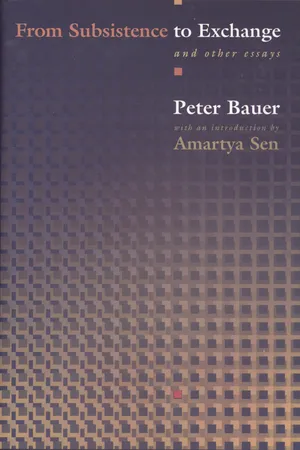
Peter Bauer, a pioneer of development economics, is an incisive thinker whose work continues to influence fields from political science to history to anthropology. As Nobel Laureate Amartya Sen writes in the introduction to this book, "the originality, force, and extensive bearing of his writings have been quite astonishing." This collection of Bauer's essays reveals the full power and range of his thought as well as the central concern that underlies so much of his diverse work: the impact of people's conduct, their cultural institutions, and the policies of their governments on economic progress.
The papers here cover pressing and controversial issues, including the process that transforms a subsistence economy into an exchange economy, the reputed correlation between poverty and population density, the alleged responsibility of the West for Third World poverty, the often counterproductive results of foreign aid, and the effects of egalitarian policies on individual freedoms. Bauer addresses these and other matters with clarity, verve, and wit, combining his deep understanding of economic theory and methodology with keen insights into human nature. The book is a penetrating account of how to develop a prosperous economy alongside a free and fair society and a stimulating introduction to the work of a man who has done so much to shape our modern understanding of developing economies and of the relationship of economics to the other social sciences.
"This selection of essays will give readers a wonderful opportunity to learn about the rich world of cognizance and analysis erected by one of the great architects of political economy. I feel privileged to be able to offer this letter of invitation."--From the introduction by Amartya Sen, Nobel Laureate in economics
- 168 pages
- English
- ePUB (mobile friendly)
- Available on iOS & Android
eBook - ePub
From Subsistence to Exchange and Other Essays
About this book
Information
Publisher
Princeton University PressYear
2009Print ISBN
9780691117829
9780691006673
eBook ISBN
9781400824649
VI
Western Guilt and Third World Poverty
Come, fix upon me that accusing eye.
I thirst for accusation.
W. B. Yeats
1
Yeats’s words might indeed have been written to describe the wide, even welcome, acceptance by the West of the accusation that it is responsible for the poverty of the Third World (i.e., most of Asia, Africa, and Latin America).1 Western responsibility for Third World backwardness is a persistent theme of the United Nations and its many affiliates.2 It has been welcomed by spokesmen of the Third World and of the Communist bloc, notably so at international gatherings where it is often endorsed by official representatives of the West, especially the United States. It is also widely canvassed in the universities, the churches, and the media the world over.
Acceptance of emphatic routine allegations that the West is responsible for Third World poverty reflects and reinforces Western feelings of guilt. It has enfeebled Western diplomacy, both towards the ideologically much more aggressive Soviet bloc and also towards the Third World. And the West has come to abase itself before countries with negligible resources and no real power. Yet the allegations can be shown to be without foundation. They are readily accepted because the Western public has little first-hand knowledge of the Third World and because of widespread feelings of guilt. The West has never had it so good and has never felt so bad about it.
2
A few characteristic examples will illustrate the general theme of Western responsibility. To begin with academics. The late Paul A. Baran, professor of economics at Stanford, was a highly regarded development economist. He was a prominent and influential exponent of Western guilt in the early days of contemporary development economics. He contributed the chapter on economic development to the Survey of Contemporary Economics published by the American Economic Association, and his book The Political Economy of Growth is a widely prescribed university textbook. In it Baran wrote:
To the dead weight of stagnation characteristic of pre-industrial society was added the entire restrictive impact of monopoly capitalism. The economic surplus appropriated in lavish amounts by monopolistic concerns in backward countries is not employed for productive purposes. It is neither plowed back into their own enterprises nor does it serve to develop others.3
This categorical statement is wholly and obviously untrue because throughout the underdeveloped world large agricultural, mineral, commercial, and industrial complexes have been built up through profits reinvested locally.
Professor Peter Townsend of Essex University is perhaps the most prominent British academic writer on poverty. In his book, The Concept of Poverty, he wrote:
I argued that the poverty of deprived nations is comprehensible only if we attribute it substantially to the existence of a system of international social stratification, a hierarchy of societies with vastly different resources in which the wealth of some is linked historically and contemporaneously to the poverty of others. This system operated crudely in the era of colonial domination, and continues to operate today, though more subtly, through systems of trade, education, political relations, military alliances, and industrial corporations.4
This again cannot be so. The poorest and most backward countries have until recently had no external economic contacts and often have never been Western colonies. It is therefore obvious that their backwardness cannot be explained by colonial domination or international social stratification. And there are no industrial corporations in the least developed countries of the Third World (the so-called Fourth World) such as Afghanistan, Chad, Bhutan, Burundi, Nepal, and Sikkim.
In this realm of discourse university students echo what they have learnt from their mentors. About ten years ago a student group at Cambridge published a pamphlet on the subject of the moral obligations of the West to the Third World. The following was its key passage:
We took the rubber from Malaya, the tea from India, raw materials from all over the world and gave almost nothing in return.
This is as nearly the opposite of the truth as one can find. The British took the rubber to Malaya and the tea to India. There were no rubber trees in Malaya or anywhere in Asia (as suggested by their botanical name, Hevea braziliensis) until about one hundred years ago, when the British took the first rubber seeds there out of the Amazon jungle. From these sprang the huge rubber industry—now very largely Asian-owned. Tea plants were brought to India by the British somewhat earlier; their origin is shown in the botanical name Camilla sinensis, as well as in the phrase “all the tea in China.”
Charles Clarke, a former president of the National Union of Students, said in his presidential address delivered in December 1976: “For over a hundred years British industry has been draining wealth away from those countries.” Far from draining wealth from the less developed countries, British industry helped to create it there, as external commerce promoted economic advance in large areas of the Third World where there was no wealth to be drained.
Western churches and charities are on the same bandwagon. Professor Ronald J. Sider is a prominent American churchman. In an article entitled “How We Oppress the Poor” in Christianity Today (16 July 1976), an influential Evangelical magazine, he wrote about the “stranglehold which the developed West has kept on the economic throats of the Third World” and then went on to say, “It would be wrong to suggest that 210 million Americans bear sole responsibility for all the hunger and injustice in today’s world. All the rich developed countries are directly involved. . . . We are participants in a system that dooms even more people to agony and death than the slave system did.” These are evident fantasies. Famines occur in Third World countries largely isolated from the West. So far from condemning Third World people to death, Western contacts have been behind the large increase in life expectation in the Third World, so often deplored as the population explosion by the same critics.
Many charities have come to think it advantageous to play on the theme of Western responsibility. According to a widely publicized Oxfam advertisement of 1972:
Coffee is grown in poor developing countries like Brazil, Colombia and Uganda. But that does not stop rich countries like Britain exploiting their economic weakness by paying as little for their raw coffee as we can get away with. On top of this, we keep charging more and more for the manufactured goods they need to buy from us. So? We get richer at their expense. Business is Business.
A similar advertisement was run about cocoa. Both advertisements were subsequently dropped in the face of protests by actual and potential subscribers.The allegations in these advertisements are largely meaningless, and they are also unrelated to reality. The world prices of coffee and cocoa, which were as it happens very high in the 1970s, are determined by market forces and not prescribed by the West. On the other hand, the farmers in many of the exporting countries receive far less than the market prices because they are subject to very high export taxes and similar government levies. The insistence on the allegedly low prices paid by the West to the producers and the lack of any reference to the penal taxation of the producers locally are examples that this guilt literature is concerned more with the flagellation of the West than with improving the conditions of the local population.
The intellectuals outside the academies and churches are also well to the fore. Cyril Connolly wrote in an article entitled “Black Man’s Burden” (Sunday Times, London, 23 February 1969):
It is a wonder that the white man is not more thoroughly detested than he is. . . . In our dealings with every single country, greed, masked by hypocrisy, led to unscrupulous coercion of the native inhabitants. . . . Cruelty, greed and arrogance . . . characterized what can be summed up in one word, exploitation.
If this were true, Third World countries would now be poorer than they were before Western contacts. In fact, they are generally much better off.
Insistence that the West has caused Third World poverty is collective self-accusation. The notion itself originated in the West. For instance, Marxism is a Western ideology, as is the belief that economic differences are anomalous and unjust and that they reflect exploitation. But people in the Third World, especially articulate people with contacts with the West, readily believed what they were told by prominent academics and other intellectuals, the more so because the idea accorded with their interests and inclinations.
Inspired by the West, Third World politicians have come habitually to insist that the West has exploited and still exploits their countries. Dr. Nkrumah, a major Third World figure of the 1950s and 1960s, was a well-known exponent of this view. He described Western capitalism as “a world system of financial enslavement and colonial oppression and exploitation of a vast majority of the population of the earth by a handful of the so-called civilized nations.”5 In fact, until the advent of Dr. Nkrumah, Ghana (the former Gold Coast) was a prosperous country as a result of cocoa exports to the West, with the cocoa farmers the most prosperous and the subsistence producers the poorest groups there.
Julius Nyerere, president of Tanzania, is a highly regarded, almost venerated, world figure.6 He said in the course of a state visit to London in 1975: “If the rich nations go on getting richer and richer at the expense of the poor, the poor of the world must demand a change.” When the West established substantial contact with Tanganyika (effectively the present Tanzania) in the nineteenth century, this was an empty region, thinly populated with tribal people exposed to Arab slavers. Its relatively modest progress since then has been the work primarily of Asians and Europeans.
The notion of Western exploitation of the Third World is standard in publications and statements emanating from the Soviet Union and other communist countries. Here is one example. The late Soviet academician Potekhin was a prominent Soviet authority on Africa. He is worth quoting because Soviet economic writings are taken seriously in Western universities:
Why is there little capital in Africa? The reply is evident. A considerable part of the national income which is supposed to make up the accumulation fund and to serve as the material basis of progress is exported outside Africa without any equivalent.7
No funds are exported from the poorest parts of Africa. Such remittances as there are from the more prosperous parts of the continent (generally very modest in the case of Black Africa, to which Potekhin refers) are partial returns on the resources supplied. In the most backward areas there are no foreigners and no foreign capital: It is the opposite of the truth to say that the reason there is little capital in Africa is that much of the national income is “exported . . . without any equivalent.” In Africa as elsewhere in the Third World, the most prosperous areas are those with most commercial contacts with the West.
I could cite many more such allegations, but the foregoing should suffice to illustrate the general theme. In subsequent sections I shall note more specific allegations, some of them even more virulent than those already quoted.
3
Far from the West having caused the poverty in the Third World, contact with the West has been the principal agent of material progress there. The materially more advanced societies and regions of the Third World are those with which the West established the most numerous, diversified, and extensive contacts: the cash-crop producing areas and entrepôt ports of Southeast Asia, West Africa, and Latin America; the mineral-producing areas of Africa and the Middle East; and cities and ports throughout Asia, Africa, the Caribbean, and Latin America. The level of material achievement usually diminishes as one moves away from the foci of Western impact. The poorest and most backward people have few or no external contacts; witness the aborigines, pygmies, and desert peoples.
All this is neither new nor surprising since the spread of material progress from more to less advanced regions i...
Table of contents
- Table of Contents
- Introduction
- I. From Subsistence to Exchange
- II. Disregard of Reality
- III. The Land and the People
- IV. Population Explosion: Disaster or Blessing
- V. Foreign Aid: Abiding Issues
- VI. Western Guilt and Third World Poverty
- VII. The Liberal Death Wish
- VIII. Ecclesiastical Economics: Envy Legitimized
- IX. Hong Kong
- X. Effective Influence on Opinion: The Shenoy Memorial Lecture
- XI. Class on the Brain
- XII. Egalitarianism: A Delicate Dilemma
Trusted by 375,005 students
Access to over 1.5 million titles for a fair monthly price.
Study more efficiently using our study tools.
Frequently asked questions
Yes, you can cancel anytime from the Subscription tab in your account settings on the Perlego website. Your subscription will stay active until the end of your current billing period. Learn how to cancel your subscription
No, books cannot be downloaded as external files, such as PDFs, for use outside of Perlego. However, you can download books within the Perlego app for offline reading on mobile or tablet. Learn how to download books offline
Perlego offers two plans: Essential and Complete
- Essential is ideal for learners and professionals who enjoy exploring a wide range of subjects. Access the Essential Library with 800,000+ trusted titles and best-sellers across business, personal growth, and the humanities. Includes unlimited reading time and Standard Read Aloud voice.
- Complete: Perfect for advanced learners and researchers needing full, unrestricted access. Unlock 1.5M+ books across hundreds of subjects, including academic and specialized titles. The Complete Plan also includes advanced features like Premium Read Aloud and Research Assistant.
We are an online textbook subscription service, where you can get access to an entire online library for less than the price of a single book per month. With over 1.5 million books across 990+ topics, we’ve got you covered! Learn about our mission
Look out for the read-aloud symbol on your next book to see if you can listen to it. The read-aloud tool reads text aloud for you, highlighting the text as it is being read. You can pause it, speed it up and slow it down. Learn more about Read Aloud
Yes! You can use the Perlego app on both iOS and Android devices to read anytime, anywhere — even offline. Perfect for commutes or when you’re on the go.
Please note we cannot support devices running on iOS 13 and Android 7 or earlier. Learn more about using the app
Please note we cannot support devices running on iOS 13 and Android 7 or earlier. Learn more about using the app
Yes, you can access From Subsistence to Exchange and Other Essays by Lord Peter Tamas Bauer in PDF and/or ePUB format, as well as other popular books in Politics & International Relations & Politics. We have over 1.5 million books available in our catalogue for you to explore.