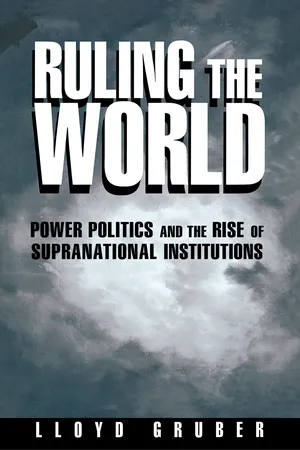
The last few decades have witnessed an extraordinary transfer of policy-making prerogatives from individual nation-states to supranational institutions. If you think this is cause for celebration, you are not alone. Within the academic community (and not only among students of international cooperation), the notion that political institutions are mutually beneficial--that they would never come into existence, much less grow in size and assertiveness, were they not "Pareto-improving"--is today's conventional wisdom. But is it true? In this richly detailed and strikingly original study, Lloyd Gruber suggests that this emphasis on cooperation's positive-sum consequences may be leading scholars of international relations down the wrong theoretical path.
The fact that membership in a cooperative arrangement is voluntary, Gruber argues, does not mean that it works to everyone's advantage. To the contrary, some cooperators may incur substantial losses relative to the original, non-cooperative status quo. So what, then, keeps these participants from withdrawing? Gruber's answer, in a word, is power--specifically the "go-it-alone power" exercised by the regime's beneficiaries, many of whom would continue to benefit even if their partners, the losers, were to opt out. To lend support to this thesis, Gruber takes a fresh look at the political origins and structures of European Monetary Unification and NAFTA. But the theoretical arguments elaborated in Ruling the World extend well beyond money and trade, touching upon issues of long-standing interest to students of security cooperation, environmental politics, nation-building--even political philosophy. Bold and compelling, this book will appeal to anyone interested in understanding how "power politics" really operates and why, for better or worse, it is fueling much of the supranational activity we see today.
- 333 pages
- English
- PDF
- Available on iOS & Android
eBook - PDF
About this book
Information
Publisher
Princeton University PressYear
2000Print ISBN
9780691010410
9780691010403
eBook ISBN
9781400823710
Table of contents
- Cover Page
- Title Page
- Copyright Page
- Dedication
- Contents
- List of Figures
- List of Tables
- Preface and Acknowledgments
- Chapter 1: Introduction: From Anarchy to Organization
- Part I: Why do Nations Cooperate?
- Part II: How do Nations Cooperate?
- Part III: North American Trade
- Part Iv: European Money
- Part V: Conclusions
- Bibliography
- Index
Trusted by 375,005 students
Access to over 1.5 million titles for a fair monthly price.
Study more efficiently using our study tools.
Frequently asked questions
Yes, you can cancel anytime from the Subscription tab in your account settings on the Perlego website. Your subscription will stay active until the end of your current billing period. Learn how to cancel your subscription
No, books cannot be downloaded as external files, such as PDFs, for use outside of Perlego. However, you can download books within the Perlego app for offline reading on mobile or tablet. Learn how to download books offline
Perlego offers two plans: Essential and Complete
- Essential is ideal for learners and professionals who enjoy exploring a wide range of subjects. Access the Essential Library with 800,000+ trusted titles and best-sellers across business, personal growth, and the humanities. Includes unlimited reading time and Standard Read Aloud voice.
- Complete: Perfect for advanced learners and researchers needing full, unrestricted access. Unlock 1.5M+ books across hundreds of subjects, including academic and specialized titles. The Complete Plan also includes advanced features like Premium Read Aloud and Research Assistant.
We are an online textbook subscription service, where you can get access to an entire online library for less than the price of a single book per month. With over 1.5 million books across 990+ topics, we’ve got you covered! Learn about our mission
Look out for the read-aloud symbol on your next book to see if you can listen to it. The read-aloud tool reads text aloud for you, highlighting the text as it is being read. You can pause it, speed it up and slow it down. Learn more about Read Aloud
Yes! You can use the Perlego app on both iOS and Android devices to read anytime, anywhere — even offline. Perfect for commutes or when you’re on the go.
Please note we cannot support devices running on iOS 13 and Android 7 or earlier. Learn more about using the app
Please note we cannot support devices running on iOS 13 and Android 7 or earlier. Learn more about using the app
Yes, you can access Ruling the World by Lloyd Gruber in PDF and/or ePUB format, as well as other popular books in Politics & International Relations & International Relations. We have over 1.5 million books available in our catalogue for you to explore.