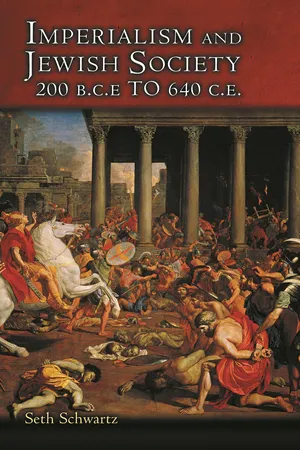
This provocative new history of Palestinian Jewish society in antiquity marks the first comprehensive effort to gauge the effects of imperial domination on this people. Probing more than eight centuries of Persian, Greek, and Roman rule, Seth Schwartz reaches some startling conclusions--foremost among them that the Christianization of the Roman Empire generated the most fundamental features of medieval and modern Jewish life.
Schwartz begins by arguing that the distinctiveness of Judaism in the Persian, Hellenistic, and early Roman periods was the product of generally prevailing imperial tolerance. From around 70 C.E. to the mid-fourth century, with failed revolts and the alluring cultural norms of the High Roman Empire, Judaism all but disintegrated. However, late in the Roman Empire, the Christianized state played a decisive role in ''re-Judaizing'' the Jews. The state gradually excluded them from society while supporting their leaders and recognizing their local communities. It was thus in Late Antiquity that the synagogue-centered community became prevalent among the Jews, that there re-emerged a distinctively Jewish art and literature--laying the foundations for Judaism as we know it today.
Through masterful scholarship set in rich detail, this book challenges traditional views rooted in romantic notions about Jewish fortitude. Integrating material relics and literature while setting the Jews in their eastern Mediterranean context, it addresses the complex and varied consequences of imperialism on this vast period of Jewish history more ambitiously than ever before. Imperialism in Jewish Society will be widely read and much debated.
- 336 pages
- English
- ePUB (mobile friendly)
- Available on iOS & Android
eBook - ePub
About this book
Information
Publisher
Princeton University PressYear
2009Print ISBN
9780691117812
9780691088501
eBook ISBN
9781400824854
PART I
THE JEWS OF PALESTINE TO 70 C.E.
ONE
POLITICS AND SOCIETY
IN THIS CHAPTER I provide some of the political and social background for the discussion in chapter 2 of the functioning of a loosely integrated Palestinian Jewish society in the later first millennium B.C.E. I focus here on some of the crucial episodes in the prehistory of Jews’ political and social integration: the activities of Ezra and Nehemiah (about which little can really be known), the Maccabean revolt, the fundamentally important but little studied or understood Hasmonean expansion, and, perhaps rather surprisingly, the activities of Herod. I also offer an account of “hellenization,” a process—or rather a complex of processes—that might have been expected to hinder the Jews’ internal integration by introducing or sharpening social divisions between Jews and by allowing some or many among the elites to cease regarding themselves as Jewish at all. But hellenization is a rather misleading concept that requires critical attention.
Persian Sponsorship of the Jerusalem Temple and the Torah of Moses1
I assume that the Israelite religion, as practiced before the destruction of the kingdom of Judah by the Babylonians in 586 B.C.E., was distinct from the religion practiced by the Israelites’ putative descendants, the Jews, in the Second Temple period.2 The Israelites, to be sure, worshiped Yahweh, whose cult was then, as later, centered in Jerusalem, and they seem to have shared many other practices with the Jews. For example, males seem to have been circumcised, pigs were rarely consumed, and mourning rituals seem to have included fasting, sackcloth, and ashes. But on the whole, except for brief periods of pietistic reform, most Israelites were not henotheists, and they may not have known of many characteristic biblical observances, such as the festivals of Passover and Sukkot, allegedly instituted either by the reformist king Josiah (reigned 639–609 B.C.E.) shortly before the Babylonian conquest or by Ezra or Nehemiah, in the fifth century. And their rituals seem often to have included practices forbidden by the Pentateuch, such as skin cutting, a mourning custom. Most importantly, perhaps, there is no evidence that the Israelites possessed a single authoritative “Torah” that bore any resemblance to the Pentateuch. The implications of the shift from the Israelite religion to Judaism will be discussed in detail in the next chapter. Here we will briefly consider some aspects of its history.
This history is controversial and poorly understood. According to the biblical books of Ezra-Nehemiah, Haggai, and Zechariah, the Persian emperors permitted several groups of Judahite exiles to return from their exile to Judah and build a temple in Jerusalem. The temple, devoted to the worship of Yahweh alone, was completed in 515 B.C.E. Two generations later, Artaxerxes I permitted first Ezra and then the courtier Nehemiah (or perhaps the order was reversed) to return to Judah and establish the “Torah of Moses,” apparently a book, as the official law of the Judahites. To judge from the biblical accounts, this book closely resembled the Pentateuch but may not have been identical with it. The account of Ezra’s career is incomplete, but Nehemiah is said to have been successful in his mission, mainly because of his political skill.
In the absence of external confirmation, it is difficult to know what to make of these stories. Most scholars, impressed by their meaningful translatability into rational historical narrative (i.e., their verisimilitude), have been inclined to take them seriously, notwithstanding some problematic details. Others, perhaps a growing number, reject the stories on the grounds that they are after all stories, whose biases are quite conspicuous.3 We need not solve this problem, since it is nearly certain that the Jerusalem Temple was built under the aegis of the Achaemenids, and likely too that some version of the Torah became the authorized law of the Jews in the same general period, if not in the circumstances the biblical books describe. We may wonder why the Persian emperors should have been interested in imposing Judaism on the Jews.
In comparison to the Assyrians and Babylonians, who were mainly interested in collecting tribute from their subjects, and punished brutally those who failed to pay, the Persians were mild but interventionist. Cyrus posed as a liberator, a restorer of gods and peoples following the depredations and deportations of the Babylonians, and this pose became a fixture of Persian imperial rhetoric. In practice, the Persians tended to patronize native oligarchies, preferably those with strong connections to temples, and encouraged them to try to regulate the legal and economic activities of their provinces. This last consideration may help explain the imperial patronage of the Torah. Though probably the work mostly of reformists and radicals, the Torah claimed to be the traditional law of the Israelites and was the only Jewish law code available. An Egyptian text informs us that the emperor Darius I had created a committee of Egyptian priests to compile an authoritative code of Egyptian law, and Artaxerxes or another Persian emperor, in authorizing the Torah, may have been doing the same sort of thing for the Jews.4 The desired and sometimes attained result of the Persians’ interventionism was a smoothly running, peaceful, and consistently profitable empire, which depended on the loyalty of the hand-picked oligarchs, a royal provincial administration more elaborate than anything the Babylonians had had, and mild intimidation produced by the presence everywhere of small numbers of Persian-commanded garrison troops.5 Persian policy thus contrasted with Babylonian, with its alternating periods of complete laissez-faire and brutal terror. In some cases, then, Persian interventionism practically created the nations the Persians ruled. It is in the light of these practices that the events reported in the biblical books of Ezra, Nehemiah, Haggai, and Zechariah should be seen.
The regime initiated in Judaea by the Persian emperors and their Jewish vassals lasted, with a few interruptions, until the middle of the second century B.C.E. Though the history of Yehud/Judaea (the province acquired its Greek name after Alexander the Great conquered it in 332 B.C.E.) in much of this period is very obscure, the apparent institutional stability of Judaea suggests that the impression of calm created by the silence of the sources, preceding the well-attested dynamism and disorder of the two and a half centuries beginning in 170 B.C.E., is no mirage.
Hellenization: A Constraint on Group Integration?
According to 1 Maccabees (1:11), some Jews in the early second century B.C.E. believed that their people’s separation from the surrounding nations was the source of all their woes. The implication, that the Jews were less integrated into their eastern Mediterranean social environment than many of their neighbors, is probably correct. But enduring integrative pressures forced them to find ways to circumvent the separatist requirements of Jewish law; this may explain, for example, how the Tobiad family, regarded as Ammonite in the book of Nehemiah, despite their marriage alliance with an important Jerusalemite priestly family (Nehemiah 13:1–8), were considered Jewish by sometime in the third century B.C.E.6 The same pressures also encouraged the Jews to embrace aspects of the common culture of the eastern Mediterranean, which Jewish law did not unambiguously prohibit.
The most significant cultural development in the eastern Mediterranean in the fifth century B.C.E. and following was the process modern historians call “hellenization” (there is no precise ancient equivalent for the word). This term is used to denote a confusing variety of phenomena, ranging from non-Greek’s use of imported Greek tableware to development of a taste for Greek and imitation Greek painted vases and sculptures to worship of Greek gods to adoption of the Greek language and reading of Greek literature to, finally, the acquisition of citizenship in Greek cities, that is, becoming “Greek” (citizenship, at least as much as descent, was an essential requirement for Greekness). To confuse matters still further, Jewish and Christian scholars, especially, use the term with a marked lack of chronological specificity—this at a time when ancient historians and classicists are increasingly recognizing the distinctions between the still rather exclusivistic Hellenism of the Hellenistic period, the characteristic urban culture of the high imperial Roman east, which simultaneously served to integrate the upper classes of the empire and was a site of subtle resistance to Roman rule, and the Greek paideia of the late empire, which first united and then divided pagans and Christians.7
In recent decades, interest in the hellenization of the Jews in the high and later Roman Empire has waned, in part because some of the main issues seem relatively uncontroversial—the material culture of Roman Palestine appears quite unambiguously hellenized—but also because the opposing viewpoints about the extent to which the rabbis participated in the common culture of the Roman east are frozen in place and no longer in dialogue. In reality, these issues are far more complex and interesting than they have come to seem, and I will discuss them in detail in the relevant sections of this book.
By contrast, the question of the hellenization of the Jews in the Second Temple period is enduringly controversial. Scholars still disagree as to whether “the Jews” were hellenized or not, as if the answer to such a question could ever be meaningful. Even those who admit that the real cultural situation was complex often regard Hellenism as a defining issue in Jewish society after 332 B.C.E. Differing attitudes to Hellenism are thought to have generated social fissures and even conflict. In what follows, I will briefly explain how and why I disagree.8
The process of hellenization in Jewish Palestine in the Second Temple period seems on the whole to have been relatively unproblematic. As elsewhere in the Greek east, the practice of adopting the trappings of Greek culture functioned to sharpen the divisions between rich and poor and city and country, which existed in any case. But hellenization rarely produced divisions or catalyzed conflicts. Furthermore, it is misleading to crowd all the effects of Macedonian rule under the rubric of hellenization. The latter may have been an important consequence of Alexander’s conquests and their aftermath, but scholars have too often tended to think that all Jewish cultural production of the Hellenistic period is best viewed as a set of artifacts either of hellenization or of opposition to it. In what follows, therefore, I will first of all introduce some terminological precision, by distinguishing several types of hellenization, and then pay special attention to those novel aspects of Jewish culture in the Hellenistic period that would be unilluminating to understand in relation to Greek culture.
Let us begin by separating hellenization in the sense of “acting Greek” while maintaining one’s own cultural identity from hellenization in the sense of “becoming Greek” and so necessarily abandoning one’s previous cultural identity.9 (One of the differences between Greekness in the Hellenistic and Roman imperial periods was that in the former it was not compatible with open retention of other ethnic or cultural identities).10 Hellenization in the first sense might culminate in hellenization in the second sense, but need not do so. In fact, it may even function to preserve a native non-Greek culture. And hellenization in the second sense need not presuppose, rather surprisingly, prior hellenization in the first sense.11 For the time being it is the first type of hellenization that concerns us.
Until 332 B.C.E. the Judaeans and their neighbors were subject to Persia, far in the east, but they remained part of the cultural and economic world of the eastern Mediterranean, which included not only the cities and nations of the Syro-Palestinian coast and Egypt but also the old Greek cities of western Asia Minor and, at its western fringe, Greece itself. There had been trade and other contacts between Greece and the east coast of the Mediterranean, including Israel, for as long as there had been boats. The Philistines, who infiltrated the coastal cities of Palestine around 1200 B.C.E., probably came from the Aegean and had close ties to the Mycenaean Greeks. Greeks served as mercenaries in the armies of the kings of Judah and Israel, and Greek traders were not unknown in the region in the same period.12 Presumably, though, there was nothing noteworthy about these people—they were just part of the general eastern Mediterranean ethnic stew, along with Egyptians, Phoenicians, and various groups of Asians.
The Greek victory over Persia in 478 B.C.E., the subsequent rise of the Athenian empire, the consolidation of classical Greek culture (which was among other things an important item for export), and of Athenian economic dominance, which survived the decline of their empire, changed matters. By the fifth century, Greek goods predominated ...
Table of contents
- Cover Page
- Title Page
- Copyright Page
- Contents
- Acknowledgments
- Abbreviations
- Introduction
- Part I: The Jews of Palestine to 70 C.E.
- Part II: Jews in Palestine from 135 to 350
- Part III: Synagogue and Community from 350 to 640
- Conclusion
- Selected Bibliography
- Index
Trusted by 375,005 students
Access to over 1.5 million titles for a fair monthly price.
Study more efficiently using our study tools.
Frequently asked questions
Yes, you can cancel anytime from the Subscription tab in your account settings on the Perlego website. Your subscription will stay active until the end of your current billing period. Learn how to cancel your subscription
No, books cannot be downloaded as external files, such as PDFs, for use outside of Perlego. However, you can download books within the Perlego app for offline reading on mobile or tablet. Learn how to download books offline
Perlego offers two plans: Essential and Complete
- Essential is ideal for learners and professionals who enjoy exploring a wide range of subjects. Access the Essential Library with 800,000+ trusted titles and best-sellers across business, personal growth, and the humanities. Includes unlimited reading time and Standard Read Aloud voice.
- Complete: Perfect for advanced learners and researchers needing full, unrestricted access. Unlock 1.5M+ books across hundreds of subjects, including academic and specialized titles. The Complete Plan also includes advanced features like Premium Read Aloud and Research Assistant.
We are an online textbook subscription service, where you can get access to an entire online library for less than the price of a single book per month. With over 1.5 million books across 990+ topics, we’ve got you covered! Learn about our mission
Look out for the read-aloud symbol on your next book to see if you can listen to it. The read-aloud tool reads text aloud for you, highlighting the text as it is being read. You can pause it, speed it up and slow it down. Learn more about Read Aloud
Yes! You can use the Perlego app on both iOS and Android devices to read anytime, anywhere — even offline. Perfect for commutes or when you’re on the go.
Please note we cannot support devices running on iOS 13 and Android 7 or earlier. Learn more about using the app
Please note we cannot support devices running on iOS 13 and Android 7 or earlier. Learn more about using the app
Yes, you can access Imperialism and Jewish Society by Seth Schwartz in PDF and/or ePUB format, as well as other popular books in History & Jewish History. We have over 1.5 million books available in our catalogue for you to explore.