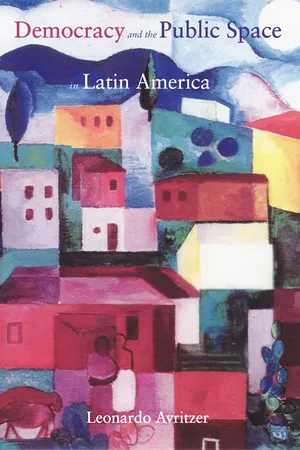
This is a bold new study of the recent emergence of democracy in Latin America. Leonardo Avritzer shows that traditional theories of democratization fall short in explaining this phenomenon. Scholars have long held that the postwar stability of Western Europe reveals that restricted democracy, or "democratic elitism," is the only realistic way to guard against forces such as the mass mobilizations that toppled European democracies after World War I. Avritzer challenges this view. Drawing on the ideas of Jürgen Habermas, he argues that democracy can be far more inclusive and can rely on a sphere of autonomous association and argument by citizens. He makes this argument by showing that democratic collective action has opened up a new "public space" for popular participation in Latin American politics.
Unlike many theorists, Avritzer builds his case empirically. He looks at human rights movements in Argentina and Brazil, neighborhood associations in Brazil and Mexico, and election-monitoring initiatives in Mexico. Contending that such participation has not gone far enough, he proposes a way to involve citizens even more directly in policy decisions. For example, he points to experiments in "participatory budgeting" in two Brazilian cities. Ultimately, the concept of such a space beyond the reach of state administration fosters a broader view of democratic possibility, of the cultural transformation that spurred it, and of the tensions that persist, in a region where democracy is both new and different from the Old World models.
- 208 pages
- English
- ePUB (mobile friendly)
- Available on iOS & Android
eBook - ePub
Democracy and the Public Space in Latin America
About this book
Information
Publisher
Princeton University PressYear
2009Print ISBN
9780691090887
9780691090870
eBook ISBN
9781400825011
Table of contents
- Cover
- Title
- Copyright
- Table of Contents
- Acknowledgments
- Introduction
- Chapter One. Democratic Theory and Democratization
- Chapter Two. Democratic Theory and the Formation of a Public Sphere
- Chapter Three. Democracy and the Latin American Tradition
- Chapter Four. The Transformation of the Latin American Pubic Space
- Chapter Five. Democratization in Latin America The Conflict between Public Practices and the Logic of Political Society
- Chapter Six. Participatory Publics in Brazil and Mexico The Compatibility of Public Deliberation and Complex Administration
- Chapter Seven. Concluding Remarks on the Democratizing Role of Participatory Publics
- Notes
- References
Trusted by 375,005 students
Access to over 1.5 million titles for a fair monthly price.
Study more efficiently using our study tools.
Frequently asked questions
Yes, you can cancel anytime from the Subscription tab in your account settings on the Perlego website. Your subscription will stay active until the end of your current billing period. Learn how to cancel your subscription
No, books cannot be downloaded as external files, such as PDFs, for use outside of Perlego. However, you can download books within the Perlego app for offline reading on mobile or tablet. Learn how to download books offline
Perlego offers two plans: Essential and Complete
- Essential is ideal for learners and professionals who enjoy exploring a wide range of subjects. Access the Essential Library with 800,000+ trusted titles and best-sellers across business, personal growth, and the humanities. Includes unlimited reading time and Standard Read Aloud voice.
- Complete: Perfect for advanced learners and researchers needing full, unrestricted access. Unlock 1.5M+ books across hundreds of subjects, including academic and specialized titles. The Complete Plan also includes advanced features like Premium Read Aloud and Research Assistant.
We are an online textbook subscription service, where you can get access to an entire online library for less than the price of a single book per month. With over 1.5 million books across 990+ topics, we’ve got you covered! Learn about our mission
Look out for the read-aloud symbol on your next book to see if you can listen to it. The read-aloud tool reads text aloud for you, highlighting the text as it is being read. You can pause it, speed it up and slow it down. Learn more about Read Aloud
Yes! You can use the Perlego app on both iOS and Android devices to read anytime, anywhere — even offline. Perfect for commutes or when you’re on the go.
Please note we cannot support devices running on iOS 13 and Android 7 or earlier. Learn more about using the app
Please note we cannot support devices running on iOS 13 and Android 7 or earlier. Learn more about using the app
Yes, you can access Democracy and the Public Space in Latin America by Leonardo Avritzer in PDF and/or ePUB format, as well as other popular books in Politics & International Relations & International Relations. We have over 1.5 million books available in our catalogue for you to explore.