Violence so often begets violence. Victims respond with revenge only to inspire seemingly endless cycles of retaliation. Conflicts between nations, between ethnic groups, between strangers, and between family members differ in so many ways and yet often share this dynamic. In this powerful and timely book Martha Minow and others ask: What explains these cycles and what can break them? What lessons can we draw from one form of violence that might be relevant to other forms? Can legal responses to violence provide accountability but avoid escalating vengeance? If so, what kinds of legal institutions and practices can make a difference? What kinds risk failure?
Breaking the Cycles of Hatred represents a unique blend of political and legal theory, one that focuses on the double-edged role of memory in fueling cycles of hatred and maintaining justice and personal integrity. Its centerpiece comprises three penetrating essays by Minow. She argues that innovative legal institutions and practices, such as truth commissions and civil damage actions against groups that sponsor hate, often work better than more conventional criminal proceedings and sanctions. Minow also calls for more sustained attention to the underlying dynamics of violence, the connections between intergroup and intrafamily violence, and the wide range of possible responses to violence beyond criminalization.
A vibrant set of freestanding responses from experts in political theory, psychology, history, and law examines past and potential avenues for breaking cycles of violence and for deepening our capacity to avoid becoming what we hate. The topics include hate crimes and hate-crimes legislation, child sexual abuse and the statute of limitations, and the American kidnapping and internment of Japanese Latin Americans during World War II. Commissioned by Nancy Rosenblum, the essays are by Ross E. Cheit, Marc Galanter, Fredrick C. Harris, Judith Lewis Herman, Carey Jaros, Frederick M. Lawrence, Austin Sarat, Ayelet Shachar, Eric K. Yamamoto, and Iris Marion Young.
eBook - ePub
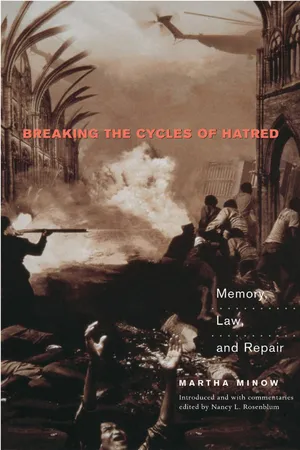
Breaking the Cycles of Hatred
Memory, Law, and Repair
- 312 pages
- English
- ePUB (mobile friendly)
- Available on iOS & Android
eBook - ePub
Breaking the Cycles of Hatred
Memory, Law, and Repair
About this book
Information
Publisher
Princeton University PressYear
2009Print ISBN
9780691096636
9780691096629
eBook ISBN
9781400825387
Topic
JuraSubtopic
RechtswissenschaftTable of contents
- Table of Contents
- ACKNOWLEDGMENTS
- INTRODUCTION
- 1 Breaking the Cycles of Hatred
- 2 Justice and the Experience of Injustice
- 3 Righting Old Wrongs
- 4 Reluctant Redress: The U.S. Kidnapping and Internment of Japanese Latin Americans
- 5 Memory, Hate, and the Criminalization of Bias-Motivated Violence: Lessons from Great Britain
- 6 Collective Memory, Collective Action, and Black Activism in the 1960s
- 7 Beyond Memory: Child Sexual Abuse and the Statute of Limitations
- 8 Peace on Earth Begins at Home: Reflections from the Womens Liberation Movement
- 9 The Thin Line between Imposition and Consent: A Critique of Birthright Membership Regimes and Their Implications
- 10 When Memory Speaks: Remembrance and Revenge in Unforgiven
- 11 Power, Violence, and Legitimacy: A Reading of Hannah Arendt in an Age of Police Brutality and Humanitarian Intervention
- NOTES ON CONTRIBUTORS
Trusted by 375,005 students
Access to over 1.5 million titles for a fair monthly price.
Study more efficiently using our study tools.
Frequently asked questions
Yes, you can cancel anytime from the Subscription tab in your account settings on the Perlego website. Your subscription will stay active until the end of your current billing period. Learn how to cancel your subscription
No, books cannot be downloaded as external files, such as PDFs, for use outside of Perlego. However, you can download books within the Perlego app for offline reading on mobile or tablet. Learn how to download books offline
Perlego offers two plans: Essential and Complete
- Essential is ideal for learners and professionals who enjoy exploring a wide range of subjects. Access the Essential Library with 800,000+ trusted titles and best-sellers across business, personal growth, and the humanities. Includes unlimited reading time and Standard Read Aloud voice.
- Complete: Perfect for advanced learners and researchers needing full, unrestricted access. Unlock 1.5M+ books across hundreds of subjects, including academic and specialized titles. The Complete Plan also includes advanced features like Premium Read Aloud and Research Assistant.
We are an online textbook subscription service, where you can get access to an entire online library for less than the price of a single book per month. With over 1.5 million books across 990+ topics, we’ve got you covered! Learn about our mission
Look out for the read-aloud symbol on your next book to see if you can listen to it. The read-aloud tool reads text aloud for you, highlighting the text as it is being read. You can pause it, speed it up and slow it down. Learn more about Read Aloud
Yes! You can use the Perlego app on both iOS and Android devices to read anytime, anywhere — even offline. Perfect for commutes or when you’re on the go.
Please note we cannot support devices running on iOS 13 and Android 7 or earlier. Learn more about using the app
Please note we cannot support devices running on iOS 13 and Android 7 or earlier. Learn more about using the app
Yes, you can access Breaking the Cycles of Hatred by Martha Minow, Nancy L. Rosenblum, Nancy Rosenblum in PDF and/or ePUB format, as well as other popular books in Jura & Rechtswissenschaft. We have over 1.5 million books available in our catalogue for you to explore.