How can religious liberty be guaranteed in societies where religion pervades everyday life? In The Wheel of Law, Gary Jacobsohn addresses this dilemma by examining the constitutional development of secularism in India within an unprecedented cross-national framework that includes Israel and the United States. He argues that a country's particular constitutional theory and practice must be understood within its social and political context. The experience of India, where religious life is in profound tension with secular democratic commitment, offers a valuable perspective not only on questions of jurisprudence and political theory arising in countries where religion permeates the fabric of society, but also on the broader task of ensuring religious liberty in constitutional polities.
India's social structure is so entwined with religion, Jacobsohn emphasizes, that meaningful social reform presupposes state intervention in the spiritual domain. Hence India's "ameliorative" model of secular constitutionalism, designed to ameliorate the disabling effects of the caste system and other religiously based practices. Jacobsohn contrasts this with the "visionary" secularism of Israel, where the state identifies itself with a particular religion, and with America's "assimilative" secularism.
Constitutional globalization is as much a reality as economic globalization, Jacobsohn concludes, and within this phenomenon the place of religion in liberal democracy is among the most vexing challenges confronting us today. A richly textured account of the Indian experience with secularism, developed in a broad comparative framework, this book is for all those seeking ways to respond to this challenge.
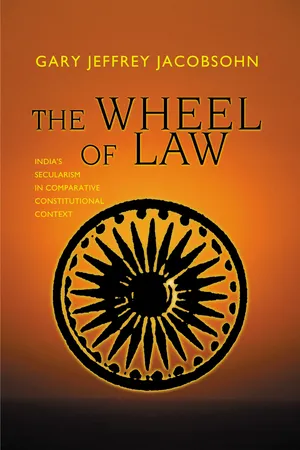
eBook - ePub
The Wheel of Law
India's Secularism in Comparative Constitutional Context
- 344 pages
- English
- ePUB (mobile friendly)
- Available on iOS & Android
eBook - ePub
About this book
Information
Publisher
Princeton University PressYear
2009Print ISBN
9780691122533
9780691092454
eBook ISBN
9781400825578
Table of contents
- Table of Contents
- Preface
- Acknowledgments
- Chapter One Introduction: Ashokas Wheel
- Part One Three Models of Secular Constitutional Design
- Chapter Two Nations and Constitutions: Dimensions of Secular Configuration
- Chapter Three Secularism in Context
- Chapter Four India: The Ameliorative Aspiration
- Part Two Constitutional Perspectives on the Challenge to Secularism in India
- Chapter Five Religion, Politics, and the Failure of Constitutional Machinery
- Chapter Six Corrupt Practices: Religious Speech and Democratic Deliberation
- Chapter Seven Adjudicating Secularism: Political Liberalism or Religious Revivalism?
- Chapter Eight So You Want a (Constitutional) Revolution? Lessons from Abroad
- Chapter Nine Conclusion: Toward Secular Convergence
- Bibliography
Trusted by 375,005 students
Access to over 1.5 million titles for a fair monthly price.
Study more efficiently using our study tools.
Frequently asked questions
Yes, you can cancel anytime from the Subscription tab in your account settings on the Perlego website. Your subscription will stay active until the end of your current billing period. Learn how to cancel your subscription
No, books cannot be downloaded as external files, such as PDFs, for use outside of Perlego. However, you can download books within the Perlego app for offline reading on mobile or tablet. Learn how to download books offline
Perlego offers two plans: Essential and Complete
- Essential is ideal for learners and professionals who enjoy exploring a wide range of subjects. Access the Essential Library with 800,000+ trusted titles and best-sellers across business, personal growth, and the humanities. Includes unlimited reading time and Standard Read Aloud voice.
- Complete: Perfect for advanced learners and researchers needing full, unrestricted access. Unlock 1.5M+ books across hundreds of subjects, including academic and specialized titles. The Complete Plan also includes advanced features like Premium Read Aloud and Research Assistant.
We are an online textbook subscription service, where you can get access to an entire online library for less than the price of a single book per month. With over 1.5 million books across 990+ topics, we’ve got you covered! Learn about our mission
Look out for the read-aloud symbol on your next book to see if you can listen to it. The read-aloud tool reads text aloud for you, highlighting the text as it is being read. You can pause it, speed it up and slow it down. Learn more about Read Aloud
Yes! You can use the Perlego app on both iOS and Android devices to read anytime, anywhere — even offline. Perfect for commutes or when you’re on the go.
Please note we cannot support devices running on iOS 13 and Android 7 or earlier. Learn more about using the app
Please note we cannot support devices running on iOS 13 and Android 7 or earlier. Learn more about using the app
Yes, you can access The Wheel of Law by Gary Jeffrey Jacobsohn in PDF and/or ePUB format, as well as other popular books in Politics & International Relations & Indian & South Asian History. We have over 1.5 million books available in our catalogue for you to explore.