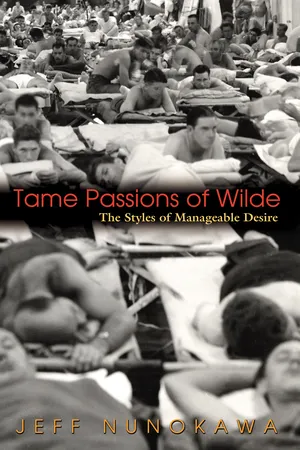
What if our strongest urges could be divested of their power to compel yet retain their power to fascinate us? What if our most basic appetites could be translated from the realm of bodily necessity to the sphere of artistic freedom? Jeff Nunokawa traces the variety of social pressures that inspired Oscar Wilde's lifelong effort to concoct forms of desire that thrill without menacing us, as well as the alchemies by which he sought to do so.
Assigning Wilde a place of honor in a heady company of thinkers drawn from the ranks of philosophy, sociology, economics, psychoanalysis, and contemporary queer theory--Kant, Marx, Simmel, Weber, Freud, Hannah Arendt, Albert O. Hirschman, Erving Goffman, Judith Butler, Eve Sedgwick, and, of course, Michel Foucault--this is the first book to recognize Wilde not only as a blatant symptom of a familiar understanding of modern sexuality, but also as a grand theorist of the subject in his own right. The result is a wholly original portrait of the artist as a social critic who, in the midst of his humor, labored to illuminate and amend the book of love.
- 176 pages
- English
- ePUB (mobile friendly)
- Available on iOS & Android
eBook - ePub
About this book
Trusted by 375,005 students
Access to over 1.5 million titles for a fair monthly price.
Study more efficiently using our study tools.
Information
Publisher
Princeton University PressYear
2009Print ISBN
9780691113807
9780691113791
eBook ISBN
9781400825653
ONE
INTRODUCTION
The most brilliant of all is that story of Wilde’s. . . .Of course it’s all paradox, don’t you know. . . . it’s so typical the way he works it out. It’s the very essence of Wilde, don’t you know. The light touch . . . Tame essence of Wilde.
—James Joyce, Ulysses
SYMPATHY WITH HELLENISM
AT THE HEART of this book is an abandoned aspiration, a “longing” so “wild” that it is hard even to discern, except to dismiss, a scheme to alleviate the risk and pain of desire, an aspiration to lessen the damage it does by altering, without abbreviating, its nature.1 The chapters that follow seek to excavate fragments, more or less submerged, of this grand project in the work of Oscar Wilde, a project utopian and anxious in equal parts, as optimistic as any plan of escape, and as frightened as any fear of what awaits in the case of its failure. This book finds Wilde hard at work cultivating and celebrating strains of passion, attraction, fascination, as absorbing as any, but freed—as if by the wave of a wand, a sudden cure, or the turn of night to day—from the hazards routinely regarded as part and parcel of such vicissitudes, like the menace to life and limb that give the edge to any thrill; the peril, say, that gives teeth to a feast with panthers.2 Sometimes earnestly, sometimes not, the manageable desires that Wilde heralds approximate the depth of feeling attached to the more driven kind, with none of its darkness. There are, for starters, attractions powerful enough to threaten the progress of the wedding-march, but thin enough to evaporate before they ever actually do so. On the other hand, there are “life-long romances” that, constitutionally disinclined to end at the altar, end instead before dawn, and therefore long before those entanglements that draw the slave of a more persistent kind of such love to his doom, “staggering like an ox to the shambles.”3 There are incurable hungers of the heart as endurable—more than that, delightful—as they are enduring, yearnings quite unlike the kind of hunger bound to haunt an Irish man, no matter how far removed from the homeland, born in the century of the Famine, the ghost of starvation from which those more glamorous hungers take their form and take their flight. Finally, there is the casual eye for the crowd that displaces and disperses the gaze caught in the act of looking at someone dazzling enough she seems to draw within the compass of her own radiance everything about the crowd that the eye could care to see.
A vision of a desire both safe and sensational is surely worthy to be seated amongst the grand alliances that Wilde contrived with all his heart and mind to arrange. At its most audacious, this is a reconciliation of antinomies, a treaty of opposites no less ambitious, no less paradoxical, surely, than his more famous plans to make synonyms of truth and fiction, art and society, work and play, ethics and aesthetics: at its most audacious, this is a desire untouched by the long arm of what he called the “tyranny of Want.”4 The very idea: after all, the sense that the things that attract and excite us are beyond our control is as near as we have now to a truth universally acknowledged, so much so that it’s hard to imagine that a species of desire under the thumb of its subject as one worthy of the name.Falling in love without the fall: what could it be but a denial of the real thing, an evasion, an inversion, of the awful truth? What is the notion of a desire governed by its subject but a dream of departure from the strain of desire that we all know all too well, the strain of desire that bears all the force of necessity, the strain of desire that rather governs him?
Or comic relief: so immodest is Wilde’s proposal to remove the element of compulsion from the chemistry of the erotic that it could only be passed off as a joke. And, of course, Wilde himself phrased it as such in his most popular work, that “trivial comedy for serious people.” Consider how far he takes the gag in The Importance of Being Earnest, where the most basic law of desire is bent beyond recognition, the fundamental rule that we cannot help whom or how we love; that we may want what we choose, but that we never choose what we want. Here the government of desires by the subject who experiences them goes well beyond the usual tactic of the double-life, beyond the power of discretion that allows him to decide when, where, or even if he will submit to them; here the very character of the desire is concocted by the subject herself. There is the “irresistible fascination” for the name at the head of the play, less like the force of an inherent proclivity than the design of a fashion statement, an “irresistible fascination” that bears all the marks of the choice to be fascinated. There is as well the passionate romance that a young girl confesses to her diary before she even meets the object of her affections, a story of true love that, like Wilde’s best one-liners, according to one malicious rumor, is written out well in advance.5
But while deciding for oneself what one will find irresistibly fascinating and just how long one will find it so flouts a basic rule of the heart, it keeps faith with an impulse to manage the heart as old as any assertion of its recalcitrance, driving to the end point—and who better to do that than one whose thirst for extremes (“Enough is as good as a meal; too much is as good as a feast”) he did so much to advertise?—a conviction that men can reform and refine their erotic lives, if not make them up out of thin air. The love of Earnest—pronounced first in words before it is established in fact, a love of the name, a love in the name that transgresses the proprieties of priority, a love in the name that reverses the relation between representation and referent—has proven easy to count as a prophecy of postmodernism, but it is also the final flourishing of what Wilde and others before and since have regarded as a classic virtue: the decadent and desperate phase of the age-old belief that, with wisdom and fortitude, we can bring the universe of our erotic urges under the influence of our own will.
The cult of Bunbury may be another name for one that dare not speak its own, but it describes a different club as well—“now that I know you to be a confirmed Bunburyist I naturally want to talk to you about Bunburying. I want to tell you the rules”6—a club, a broad school of thought, really, concerned to teach the methods and value of sexual self-management, a school of thought that Wilde himself, by means of his spokesman in The Picture of Dorian Gray, calls, in keeping with a usage popular then, and now as well, by an ancient name:
“And yet, ” continued Lord Henry, in his low musical voice, and with that graceful wave of the hand that was always so characteristic of him, and that he had even in his Eton days, “I believe that if one man were to live out his life fully and completely, were to give form to every feeling, expression to every thought, reality to every dream—I believe that the world would gain such a fresh impulse of joy that we would forget all the maladies of mediaevalism, and return to the Hellenic ideal—to something finer, richer, than the Hellenic ideal, it may be. But the bravest man amongst us is afraid of himself.The mutilation of the savage has its tragic survival in the self-denial that mars our lives. We are punished for our refusals. Every impulse that we strive to strangle broods in the mind, and poisons us. The body sins once, and has done with its sin, for action is a mode of purification. Nothing remains then but the recollection of a pleasure, or the luxury of a regret. The only way to get rid of a temptation is to yield to it. Resist it, and your soul grows sick with longing for the things it has forbidden itself, with desire for what its monstrous laws have made monstrous and unlawful. It has been said that the great events of the world take place in the brain. It is in the brain, and the brain only, that the great sins of the world take place also.”7
Like a key to a paternity mystery buried in a book of army lists, a novel abandoned in a perambulator, or a baby in briefcase, the rules of Bunbury that Algernon never has a chance to expound upon are discovered here, filed under the heading of “Hellenic ideal” in a didactic tome, far away from the comedy where the mention of them is dropped. Of course Lord Henry’s Hellenic oration can hardly evade the suspicion that it addresses first of all, a specific species of desire, and of the species “confirmed” by it, those that monstrous laws have made monstrous and unlawful, but they apply more generally to the category of desire, tout court. If his speech admits the implication that those whose desires monstrous laws make monstrous and unlawful have special reasons to acquire the savoir faire necessary to contain them; if his hedonistic calculus pertains most urgently to those, it nevertheless covers all others as well. Like an eye for color or couture, the genealogy of the aim to manage the erotic advertised here is no more than the regional origin of a fashion that comes to cover the globe.
This savoir faire begins by conceding the very point on which Earnest, like the most dogged defendant, even in the face of all the ocular proof and common sense in the world, refuses to give an inch. Lord Henry’s brief Bon Usage on the proper handling of desire admits, after only the slightest haggling, its irresistible power at the outset. Managing passions is merely a matter of giving them form or expression, just as the speaker’s musical voice, the gesture of his hand, the turn of his phrase together comprise the elegant vessel that carries the burden of his argument. Of course, to speak of form or expression as if it only reflects some content distinct from it is hardly the thing on the premises of the premier spokesman for the other side. It’s no surprise then that the work of fashioning desire Lord Henry urges on his pupil nears the midpoint between making and finding it, the midpoint where the difference between giving form to feelings and forming them more thoroughly would be impossible to tell, but this familiar mission disbands long before it comes to the wholesale fabrication of fascination staged by Earnest.
Any doubt entertained by the first part of Lord Henry’s exhortation—that the desires he pictures have a life quite apart from the imagination of the subject who experiences them, a force all their own that quite eludes his will—is discouraged by the distinction admitted in the language that follows: thoughts and dreams, as opposed to the forms into which they are translated. And it is dispelled utterly as Lord Henry’s advice for their regulation shifts from an active strategy of owning one’s impulses to a passive submission to them: “Every impulse that we strive to strangle broods in the mind, and poisons us. The body sins once, and has done with its sin, for action is a mode of purification. Nothing remains then but the recollection of a pleasure of a regret. The only way to get rid of a temptation is to yield to it.” But if to acknowledge the irresistible force of temptation, as Wilde famously did, is to relinquish one method of controlling desire, it does so only to prosecute the project by other means, this time a tactic rather like the martial art by which one exhausts and confuses an enemy force by first yielding to it. The containment of desire proposed by Lord Henry is a matter of embracing it, an embrace that begins by the act of encircling it within the artful arms of form and ends with the more prosaic act of taking it to bed and thus putting it there.
And while the subject who obeys the call to regulate his desires thus stops short of fabricating them, he ends up fabricating something else instead, namely himself: for a man to “give form to every feeling, expression to every thought, reality to every dream,” is to “live out his life fully and completely.” To take on the task of managing one’s desires is the royal road to the only accomplishment that really matters in Wilde’s book, the good work that is its only holy order—“What Jesus meant was this. He said to man, ‘You have a wonderful personality. Develop it’ ”8—indeed, its only order: “The first duty in life is to be as artificial as possible. What the second duty is no one has as yet discovered.”9 This is the design for living that Wilde, through all his costume changes, sustained as his signature style, the design that labors above all to make oneself a thing of beauty, such as the one that the teacher hails when he sees his student for the last time, his being swayed to music, the perfection of his life, the perfection of his art: “Ah Dorian, how happy you are . . . I am so glad that you have never done anything, never carved a statue, or painted a picture, or produced anything outside yourself! Life has been your art. You have set yourself to music. Your days are your sonnets.”10 To learn the ancient arts, which, according to Lord Henry, requi...
Table of contents
- Table of Contents
- ACKNOWLEDGMENTS
- CHAPTER ONE INTRODUCTION
- CHAPTER Oscar Wilde in Japan: Aestheticism, Orientalism, and the Derealization of the Homosexual
- CHAPTER THREE Oscar Wilde, Erving Goffman, and the Social Body Beautiful
- CHAPTER FOUR The Importance of Being Bored: The Dividends of Ennui in The Picture of Dorian Gray
- CHAPTER FIVE The Protestant Ethic and the Spirit of Anorexia:The Case of Oscar Wilde
- CHAPTER SIX Oscar Wilde and the Passion of the Eye
Frequently asked questions
Yes, you can cancel anytime from the Subscription tab in your account settings on the Perlego website. Your subscription will stay active until the end of your current billing period. Learn how to cancel your subscription
No, books cannot be downloaded as external files, such as PDFs, for use outside of Perlego. However, you can download books within the Perlego app for offline reading on mobile or tablet. Learn how to download books offline
Perlego offers two plans: Essential and Complete
- Essential is ideal for learners and professionals who enjoy exploring a wide range of subjects. Access the Essential Library with 800,000+ trusted titles and best-sellers across business, personal growth, and the humanities. Includes unlimited reading time and Standard Read Aloud voice.
- Complete: Perfect for advanced learners and researchers needing full, unrestricted access. Unlock 1.5M+ books across hundreds of subjects, including academic and specialized titles. The Complete Plan also includes advanced features like Premium Read Aloud and Research Assistant.
We are an online textbook subscription service, where you can get access to an entire online library for less than the price of a single book per month. With over 1.5 million books across 990+ topics, we’ve got you covered! Learn about our mission
Look out for the read-aloud symbol on your next book to see if you can listen to it. The read-aloud tool reads text aloud for you, highlighting the text as it is being read. You can pause it, speed it up and slow it down. Learn more about Read Aloud
Yes! You can use the Perlego app on both iOS and Android devices to read anytime, anywhere — even offline. Perfect for commutes or when you’re on the go.
Please note we cannot support devices running on iOS 13 and Android 7 or earlier. Learn more about using the app
Please note we cannot support devices running on iOS 13 and Android 7 or earlier. Learn more about using the app
Yes, you can access Tame Passions of Wilde by Jeff Nunokawa in PDF and/or ePUB format, as well as other popular books in Literature & English Literary Criticism. We have over 1.5 million books available in our catalogue for you to explore.