Around the year 1215, female mystics and their sacramental devotion were among orthodoxy's most sophisticated weapons in the fight against heresy. Holy women's claims to be in direct communication with God placed them in positions of unprecedented influence. Yet by the end of the Middle Ages female mystics were frequently mistrusted, derided, and in danger of their lives. The witch hunts were just around the corner.
While studies of sanctity and heresy tend to be undertaken separately, Proving Woman brings these two avenues of inquiry together by associating the downward trajectory of holy women with medieval society's progressive reliance on the inquisitional procedure. Inquisition was soon used for resolving most questions of proof. It was employed for distinguishing saints and heretics; it underwrote the new emphasis on confession in both sacramental and judicial spheres; and it heralded the reintroduction of torture as a mechanism for extracting proof through confession.
As women were progressively subjected to this screening, they became ensnared in the interlocking web of proofs. No aspect of female spirituality remained untouched. Since inquisition determined the need for tangible proofs, it even may have fostered the kind of excruciating illnesses and extraordinary bodily changes associated with female spirituality. In turn, the physical suffering of holy women became tacit support for all kinds of earthly suffering, even validating temporal mechanisms of justice in their most aggressive forms. The widespread adoption of inquisitional mechanisms for assessing female spirituality eventuated in a growing confusion between the saintly and heretical and the ultimate criminalization of female religious expression.
eBook - ePub
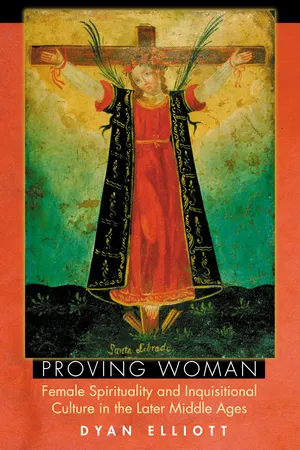
Proving Woman
Female Spirituality and Inquisitional Culture in the Later Middle Ages
- 368 pages
- English
- ePUB (mobile friendly)
- Available on iOS & Android
eBook - ePub
About this book
Trusted by 375,005 students
Access to over 1.5 million titles for a fair monthly price.
Study more efficiently using our study tools.
Information
Publisher
Princeton University PressYear
2009Print ISBN
9780691118604
9780691059563
eBook ISBN
9781400826025
Table of contents
- Table of Contents
- ACKNOWLEDGMENTS
- ABBREVIATIONS
- Introduction
- CHAPTER ONE Sacramental Confession as Proof of Orthodoxy
- PART 1 Women as Proof of Orthodoxy
- CHAPTER TWO The Beguines: A Sponsored Emergence
- CHAPTER THREE Elisabeth of Hungary: Between Men
- PART 2 Inquisitions and Proof
- CHAPTER FOUR Sanctity, Heresy, and Inquisition
- CHAPTER FIVE Between Two Deaths: The Living Mystic
- PART 3 The Discernment of Spirits
- CHAPTER SIX Clerical Quibbles
- CHAPTER SEVEN John Gerson and Joan of Arc
- Conclusion
- BIBLIOGRAPHY
Frequently asked questions
Yes, you can cancel anytime from the Subscription tab in your account settings on the Perlego website. Your subscription will stay active until the end of your current billing period. Learn how to cancel your subscription
No, books cannot be downloaded as external files, such as PDFs, for use outside of Perlego. However, you can download books within the Perlego app for offline reading on mobile or tablet. Learn how to download books offline
Perlego offers two plans: Essential and Complete
- Essential is ideal for learners and professionals who enjoy exploring a wide range of subjects. Access the Essential Library with 800,000+ trusted titles and best-sellers across business, personal growth, and the humanities. Includes unlimited reading time and Standard Read Aloud voice.
- Complete: Perfect for advanced learners and researchers needing full, unrestricted access. Unlock 1.5M+ books across hundreds of subjects, including academic and specialized titles. The Complete Plan also includes advanced features like Premium Read Aloud and Research Assistant.
We are an online textbook subscription service, where you can get access to an entire online library for less than the price of a single book per month. With over 1.5 million books across 990+ topics, we’ve got you covered! Learn about our mission
Look out for the read-aloud symbol on your next book to see if you can listen to it. The read-aloud tool reads text aloud for you, highlighting the text as it is being read. You can pause it, speed it up and slow it down. Learn more about Read Aloud
Yes! You can use the Perlego app on both iOS and Android devices to read anytime, anywhere — even offline. Perfect for commutes or when you’re on the go.
Please note we cannot support devices running on iOS 13 and Android 7 or earlier. Learn more about using the app
Please note we cannot support devices running on iOS 13 and Android 7 or earlier. Learn more about using the app
Yes, you can access Proving Woman by Dyan Elliott in PDF and/or ePUB format, as well as other popular books in History & European History. We have over 1.5 million books available in our catalogue for you to explore.