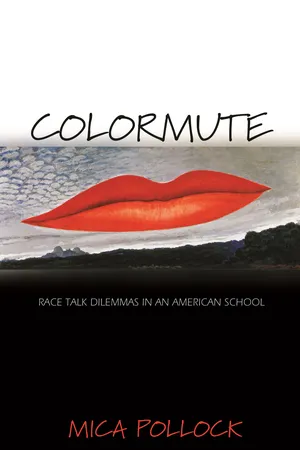
This book considers in unprecedented detail one of the most confounding questions in American racial practice: when to speak about people in racial terms. Viewing "race talk" through the lens of a California high school and district, Colormute draws on three years of ethnographic research on everyday race labeling in education. Based on the author's experiences as a teacher as well as an anthropologist, it discusses the role race plays in everyday and policy talk about such familiar topics as discipline, achievement, curriculum reform, and educational inequality.
Pollock illustrates the wide variations in the way speakers use race labels. Sometimes people use them without thinking twice; at other moments they avoid them at all costs or use them only in the description of particular situations. While a major concern of everyday race talk in schools is that racial descriptions will be inaccurate or inappropriate, Pollock demonstrates that anxiously suppressing race words (being what she terms "colormute") can also cause educators to reproduce the very racial inequities they abhor.
The book assists readers in cultivating a greater understanding of the pitfalls and possibilities of everyday race talk and clarifies previously murky discussions of "colorblindness." By bridging the gap between theory and practice, Colormute will be enormously helpful in fostering ongoing conversations about dismantling racial inequality in America.
Although Talking in Racial Terms Can Make Race Matter, Not Talking in Racial Terms Can Make Race Matter Too
Between me and the other world there is ever an unasked question: unasked by some through feelings of delicacy;by others through the difficulty of rightly framing it. All, nevertheless, flutter round it. They approach me in a half-hesitant sort of way, eye me curiously or compassionately, and then, instead of saying directly, How does it feel to be a problem? they say, I know an excellent colored man in my town;or , I fought at Mechanicsville;or , do not these Southern outrages make your blood boil? At these I smile, or am interested, or reduce the boiling to a simmer, as the occasion may require. To the real question, How does it feel to be a problem? I answer seldom a word.
—W.E.B. Du Bois, The Souls of Black Folk, 1903
One day in 1997, I see Mr. Charles in the hallway during classtime. We banter about how things are going. He asks me again what my thesis is for my dissertation, and I say I’m interested in how people talk about diversity. He says I’m welcome to come to any of his classes. “They’re pretty diverse—you can go to my student teacher’s class. Actually, it’s mostly African-American and so it has a real interesting dynamic,” he says. “Why?” I ask. “Because it’s student teacher team taught, and because the students are African-American. They actually have some African-American students coming really regularly, which is unusual I think.” “For African-American students to come regularly?” I ask. “Yes,” he says. “Do they not come regularly to your other classes?” I ask. “I think schoolwide . . . African-American students really aren’t being well served,” he replies. “I mean not just at Columbus—it’s a districtwide problem. I have some friends who teach at other schools and they say the same thing. It’s a problem that really needs to be addressed, it’s not being addressed,” he finishes.
The whole time we’re talking, students—mostly black—are passing us in the halls. In fact, every kid, with the exception of two Latinos and a Filipina holding a pass, has been black since the beginning of second period. As I walked down the stairs I was amazed by how consistently black the cutters were. . . .While talking to Mr. C, I did see a Latino guy from Mr.P’s class whom I had already passed in the hallway by the main office. “Again,” the student sighed in resigned agreement, as I looked at him with raised eyebrows. He kept walking glumly, swatting at the walls. . .
Two black girls pass Mr. C and one, with a lollipop stuck in her bun of hair, says, “I left that test at home, can I bring it in tomorrow?” “Sure you can bring it in tomorrow,” he says, adding, “You’re going to class, right?” “Yeah,” she says, walking off with her friend. Later in our conversation they pass us again (they must have circled the Quad). “I thought you were going to class,” Mr. C says, smiling.She turns her head back to him with a big smile and turns back around and keeps walking forward. He turns back to me and keeps talking.
Periodically over the days and years at Columbus, the halls filled with waves of wandering students who had cut class. Some laughed and shouted to one another as they bounded through the corridors;others shuffled slowly, aimlessly, eyes down as they batted walls with folded papers. During the recurrent phases when class-cutters circled the halls in a regular stream, adults fretted constantly about “the hall wanderers” in both public and private discussions. Adults used the hallway as a barometer for assessing schoolwide order, and the hall wanderers indicated to adults not only academic disengagement but cracks in the schoolwide disciplinary system. “The hallways” served as a key symbol of the school’s state of mind, and the topic always inspired in adults a kind of impotent fury.
The hallways were also a topic to which race was sporadically said to matter. In early 1997, a teacher suggested privately to me that I test a personal hypothesis of his that the hall wanderers were “90 percent black.” The overrepresentation of “black” students was a pattern I had long suspected myself, and I decided to take his suggestion. After many hours struggling to tally the “race” of wandering students, I found that students who appeared black to me did indeed make up the majority of the hall wanderers, even though “blacks” comprised only a fifth of the official student population.
Curious to see if other adults had noticed this overrepresentation, I started paying more attention to people’s talk of the hallways in our informal conversations. With startling regularity, I came to realize, people privately describing the hall wanderers with labored pauses, hedges, and disclaimers finally blurted out that the majority of hall wanderers seemed to be “black”—and most who did so then said decisively that they would not raise “the subject” with anyone besides one or two close friends. It was “an issue that needs to be addressed,” most sighed, but many maintained that they would consider “racist” any actions to focus publicly on the “black students wandering in the halls.” As they predicted, the word “black” never appeared once in public complaints about “the hallway”—and throughout my years at Columbus, the demographics of the hallways remained the same.
In private debates about the subject, these adults acknowledged that they were trapped in a most paradoxical situation. While publicly framing the hall wanderers as predominantly “black” could seem explicitly “racist,” public silence on the hallway’s racial demographics effectively allowed black students to miss class disproportionately, an institutional allowance that to many seemed no less “racist.” Adults seemed somewhat less aware that the combined effect of nervously whispering the word “black” in private and knowingly deleting the word in public was actually to highlight the perceived relevance of blackness to the hallway “problem.” In routinely focusing fleeting and anxious private analysis exclusively on the presumably unnameable role of “blacks” in the hallways, that is, adults repeatedly displaced analysis from their own roles in producing the hallway’s racial demographics—and in packing the full anxiety of the hallway “problem” into the very word “black,” they repeatedly framed black students themselves as a disproportionate Columbus “problem” that was alternately the focus of private attention and knowingly ignored. Indeed, in their everyday struggles over describing and not describing the hall wandering phenomenon in racial terms, as this chapter shows, Columbus adults actually exemplified the most confounding paradox of racial description: although speaking in racial terms can make race matter, not speaking in racial terms can make race matter too.
Knowing silences, I want to demonstrate, are themselves actions with racializing consequences: actively deleting race words from everyday talk can serve to increase the perceived relevance of race as much as to actively ignore race’s relevance. As Blum (2002) writes, “we cannot deracialize a racialized group simply by refusing to use racial language” (169), and as Haney Lopez (1996) argues further of racial orders, “to banish race-words redoubles the hegemony of race,” by “leaving race and its effects unchallenged and embedded in society, seemingly natural rather than the product of social choices” (177). Indeed, just as the person stuttering and hesitating before describing an individual partygoer across the room as “black” actually highlights the anxious relevance of race to his own observations, black students as a group at Columbus assumed a hypervisibility in the discourse of school problems even as people vigorously tried to avoid talking about “blacks.” Further, adults repeatedly muttering quiet critiques and hypotheses about “blacks” routinely avoided a racialized analysis of their own practices of serving the school’s black students—and in the absence of any wider debate about how race mattered to the actions of various players in the Columbus hallways, a framing of “black” students as a disproportionately problematic population just continued to echo throughout Columbus adults’ private conversations.
As one black administrator put it to me, “black” students at Columbus somehow kept becoming this hyper-diverse school’s “million-dollar question”—and as various players routinely muttered only quiet anxious analyses about the school’s “black” population, “black” students themselves were not just made hypervisible but also simultaneously vigorously overlooked. Districtwide, in fact—as plans to “focus” on black students waxed and waned—the word “black” had long been the race label most systematically spoken and the one most systematically suppressed. Both actions, it seemed, could serve to fuse the very label “black” to the notion of “problems”: for all discussion of “problems,” as Du Bois wrote a century ago, came to “nevertheless, flutter round” the very word.1
Making the Word “Black” Especially “Problematic”: The Variable Weight of Race Words
Imagine that every word is a stone. While some words drop into an existing pool of talk with no more consequence than a pebble, dropping certain heavy words creates noticeable social waves.2 As we have seen, race labels can be particularly heavy stones in American talk—depending on who is talking about what to whom—but even these are not weighted equally. When using the words “black” or “African-American,” most Columbus adults, particularly white adults, stuttered, mumbled, and paused measurably even in private—as they did before using no other race label. In one conversation, for example, Sarah, a white teacher, whispered hesitatingly and conspiratorially as she explained to me and Lou, another white teacher, her claim that the school seemed “Afrocentric”:3
“I dunno, it seems like the sports teams are almost all black,” whispers Sarah. Lou says, “I dunno, the basketball team is. The badminton team is all Chinese.”We all laugh.
While white Columbus adults often treated the word “black” with palpable whispered anxiety, few paused anxiously before labeling “Chinese” students. Speakers of all “races” also typically smiled or laughed when privately using the word “Samoan,” often displaying little discomfort when describing the antics of “Samoan girls” or “Samoan boys.” No one hedged or stuttered before saying the word “Filipino” either. But many adults privately using the word “black” paused and stuttered predictably;indeed, when they resisted using a racial label to describe someone, it was typically a “black” person they were struggling to describe. In the fall immediately after reconstitution, for example, a white teacher who substituted regularly at Columbus started talking to me in the dean’s office:
She says she has a lot of questions about reconstitution and if it’s really serving the students. The noise in the dean’s office is now getting really loud. There are about 10 black kids in the small space, talking loudly to each other. “Reconstitution ruined all these people’s lives,” she says, “and it doesn’t seem to be serving the kids here well—particularly the students in this room here,” she finishes, smiling with her eyebrows raised. I smile back. “What about the students here?” I ask. “. . . As a group,” she says hesitatingly. “What kind of group?” I ask. She pauses. “African-American students,” she says, exhaling.
Of course there were occasional exceptions, adults who were quite direct in quietly using the word “black.” One white teacher’s private critique of “black” “cutters” was so unusually blunt that I remembered it for years afterwards as an example of talk that in its very accusatory bluntness indeed sounded racist:
March 28th, 1995
I am driving in the car with some colleagues. It is raining hard outside. Kay [white]:
“Well, guess who will be cutting today? All the black kids.”
Such talk pointedly critiquing “black kids” without hesitation was relatively rare around Columbus. Rather, white teachers often treated even basic references identifying students as “black” as if they were inherently critical, and as if the very word “black” risked offense. Usually, the only adults who seemed to describe individual students nonchalantly as “black” or “African-American” were adults who called themselves “black”:
Sam [a black security guard] and Mr. S [a black teacher]walked past in the hallway. “Who are you looking for?” Connie [white teacher] asks. Sam calls out, still walking, “A light-skinned Afro-American guy . . . acne.”
For Columbus students of all “races,” it is worth noting, using the word “black” to describe peers or adults typically seemed relatively unremarkable. Contrast, for example, the student practice of describing a “black” ...
Table of contents
Cover
Title
Copyright
Table of Contents
Preface
Acknowledgments
COLORMUTE
Introduction
One We Don’t Belong to Simple Race Groups, but We Do
Two Race Doesn’t Matter, but It Does
Three The De-Raced Words We Use When Discussing Plans for Racial Equality Can Actually Keep Us from Discussing Ways to Make Opportunities Racially Equal
Four The More Complex Inequality Seems to Get, the More Simplistic Inequality Analysis Seems to Become
Five The Questions We Ask Most about Race Are the Very Questions We Most Suppress
Six Although Talking in Racial Terms Can Make Race Matter, Not Talking in Racial Terms Can Make Race Matter Too
Notes
Bibliography
Trusted by 375,005 students
Access to over 1.5 million titles for a fair monthly price.
Study more efficiently using our study tools.
Frequently asked questions
Yes, you can cancel anytime from the Subscription tab in your account settings on the Perlego website. Your subscription will stay active until the end of your current billing period. Learn how to cancel your subscription
No, books cannot be downloaded as external files, such as PDFs, for use outside of Perlego. However, you can download books within the Perlego app for offline reading on mobile or tablet. Learn how to download books offline
Perlego offers two plans: Essential and Complete
Essential is ideal for learners and professionals who enjoy exploring a wide range of subjects. Access the Essential Library with 800,000+ trusted titles and best-sellers across business, personal growth, and the humanities. Includes unlimited reading time and Standard Read Aloud voice.
Complete: Perfect for advanced learners and researchers needing full, unrestricted access. Unlock 1.5M+ books across hundreds of subjects, including academic and specialized titles. The Complete Plan also includes advanced features like Premium Read Aloud and Research Assistant.
Both plans are available with monthly, semester, or annual billing cycles.
We are an online textbook subscription service, where you can get access to an entire online library for less than the price of a single book per month. With over 1.5 million books across 990+ topics, we’ve got you covered! Learn about our mission
Look out for the read-aloud symbol on your next book to see if you can listen to it. The read-aloud tool reads text aloud for you, highlighting the text as it is being read. You can pause it, speed it up and slow it down. Learn more about Read Aloud
Yes! You can use the Perlego app on both iOS and Android devices to read anytime, anywhere — even offline. Perfect for commutes or when you’re on the go. Please note we cannot support devices running on iOS 13 and Android 7 or earlier. Learn more about using the app
Yes, you can access Colormute by Mica Pollock in PDF and/or ePUB format, as well as other popular books in Pedagogía & Política educativa. We have over 1.5 million books available in our catalogue for you to explore.