Löwenheim's theorem reflects a critical point in the history of mathematical logic, for it marks the birth of model theory--that is, the part of logic that concerns the relationship between formal theories and their models. However, while the original proofs of other, comparably significant theorems are well understood, this is not the case with Löwenheim's theorem. For example, the very result that scholars attribute to Löwenheim today is not the one that Skolem--a logician raised in the algebraic tradition, like Löwenheim--appears to have attributed to him. In The Birth of Model Theory, Calixto Badesa provides both the first sustained, book-length analysis of Löwenheim's proof and a detailed description of the theoretical framework--and, in particular, of the algebraic tradition--that made the theorem possible.
Badesa's three main conclusions amount to a completely new interpretation of the proof, one that sharply contradicts the core of modern scholarship on the topic. First, Löwenheim did not use an infinitary language to prove his theorem; second, the functional interpretation of Löwenheim's normal form is anachronistic, and inappropriate for reconstructing the proof; and third, Löwenheim did not aim to prove the theorem's weakest version but the stronger version Skolem attributed to him. This book will be of considerable interest to historians of logic, logicians, philosophers of logic, and philosophers of mathematics.
eBook - ePub
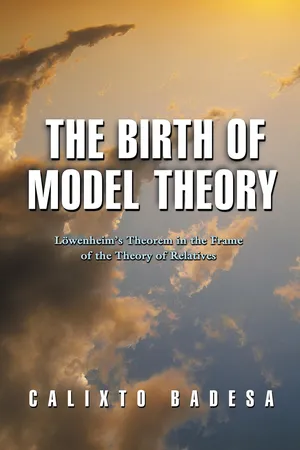
The Birth of Model Theory
Löwenheim's Theorem in the Frame of the Theory of Relatives
- 256 pages
- English
- ePUB (mobile friendly)
- Available on iOS & Android
eBook - ePub
About this book
Information
Table of contents
- Table of Contents
- Preface
- Chapter 1. Algebra of Classes and Propositional Calculus
- Chapter 2. The Theory of Relatives
- Chapter 3. Changing the Order of Quantifiers
- Chapter 4. The Löwenheim Normal Form
- Chapter 5. Preliminaries to Löwenheim's Theorem
- Chapter 6. Löwenheim's Theorem
- Appendix. First-Order Logic with Fleeing Indices
- References
Trusted by 375,005 students
Access to over 1.5 million titles for a fair monthly price.
Study more efficiently using our study tools.
Frequently asked questions
Yes, you can cancel anytime from the Subscription tab in your account settings on the Perlego website. Your subscription will stay active until the end of your current billing period. Learn how to cancel your subscription
No, books cannot be downloaded as external files, such as PDFs, for use outside of Perlego. However, you can download books within the Perlego app for offline reading on mobile or tablet. Learn how to download books offline
We are an online textbook subscription service, where you can get access to an entire online library for less than the price of a single book per month. With over 1.5 million books across 990+ topics, we’ve got you covered! Learn about our mission
Look out for the read-aloud symbol on your next book to see if you can listen to it. The read-aloud tool reads text aloud for you, highlighting the text as it is being read. You can pause it, speed it up and slow it down. Learn more about Read Aloud
Yes! You can use the Perlego app on both iOS and Android devices to read anytime, anywhere — even offline. Perfect for commutes or when you’re on the go.
Please note we cannot support devices running on iOS 13 and Android 7 or earlier. Learn more about using the app
Please note we cannot support devices running on iOS 13 and Android 7 or earlier. Learn more about using the app
Yes, you can access The Birth of Model Theory by Calixto Badesa in PDF and/or ePUB format, as well as other popular books in Mathematics & History & Philosophy of Mathematics. We have over 1.5 million books available in our catalogue for you to explore.