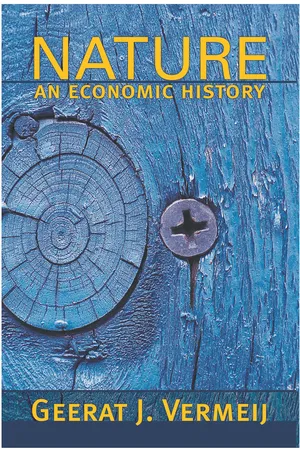
From humans to hermit crabs to deep water plankton, all living things compete for locally limiting resources. This universal truth unites three bodies of thought--economics, evolution, and history--that have developed largely in mutual isolation. Here, Geerat Vermeij undertakes a groundbreaking and provocative exploration of the facts and theories of biology, economics, and geology to show how processes common to all economic systems--competition, cooperation, adaptation, and feedback--govern evolution as surely as they do the human economy, and how historical patterns in both human and nonhuman evolution follow from this principle.
Using a wealth of examples of evolutionary innovations, Vermeij argues that evolution and economics are one. Powerful consumers and producers exercise disproportionate controls on the characteristics, activities, and distribution of all life forms. Competition-driven demand by consumers, when coupled with supply-side conditions permitting economic growth, leads to adaptation and escalation among organisms. Although disruptions in production halt or reverse these processes temporarily, they amplify escalation in the long run to produce trends in all economic systems toward greater power, higher production rates, and a wider reach for economic systems and their strongest members.
Despite our unprecedented power to shape our surroundings, we humans are subject to all the economic principles and historical trends that emerged at life's origin more than 3 billion years ago. Engagingly written, brilliantly argued, and sweeping in scope, Nature: An Economic History shows that the human institutions most likely to preserve opportunity and adaptability are, after all, built like successful living things.
- 464 pages
- English
- ePUB (mobile friendly)
- Available on iOS & Android
eBook - ePub
About this book
Information
Publisher
Princeton University PressYear
2009Print ISBN
9780691127934
9780691115276
eBook ISBN
9781400826490
Chapter 1
ECONOMY AND EVOLUTION: A ROAD MAP
WE LIVE IN A CHANGING WORLD, in an economic context of competition and resources to which we and our forebears have both adapted and contributed. It is impossible to separate us and other life forms from that context, for the context determines our character and we determine its character. If we wish to understand the past and the future, we must discover how the link between life and its context changed in history, to what extent economic change is predictable, and how the principles governing competition-driven demand and resource-driven supply intersect to yield laws of history.
At its core, this book is an economic analysis of history. In it, I argue that economic principles applicable to humans are the same as those that govern all other forms of life. The patterns of history that emerge from these principles are therefore universal, even if the details of timing and actors vary according to time and place.
It is easy to get lost in the fascinating phenomenology of economic history—in the particulars of places, participants, events, behavior, relationships, patterns of descent, and the like—and to lose sight of the structure of the arguments and of the principles on which these arguments rest. I therefore begin with an outline of the main points, with a road map to the sometimes tortuous path of the narrative that follows as it takes us through past and present ecosystems around the world.
Although we usually think of the word economy in such human terms as trade, profits, markets, and finance, it applies just as aptly to the systems of which living things other than humans are constituents and architects. In chapter 2 I lay out what I hold to be the fundamental characteristics and principles of economies. An economy is a collective whole, a system of metabolizing, interacting, smaller units or entities that are themselves economies. The constituent units adapt to, and bring about changes in, their environment as they compete locally for energy and material resources. Economies are built on living things, which complete cycles of work by coupling chemical transformations that alternately use and release energy in the context of an architecturally and organizationally constrained physical structure. Economies thus have knowable properties not possessed by any one of their individual members. The work of life—growth, replication, and activity—creates meaning and information and ultimately leads to a history in which self-interested parties who cooperate to fashion larger wholes give rise to and replace each other. Evolution—descent with modification—is thus an expected and universal historical process in economic systems. It occurs because economic units compete locally for resources, and because only those entities that acquire and retain the necessities of life in the face of such competition and of uncertainty persist. Cooperation among economic players reduces rivalry at one level, but creates more potent competitors on a larger scale. Trade and cooperation (or mutual exploitation) thus lead through self-organization, or co-construction, to regulation of resource supply and consumption, and to complex interdependencies that emerge as the common good for the larger economy and for many of its constituents, especially for those that wield disproportionate power.
Energy or its equivalent is what economic systems or their members exchange, but power—the amount of energy produced, consumed, or retained per unit time—is the best measure of absolute performance of living things. To the evolutionary biologist, absolute performance is usually expressed as fitness, the number of offspring in the next generation; to the economist, it usually translates into profits. Although we often think of words like economy or economical in terms of efficiency—the amount of energy gained per amount of energy invested—it is absolute power rather than efficiency that matters in the economies of nature and human affairs. Selection (or nonrandom elimination) operates whenever entities differ in performance-related characteristics that are heritable in some way. The universe works, and life works and persists, because we co-construct our universe through the combined processes of modification and selection. Adaptation, the process resulting in a better fit between entities and their environment, is universal among living things, which create and improve hypotheses about their surroundings much as scientists propose and test hypotheses explaining observations and regularities in the world.
For a variety of reasons, adapted entities are inevitably imperfect, and thus in principle are capable of improvement. Some challenging circumstances are simply too infrequent for an entity of limited lifespan to predict; others call for adaptive solutions that are in conflict with the demands imposed by different challenges, so that an imperfect compromise reflecting functional tradeoffs becomes the most likely option. Moreover, information about the environment is never either complete or accurate, a situation often exacerbated by the actions of competitors. Economic units and the coalitions they form create hypotheses about their environment that are as good as they have to be relative to the hypotheses of their competitors. Where competition is intense—where the consequences of losing are dire and the benefits of winning are great—the standards of performance and the predictiveness of adaptive hypotheses must be high. Where the stakes are lower, or where there is more tolerance of error, trade-offs are less constraining and persistence, or economic success, is achievable with lower levels of performance and with more generalized hypotheses. In other words, living things do only as well as they have to rather than optimize, pretty much as students do in classes.
One of the most pervasive and far-reaching realities in economic systems is inequality, the tendency for one party involved in an interaction over resources to gain more, or lose less, than its rival. Dominants exercise disproportionate influence and accumulate disproportionate power and wealth. Through top-down control, they affect not only the characteristics and distribution of other members of the economy, but they define the structure and workings of the economy as a whole. Inequality and dominance occur at all scales of economic life, from the cell to the biota, from the household and firm to international relations. They are expressed at all scales of time, from the life cycles of cells to the long-term replacements observed among empires and the great evolutionary branches of life. Inequality does not mean that the winners succeed while the losers fail. Winners can be, and often are, replaced, and although the losers are often restricted to the economic margins where resources are less plentiful and less reliable, the entities with subordinate economic positions may enjoy long periods of stability. In fact, the refuges in which they find themselves are often created by the winners, and as long as such refuges exist, the losing parties and their adapted descendants not only survive, but are often at the forefront of economic expansion into underex-ploited domains of the biosphere.
The fundamental processes operating in economic systems—competition, cooperation, selection, adaptation, and the feedback between living things and their environment—apply to all such systems, from those as small as a cell to human societies and to the biosphere as a whole. They work regardless of the particulars of how performance-related characteristics are introduced, inherited, modified, or eliminated. Importantly, they have characterized life since its beginning some 3.5 billion years ago, and they have been responsible for unbroken evolutionary lines of descent chronicling continuous success in the face of startling long-term change, devastating disruptions, and ever-present struggles over resources.
It is all well and good to characterize the domain of nonhuman life as a hierarchy of economies ruled by competition, cooperation, adaptation, and inequality, but does this perspective have anything useful to say about human economic life and civilization? There is a long history of claiming for humanity all sorts of unique attributes—language, intentionality, cultural transmission of knowledge, anticipation of future conditions, moral codes, the ability to use previously unexploited sources of energy, and more—to say nothing of the unique institutions that dot the landscape of civilization: schools, corporations, governments, stock markets, farms, factories, shops, prisons, churches, banks, amusement parks, and so on.
I argue in chapter 3, however, that the human species and the human economy do not differ fundamentally from units encountered in the rest of the biosphere. Humans are without question the most powerful economic entity that has yet evolved on Earth; we accomplish things on spatial scales vastly larger than any other species, and our unparalleled power enables us to do everything much faster by orders of magnitude than is possible in any other economy that arose on Earth. We anticipate and predict; we modify environments globally, and exercise control over every ecosystem on this planet. Yet, in spite of all these unique qualities and institutions, our species and the economic and social system we have created follow all the same fundamental rules that govern other life forms and their economic structures. Like other living things, we too are ruled by conflicts of interest, cooperative behavior, adaptation, unequal outcomes of trade, the disproportionate influence of the rich and powerful, and the vagaries of resource supply that dictate when and where opportunities are created and constraints are imposed. None of our attributes has thus far enabled humans to violate the principles that apply to all other life forms. Life and its history therefore have much to say about ourselves, including our future. Moreover, all of our unique characteristics are derived from precursors observable in nonhuman life forms. Cultural (or at any rate nongenetic) transmission of performance-related information, machinery, and behavior has existed since life’s origin; and our ability to modify and to anticipate has obvious, if less spectacular, precedents in the adaptations and the mechanisms of adaptation in other organisms.
Having laid out the rules common to all economies, I turn to the two activities—consumption and production—that together describe what living things do. Predation—the consumption of living things by other living things—invests the abstract ideas of chapters 2 and 3 with real life-and-death significance in chapter 4. Here we meet potential victims who face daily confrontations with, and risks from, enemies. Their defenses range from the passive—cryptic coloration, toxicity, and heavy armor—to more active means such as fleeing and aggression. Those victims without effective defenses are restricted by their enemies to refuges, safe sites where predators are themselves physically constrained. Thus, we find life forms on the bodies of well-defended large organisms, or deeply buried in soil, or floating in the plankton, or cowering in the inhospitable border between sea and land, or populating temporary habitats.
We also meet the predators themselves, animals among which competition for food is intense and whose feeding methods and abilities are dictated largely by performance during encounters with rivals. Predator and prey respond to one another directly behaviorally and even architecturally, but in an evolutionary sense it is the predators in particular, and enemies in general, who hold the upper hand. In all ecosystems, at least some predators exceed all potential prey in energy-demanding performance. They have more acute senses, move or maneuver more rapidly, and exert greater forces than do their victims. It is only in passive performance—toxicity, armor, and large body size—that potential victims exceed their enemies in performance. Given that passivity is usually linked to inactivity, predators exercise far more control over the characteristics of living things—their behavior, form, and distribution—than do victims. Powerful consumers, with high per capita and collective rates of consumption, drive economic systems and impart structure and direction to them. They impose pervasive top-down evolutionary and economic control, because adaptation to enemies characterizes all members of all economies. In short, adaptive evolution is largely a process of escalation in which potential victims adapt to enemies, which in turn adapt or accommodate to their enemies.
Consumers may evolutionarily control the characteristics and distribution of life, but they cannot exist without producers. In chapter 5, I explore how primary producers—microbes, plants, and phytoplankton, which make organic matter from inorganic components—compete for energy and raw materials. Resources often appear to be globally superabundant—think of energy from the sun, nitrogen in the atmosphere, and silicon in the sand, for example—but they limit productivity because competition for them is local, and because access to them is constrained by the technology of extraction, storage, conversion, and distribution. Resources and the creatures that convert them to biomass exercise pervasive, diffuse, bottom-up controls over economic systems and their constituents. All living things are in some sense producers, and all provide potential resources to other life forms. A surplus of production—that is, the amount produced beyond the requirements of the producers themselves—determines how much consumption an economy can support sus-tainably. It, in turn, depends on the ability of victims to thwart consumption, often through passive means. Resource supply and anti-consumer adaptation thus set limits to the amount and nature of consumption through a series of complex positive and negative evolutionary and economic feedbacks. Abundance and access provide evolutionary and economic opportunity for adaptation and growth; scarcity and lack of access impose constraint.
Forms of consumption that stimulate production will in general be favored over those that interfere with it. By consuming living plant matter, for example, herbivores circumvent some decomposers and therefore recycle nutrients faster than if nutrient transfer from plants were exclusively in the hands of organisms that consume dead tissues. Organisms tend to regulate and often improve the supply of resources so that the supply becomes reliable and high enough to support populations of consumers. For example, predators that eat snails without destroying the shells of their victims create a reasonably steady supply of shells for hermit crabs, which in the absence of such consumers would be at the mercy of rare storms or other unpredictable events to make empty shells available. Functional links between producers and consumers thus create a more productive, more opportunity-rich economy in which conditions for the common good of both dominant and subordinate members emerge.
Energy is the currency of economic exchange and value, but power—the rate at which energy and raw materials are used—is the measure of economic performance. More power means more control. In part, power is derived from the environment. The ability to respond adaptively, to improve hypotheses about the environment, and to capitalize on opportunity depends on how rapidly and how reliably the environment delivers resources, but it also depends on the technology that economic entities possess. In chapter 6, I explore the architectural and organizational qualities that bestow power, wealth, and adaptability on living things. Powerful entities are large, metabolize rapidly, have a wide individual or collective reach, and possess a flexible, hierarchical organization characterized by semiautonomous interacting parts subject to diffuse central control. Cooperation, division of labor, effective communication among parts and among individuals, and an ability to respond rapidly and flexibly under a very wide variety of circumstances, including rare ones, characterize all economically powerful entities. Power provides access to resources, and this power stimulates production and all other processes that confer greater power in the first place. It is therefore a great amplifier of economic life, an attribute which depends on, and in turn promotes, intense high-stakes competition.
The technological and organizational qualities that bestow economic and physical power will increase only if the benefits of greater power exceed the high costs of investment in power-enhancing innovations. Such large outlays become feasible only when resources are abundant, accessible, and predictable in economies of large effective size in which competition is intense. It is only under such circumstances that entities are able to modify patterns of allocation and where large imperfections of innovations are able to survive long enough without lethal consequences for selection to improve them. Conditions favoring increases in the sizes and numbers of individuals and groups thus provide opportunities for improvement and growth by reducing the cost of imperfection and by relaxing the constraints of trade-offs that under economic stagnation or decline enforce an adaptive status quo.
Four interrelated factors and processes in the environment—temperature, the effective size of economies, heat-powered eruptions and tectonic movements of Earth’s crust, and life’s metabolism—together determine the supply of resources and therefore the distribution of opportunity and constraint in space and time on our planet. I consider this environmental component in chapter 7.
Temperature—the average kinetic energy of molecules moving in a fluid or gas—affects almost every chemical reaction and material property on which life depends. A rise in temperature from the freezing point of water to somewhere between 35 and 40°C, above which the molecules of life begin to suffer heat-related loss of function, enables organisms whose body temperatures approximately match those of the surroundings to accomplish the work of life faster and often more cheaply, and thus to draw and deliver more power. Animals can move and feed faster, growth rates are potentially higher, and microbes and p...
Table of contents
- Table of Contents
- PREFACE
- Chapter 1 Economy and Evolution: A Road Map
- Chapter 2 The Evolving Economy
- Chapter 3 Human and Nonhuman Economies Compared
- Chapter 4 The Economics of Everyday: Consumption and the Role of Enemies in Nature
- Chapter 5 The Economics of Everyday: Production and the Role of Resources
- Chapter 6 The Ingredients of Power and Opportunity: Technology and Organization
- Chapter 7 The Ingredients of Power and Opportunity: The Environment
- Chapter 8 The Geography of Power and Innovation
- Chapter 9 Breaking Down and Building Up: The Role of Disturbance
- Chapter 10 Patterns in History: Toward Greater Reach and Power
- Chapter 11 The Future of Growth and Power
- Appendix 1: Abbreviations
- Appendix 2: The Geological Time Scale
- NOTES
- LITERATURE CITED
Trusted by 375,005 students
Access to over 1.5 million titles for a fair monthly price.
Study more efficiently using our study tools.
Frequently asked questions
Yes, you can cancel anytime from the Subscription tab in your account settings on the Perlego website. Your subscription will stay active until the end of your current billing period. Learn how to cancel your subscription
No, books cannot be downloaded as external files, such as PDFs, for use outside of Perlego. However, you can download books within the Perlego app for offline reading on mobile or tablet. Learn how to download books offline
Perlego offers two plans: Essential and Complete
- Essential is ideal for learners and professionals who enjoy exploring a wide range of subjects. Access the Essential Library with 800,000+ trusted titles and best-sellers across business, personal growth, and the humanities. Includes unlimited reading time and Standard Read Aloud voice.
- Complete: Perfect for advanced learners and researchers needing full, unrestricted access. Unlock 1.5M+ books across hundreds of subjects, including academic and specialized titles. The Complete Plan also includes advanced features like Premium Read Aloud and Research Assistant.
We are an online textbook subscription service, where you can get access to an entire online library for less than the price of a single book per month. With over 1.5 million books across 990+ topics, we’ve got you covered! Learn about our mission
Look out for the read-aloud symbol on your next book to see if you can listen to it. The read-aloud tool reads text aloud for you, highlighting the text as it is being read. You can pause it, speed it up and slow it down. Learn more about Read Aloud
Yes! You can use the Perlego app on both iOS and Android devices to read anytime, anywhere — even offline. Perfect for commutes or when you’re on the go.
Please note we cannot support devices running on iOS 13 and Android 7 or earlier. Learn more about using the app
Please note we cannot support devices running on iOS 13 and Android 7 or earlier. Learn more about using the app
Yes, you can access Nature by Geerat Vermeij in PDF and/or ePUB format, as well as other popular books in Biological Sciences & Economic Theory. We have over 1.5 million books available in our catalogue for you to explore.