George Orwell's Nineteen Eighty-Four is among the most widely read books in the world. For more than 50 years, it has been regarded as a morality tale for the possible future of modern society, a future involving nothing less than extinction of humanity itself. Does Nineteen Eighty-Four remain relevant in our new century? The editors of this book assembled a distinguished group of philosophers, literary specialists, political commentators, historians, and lawyers and asked them to take a wide-ranging and uninhibited look at that question. The editors deliberately avoided Orwell scholars in an effort to call forth a fresh and diverse range of responses to the major work of one of the most durable literary figures among twentieth-century English writers.
As Nineteen Eighty-Four protagonist Winston Smith has admirers on the right, in the center, and on the left, the contributors similarly represent a wide range of political, literary, and moral viewpoints. The Cold War that has so often been linked to Orwell's novel ended with more of a whimper than a bang, but most of the issues of concern to him remain alive in some form today: censorship, scientific surveillance, power worship, the autonomy of art, the meaning of democracy, relations between men and women, and many others. The contributors bring a variety of insightful and contemporary perspectives to bear on these questions.
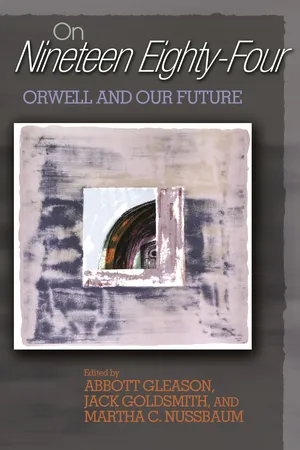
eBook - ePub
On Nineteen Eighty-Four
Orwell and Our Future
- 328 pages
- English
- ePUB (mobile friendly)
- Available on iOS & Android
eBook - ePub
On Nineteen Eighty-Four
Orwell and Our Future
About this book
Information
Publisher
Princeton University PressYear
2010Print ISBN
9780691113616
9780691113609
eBook ISBN
9781400826643
_______________ Part I _______________
POLITICS AND THE LITERARY
IMAGINATION


A Defense of Poesy (The Treatise of Julia)
Editor’s note: This treatise on poetry was found among the ashes of Oceania. The author is known to us only by the single name Julia. The treatise survives because it was etched in metal, specifically the metal casing of a small lipstick canister. It was found in a mound of soft ash where paper records were routinely incinerated. So microscopic is the writing that it at first appeared to archaeologists only as an ornate wreathing on the case. The fire of the incineration had reacted with the metal in such a way that these tiny marks became burnished and glowing, as though inviting further scrutiny. Once given that scrutiny, the delicate wreathing—which had itself occasioned much excitement since ornamentation was thought to have been nonexistent in Oceania—quickly revealed the secret text contained there. Transcription proved fairly straightforward; the only difficulties came from the fact that no spaces separate the words, and from the fact that once the author finished writing vertically (beginning each line at the bottom of the canister and moving upward), she then turned the canister ninety degrees, continuing her text by now cutting perpendicularly across the already existing lines.
Statements made by Julia inside the treatise suggest what expert analysis of the incision marks confirms: the etching implement was almost certainly a razor blade, a tool regarded as semiprecious in this civilization. Irregularities in the wreathing—whose clarity declines, then resumes, five times—indicate the use of five separate implements. The treatise is addressed throughout to a lover. Occasionally the author refers to “my brother.” The scholarly consensus about the identity of the lover and disagreement about the identity of the brother are summarized (along with other lines of scholarly inquiry) in an annotated bibliography now in preparation.
The treatise is widely considered remarkable for its brilliant feat of thinking carried out in a civilization where even modest acts of thinking were discouraged. Occasionally Julia’s meaning becomes unclear, and scholars have debated whether the author has lost her way in such passages or whether she has instead made her way onto paths where we have not yet successfully followed. The treatise belongs in a line that includes Sidney’s Apologie for Poetrie and Shelley’s Defence of Poetry, though its claims for art go beyond either. Sidney urged that poetry delights and instructs. Shelley said poets were the unacknowledged legislators of the world. The work that Julia’s treatise assigns to poetry is anterior to either instruction or legislation, since it claims that poesis makes thinking itself possible.
Though the treatise is undated, metallurgical analysis of the inscriptions places its composition in the year A.D. 1984.
THE HUMAN ability to think freely—or, simply, to think—is premised on an ability to carry out two distinguishable mental practices, the practice of accurately identifying what is the case and the practice of entering mentally into what is not the case. The two familiar names for these practices are history and literature.
In Oceania, where the goal is to eliminate thought, each of the two mental practices is systematically damaged by two leading agencies, the Records Department and the Fiction Department. The first dedicates its daily labor to erasing names, dates, and actions that have actually occurred and replacing them with altered substitutes. The second provides machine-generated stories and songs to satiate all longing for the counterfactual before it can arise, thereby preempting the human impulse to generate imaginary objects of its own.
It is easy to see why—in order to think—one must be able to formulate sentences that match physical events in the world. If a woman walks over the footbridge carrying a pink parasol, one must be able to say the sentence “A woman is walking over the footbridge carrying a pink parasol”; and one must also, later in the afternoon, still be able to hold steady the fact “This morning, a woman walked over the footbridge carrying a pink parasol.” If the event is memorable enough to be recalled ten months later, the more closely the memory matches the event, the better.
But imagine if the only sentences we could make had to conform to physical events that had actually taken place; our only thoughts would be registrations of already occurring events. We would be prisoners of the actual. We would be like intricate copying machines that could only record factual events happening in close proximity to ourselves (we would not even have any way of choosing among the factual events). But just as primary as the factual reflex of the mind is the counterfactual reflex; and while the factual keeps our thoughts stuck to the world, the counterfactual keeps us unstuck. The factual reflex lets me think that a woman walked over the footbridge carrying a pink parasol, while the counterfactual lets me think about her.
In all our hours together, it has seemed to me that you keenly appreciate the factual work carried out by the mind but that you consistently underestimate the work of the counterfactual, and it is to open your eyes to the second that I write. You rage at Oceania’s assaults on the factual but shrug at its assaults on the counterfactual—as though the imaginary could not be damaged or, upon being damaged, would be no loss.
Yet every day, I also see how strong is your own counterfactual yearning—you, who fell in love with the bright ornament in my name, you who waited to make love until the thrush had sung her song. I have felt your pulse race when you touched the pages of a book. Close this in your hand so your heart will race now.
The counterfactual lets us think about events we do not at that moment perceive by sight or touch or one of the other senses. I did not see the woman before she stepped onto the footbridge, but as I watched her gliding across the bridge, this anterior space presented itself to my mind (where did she come from? she must have passed close to me? how did I miss her?), as well as the posterior space (long before she reached the other side, I pictured the small stairway leading from the bridge down to the street level). As for her motion on the bridge itself, I could feel my mind sorting through descriptions, reaching for, then rejecting, adjectives, trying others, starting over.
My thought “that the woman is moving over the bridge” enlists the factual reflex of the mind; my thoughts about her moving over the bridge enlist the counterfactual. Do I seem to claim too much? What I say is modest compared to what others have argued. Do you remember the night at the Chestnut Tree Café, when young Mary recited passages about imagining from Hume, Kant, and Wittgenstein?1 She thinks the imagination is at work even in my being able to think “that a woman carrying a parasol is moving over the bridge.” Her philosophers say it is at work in every perception, no matter how starkly factual.
For example, as the woman moved away from me across the bridge, I only actually saw her at intermittent intervals. It was you I had been waiting for by the bridge. It was your figure, starting across from the other side, that I had searched out, had at last found, and had watched as you began the passage toward me. At first my eyes were steadily on you; then they got tugged away by an anomalous streak on my peripheral vision. I looked to see what it was, and then, struck by the sight of her, I kept moving back and forth, between your two figures—hers and then yours; yours and then hers. The two of you moved toward one another, merged midway on the bridge, then separated again, you moving closer and closer to me, she moving farther and farther away. (You saw me lift my arm, and later cautioned me against greeting you so openly in public, but I was not waving to you; my arm lifted because I wanted to arrest her passage.)
Hume says I did not factually see the woman carrying the pink parasol over the bridge. I factually saw only intermittent patches of her, now at one station on the bridge, later at another, then another; and another. My confident perception that this discontinuous series of events was a solid and singular person was made possible by the images the imagination supplied for all the missing spaces; just as, more generally, everyday objects in the world—tables and chairs with which we have only very interrupted perceptual experiences—acquire their solidity and integrity and continuity of existence only with the assistance of the counterfactual.
But I, who am more modest, will be content if you will agree to locate the counterfactual only in all that lies “about” or “above” the perception—beginning with the cloud of “not” structures that lie in the field of any perception. In order to perceive what something is, one sees what it is not, and though what it is “not” usually lies inert, it marks out a path for what the thing might have been if it were something other than what it was. This is just the ordinary process of sorting out perceptions—What is that against the sky? an umbrella? no, not an umbrella, a parasol. It is shimmering with light, like sand; no, not sand; like cream, light pink. It has a sheen. Is it metal? But it lets the light through: ah, it is silk. Do you see—the small burst of fireflies of negations that keep shooting out of what is: The woman is carrying a parasol (not an umbrella) that is pink (not tan) and made of silk (not metal).
Ordinarily we have no interest in the cloud of nots, which either go unnoticed or are waved away like gnats, unless there is something about the fact at hand that is aversive. And if it is aversive, then we begin to track out the path of the nots. Let her carry an umbrella, I thought, let it be a drab umbrella, tan or green. (That way she will not call attention to herself on the high footbridge.) Let the pink parasol be made of metal. (That way, she can shield herself once she reaches the other side.) And many more counterfactuals arose in my mind. I surrounded the fact of your own forward motion with a flurry of counterfactual motions. As your path took you near her, I felt dread and accelerated your pace to separate the two of you. (Hurry, hurry past her, out of the path of danger.) But once you were safely past, I wanted you to help her. (Turn around, Winston, look what you are passing, go after her, wrap a coat around her. Pull the silly object from her hand.) But you were all along looking over the railing at me and did not see what was taking place on the bridge: a magnificent woman walking calmly over the river to her death.
What is the point of the counterfactual, on whose behalf she carried out her brief campaign? The counterfactuals my mind so ardently supplied did nothing to alter her fate (though if I were a swift runner, or if you were telepathic, one of us might have reached her in time—you see, the problem was a deficit of counterfactuals, not a surfeit). Even as is, the counterfactual benefits us in two ways. It carries freedom inside itself. It lets us get free of what happened, to picture an alternative world where silk parasols are tolerated—either because no soldier shoots you when you get to the other side, or because, before you get to the other side, a friend has already taken the parasol from your hand. At the same time, it enables us, by lifting a moment away from the facts, to penetrate the facts more deeply. It lets us sense—because she needn’t have chosen to do this, she needn’t have worn pink, she needn’t have held it so high, she needn’t have chosen so bright a day when the sunlight would flash around it—the full force of the fact of her courage, the clarity of her defiance.
Not knowing her name, I conferred a name on her as I watched. Will you guess a name such as Odette? Simone? Paulina? All appropriate for her visionary carriage. But no, I called her Polyxena, the young Trojan girl the Greeks decide to slay as a sacrifice to honor Achilles. She consents to die but refuses to be hauled to the altar: “Unhand me, I die willingly.” Walking over the footbridge, in her own small corridor of sunlight, the woman with the parasol must have thought what the other earlier thought: “all the light / that now belongs to me is what remains between / this moment and the sword.”
In Oceania, where the counterfactual impulse is damaged, it arises not at all or, if at all, only in times of full adversity. But in other empires, where people’s lives aren’t threatened, and where people wear silk with impunity, the counterfactual comes to be highly prized, easily instigated, prompted at the drop of a hat. In such a world, a color might be not to my liking, and so that alone might prompt me to think of another color, even if no one’s life were in danger or even discomfort—except my own exquisitely small discomfort of seeing a hue that is not fully to my liking. Upon seeing a pink dress, I might find its pink not enough inflected with lavender; and this “lavender-deficient state” might count as aversive enough that it would prompt me to mentally revise the color. You complain that empires of aesthetes are decadent, an...
Table of contents
- Cover
- Title
- Copyright
- Dedication
- Contents
- Dedicatory Foreword
- Acknowledgments
- Introduction Abbott
- Part I: Politics and the Literary Imagination
- Part II: Truth, Objectivity, and Propaganda
- Part III: Political Coercion
- Part IV: Technology and Privacy
- Part V: Sex and Politics
- Conclusion
- The Death of Pity: Orwell and American Political Life
- Contributors
- Index
Trusted by 375,005 students
Access to over 1.5 million titles for a fair monthly price.
Study more efficiently using our study tools.
Frequently asked questions
Yes, you can cancel anytime from the Subscription tab in your account settings on the Perlego website. Your subscription will stay active until the end of your current billing period. Learn how to cancel your subscription
No, books cannot be downloaded as external files, such as PDFs, for use outside of Perlego. However, you can download books within the Perlego app for offline reading on mobile or tablet. Learn how to download books offline
Perlego offers two plans: Essential and Complete
- Essential is ideal for learners and professionals who enjoy exploring a wide range of subjects. Access the Essential Library with 800,000+ trusted titles and best-sellers across business, personal growth, and the humanities. Includes unlimited reading time and Standard Read Aloud voice.
- Complete: Perfect for advanced learners and researchers needing full, unrestricted access. Unlock 1.5M+ books across hundreds of subjects, including academic and specialized titles. The Complete Plan also includes advanced features like Premium Read Aloud and Research Assistant.
We are an online textbook subscription service, where you can get access to an entire online library for less than the price of a single book per month. With over 1.5 million books across 990+ topics, we’ve got you covered! Learn about our mission
Look out for the read-aloud symbol on your next book to see if you can listen to it. The read-aloud tool reads text aloud for you, highlighting the text as it is being read. You can pause it, speed it up and slow it down. Learn more about Read Aloud
Yes! You can use the Perlego app on both iOS and Android devices to read anytime, anywhere — even offline. Perfect for commutes or when you’re on the go.
Please note we cannot support devices running on iOS 13 and Android 7 or earlier. Learn more about using the app
Please note we cannot support devices running on iOS 13 and Android 7 or earlier. Learn more about using the app
Yes, you can access On Nineteen Eighty-Four by Abbott Gleason, Jack Goldsmith, Martha C. Nussbaum, Abbott Gleason,Jack Goldsmith,Martha C. Nussbaum, Abbott Gleason, Jack Goldsmith, Martha Nussbaum in PDF and/or ePUB format, as well as other popular books in Politics & International Relations & English Literary Criticism. We have over 1.5 million books available in our catalogue for you to explore.