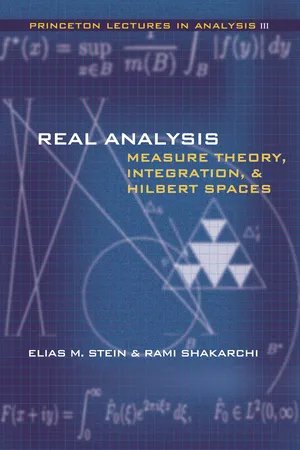
Real Analysis is the third volume in the Princeton Lectures in Analysis, a series of four textbooks that aim to present, in an integrated manner, the core areas of analysis. Here the focus is on the development of measure and integration theory, differentiation and integration, Hilbert spaces, and Hausdorff measure and fractals. This book reflects the objective of the series as a whole: to make plain the organic unity that exists between the various parts of the subject, and to illustrate the wide applicability of ideas of analysis to other fields of mathematics and science.
After setting forth the basic facts of measure theory, Lebesgue integration, and differentiation on Euclidian spaces, the authors move to the elements of Hilbert space, via the L2 theory. They next present basic illustrations of these concepts from Fourier analysis, partial differential equations, and complex analysis. The final part of the book introduces the reader to the fascinating subject of fractional-dimensional sets, including Hausdorff measure, self-replicating sets, space-filling curves, and Besicovitch sets. Each chapter has a series of exercises, from the relatively easy to the more complex, that are tied directly to the text. A substantial number of hints encourage the reader to take on even the more challenging exercises.
As with the other volumes in the series, Real Analysis is accessible to students interested in such diverse disciplines as mathematics, physics, engineering, and finance, at both the undergraduate and graduate levels.
Also available, the first two volumes in the Princeton Lectures in Analysis:
The sets whose measure we can define by virtue of the preceding ideas we will call measurable sets; we do this without intending to imply that it is not possible to assign a measure to other sets.
E. Borel, 1898
This chapter is devoted to the construction of Lebesgue measure in
d and the study of the resulting class of measurable functions. After some preliminaries we pass to the first important definition, that of exterior measure for any subset E of
d. This is given in terms of approximations by unions of cubes that cover E. With this notion in hand we can define measurability and thus restrict consideration to those sets that are measurable. We then turn to the fundamental result: the collection of measurable sets is closed under complements and countable unions, and the measure is additive if the subsets in the union are disjoint.
The concept of measurable functions is a natural outgrowth of the idea of measurable sets. It stands in the same relation as the concept of continuous functions does to open (or closed) sets. But it has the important advantage that the class of measurable functions is closed under pointwise limits.
1 Preliminaries
We begin by discussing some elementary concepts which are basic to the theory developed below.
The main idea in calculating the “volume” or “measure” of a subset of
d consists of approximating this set by unions of other sets whose geometry is simple and whose volumes are known. It is convenient to speak of “volume” when referring to sets in
d; but in reality it means “area” in the case d = 2 and “length” in the case d = 1. In the approach given here we shall use rectangles and cubes as the main building blocks of the theory: in
we use intervals, while i...
Table of contents
Cover
Half title
Title
Copyright
Dedication
Contents
Foreword
Introduction
Chapter 1. Measure Theory
Chapter 2. Integration Theory
Chapter 3. Differentiation and Integration
Chapter 4. Hilbert Spaces: An Introduction
Chapter 5. Hilbert Spaces: Several Examples
Chapter 6. Abstract Measure and Integration Theory
Chapter 7. Hausdorff Measure and Fractals
Notes and References
Bibliography
Symbol Glossary
Index
Trusted by 375,005 students
Access to over 1.5 million titles for a fair monthly price.
Study more efficiently using our study tools.
Frequently asked questions
Yes, you can cancel anytime from the Subscription tab in your account settings on the Perlego website. Your subscription will stay active until the end of your current billing period. Learn how to cancel your subscription
No, books cannot be downloaded as external files, such as PDFs, for use outside of Perlego. However, you can download books within the Perlego app for offline reading on mobile or tablet. Learn how to download books offline
Perlego offers two plans: Essential and Complete
Essential is ideal for learners and professionals who enjoy exploring a wide range of subjects. Access the Essential Library with 800,000+ trusted titles and best-sellers across business, personal growth, and the humanities. Includes unlimited reading time and Standard Read Aloud voice.
Complete: Perfect for advanced learners and researchers needing full, unrestricted access. Unlock 1.5M+ books across hundreds of subjects, including academic and specialized titles. The Complete Plan also includes advanced features like Premium Read Aloud and Research Assistant.
Both plans are available with monthly, semester, or annual billing cycles.
We are an online textbook subscription service, where you can get access to an entire online library for less than the price of a single book per month. With over 1.5 million books across 990+ topics, we’ve got you covered! Learn about our mission
Look out for the read-aloud symbol on your next book to see if you can listen to it. The read-aloud tool reads text aloud for you, highlighting the text as it is being read. You can pause it, speed it up and slow it down. Learn more about Read Aloud
Yes! You can use the Perlego app on both iOS and Android devices to read anytime, anywhere — even offline. Perfect for commutes or when you’re on the go. Please note we cannot support devices running on iOS 13 and Android 7 or earlier. Learn more about using the app
Yes, you can access Real Analysis by Elias M. Stein,Rami Shakarchi in PDF and/or ePUB format, as well as other popular books in Matematica & Analisi matematica. We have over 1.5 million books available in our catalogue for you to explore.