Bernard Williams is remembered as one of the most brilliant and original philosophers of the past fifty years. Widely respected as a moral philosopher, Williams began to write about politics in a sustained way in the early 1980s. There followed a stream of articles, lectures, and other major contributions to issues of public concern--all complemented by his many works on ethics, which have important implications for political theory.
This new collection of essays, most of them previously unpublished, addresses many of the core subjects of political philosophy: justice, liberty, and equality; the nature and meaning of liberalism; toleration; power and the fear of power; democracy; and the nature of political philosophy itself. A central theme throughout is that political philosophers need to engage more directly with the realities of political life, not simply with the theories of other philosophers. Williams makes this argument in part through a searching examination of where political thinking should originate, to whom it might be addressed, and what it should deliver.
Williams had intended to weave these essays into a connected narrative on political philosophy with reflections on his own experience of postwar politics. Sadly he did not live to complete it, but this book brings together many of its components. Geoffrey Hawthorn has arranged the material to resemble as closely as possible Williams's original design and vision. He has provided both an introduction to Williams's political philosophy and a bibliography of his formal and informal writings on politics.
Those who know the work of Bernard Williams will find here the familiar hallmarks of his writing--originality, clarity, erudition, and wit. Those who are unfamiliar with, or unconvinced by, a philosophical approach to politics, will find this an engaging introduction. Both will encounter a thoroughly original voice in modern political theory and a searching approach to the shape and direction of liberal political thought in the past thirty-five years.
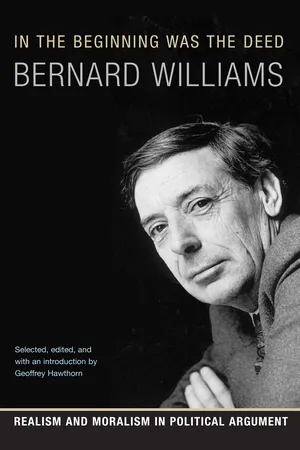
eBook - ePub
In the Beginning Was the Deed
Realism and Moralism in Political Argument
- 200 pages
- English
- ePUB (mobile friendly)
- Available on iOS & Android
eBook - ePub
In the Beginning Was the Deed
Realism and Moralism in Political Argument
About this book
Information
Publisher
Princeton University PressYear
2009Print ISBN
9780691134109
9780691124308
eBook ISBN
9781400826735
Topic
FilosofíaSubtopic
Ética y filosofía moralTable of contents
- Table of Contents
- Preface Patricia Williams
- Introduction Geoffrey Hawthorn
- ONE Realism and Moralism in Political Theory
- TWO In the Beginning Was the Deed
- THREE Pluralism, Community and Left Wittgensteinianism
- FOUR Modernity and the Substance of Ethical Life
- FIVE The Liberalism of Fear
- SIX Human Rights and Relativism
- SEVEN From Freedom to Liberty: The Construction of a Political Value
- EIGHT The Idea of Equality
- NINE Conflicts of Liberty and Equality
- TEN Toleration, a Political or Moral Question?
- ELEVEN Censorship
- TWELVE Humanitarianism and the Right to Intervene
- THIRTEEN Truth, Politics, and Self-Deception
- Bernard Williams: Writings of Political Interest
Trusted by 375,005 students
Access to over 1.5 million titles for a fair monthly price.
Study more efficiently using our study tools.
Frequently asked questions
Yes, you can cancel anytime from the Subscription tab in your account settings on the Perlego website. Your subscription will stay active until the end of your current billing period. Learn how to cancel your subscription
No, books cannot be downloaded as external files, such as PDFs, for use outside of Perlego. However, you can download books within the Perlego app for offline reading on mobile or tablet. Learn how to download books offline
Perlego offers two plans: Essential and Complete
- Essential is ideal for learners and professionals who enjoy exploring a wide range of subjects. Access the Essential Library with 800,000+ trusted titles and best-sellers across business, personal growth, and the humanities. Includes unlimited reading time and Standard Read Aloud voice.
- Complete: Perfect for advanced learners and researchers needing full, unrestricted access. Unlock 1.5M+ books across hundreds of subjects, including academic and specialized titles. The Complete Plan also includes advanced features like Premium Read Aloud and Research Assistant.
We are an online textbook subscription service, where you can get access to an entire online library for less than the price of a single book per month. With over 1.5 million books across 990+ topics, we’ve got you covered! Learn about our mission
Look out for the read-aloud symbol on your next book to see if you can listen to it. The read-aloud tool reads text aloud for you, highlighting the text as it is being read. You can pause it, speed it up and slow it down. Learn more about Read Aloud
Yes! You can use the Perlego app on both iOS and Android devices to read anytime, anywhere — even offline. Perfect for commutes or when you’re on the go.
Please note we cannot support devices running on iOS 13 and Android 7 or earlier. Learn more about using the app
Please note we cannot support devices running on iOS 13 and Android 7 or earlier. Learn more about using the app
Yes, you can access In the Beginning Was the Deed by Bernard Williams, Geoffrey Hawthorn in PDF and/or ePUB format, as well as other popular books in Filosofía & Ética y filosofía moral. We have over 1.5 million books available in our catalogue for you to explore.