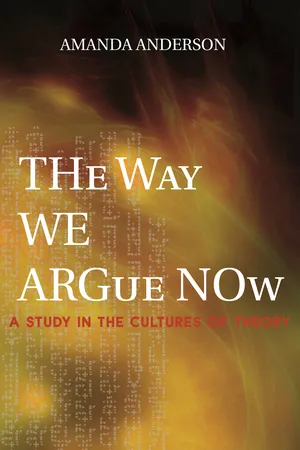
How do the ways we argue represent a practical philosophy or a way of life? Are concepts of character and ethos pertinent to our understanding of academic debate? In this book, Amanda Anderson analyzes arguments in literary, cultural, and political theory, with special attention to the ways in which theorists understand ideals of critical distance, forms of subjective experience, and the determinants of belief and practice. Drawing on the resources of the liberal and rationalist tradition, Anderson interrogates the limits of identity politics and poststructuralism while holding to the importance of theory as a form of life.
Considering high-profile trends as well as less noted patterns of argument, The Way We Argue Now addresses work in feminism, new historicism, queer theory, postcolonialism, cosmopolitanism, pragmatism, and proceduralism. The essays brought together here--lucid, precise, rigorously argued--combine pointed critique with an appreciative assessment of the productive internal contests and creative developments across these influential bodies of thought.
Ultimately, The Way We Argue Now promotes a revitalized culture of argument through a richer understanding of the ways critical reason is practiced at the individual, collective, and institutional levels. Bringing to the fore the complexities of academic debate while shifting the terms by which we assess the continued influence of theory, it will appeal to readers interested in political theory, literary studies, cultural studies, gender studies, and the place of academic culture in society and politics.
- 224 pages
- English
- ePUB (mobile friendly)
- Available on iOS & Android
eBook - ePub
About this book
Information
Publisher
Princeton University PressYear
2009Print ISBN
9780691114040
9780691114033
eBook ISBN
9781400826827
PA RT I
Critical Practices
CHAPTER 1
Debatable Performances
RESTAGING CONTENTIOUS FEMINISMS
THIS ESSAY INVESTIGATES an important feminist rerouting of the Habermas-Foucault debate, as it has been articulated and publicly staged by Seyla Benhabib and Judith Butler. A particularly vivid enactment of this dispute appears in the book Feminist Contentions: A Philosophical Exchange (1995). The book has four contributors—Butler, Benhabib, Nancy Fraser, and Drucilla Cornell—but the debate narrows pretty rapidly to a face-off between Butler and Benhabib, with Fraser attempting to mediate, and Cornell pursuing an offbeat, idiosyncratic theoretical project informed by Lacan, Derrida, and Levinas. It’s a strange book, and everyone is a little uncomfortable being counted among an elite “gang of four” implicitly authorized to chart the course of feminist debate.1 The editor, Linda Nicholson, who is also general editor of Routledge’s Thinking Gender series (in which this book appears), feels compelled to give a detailed history of the essays collected in the text: beginning as a symposium organized by the Greater Philadelphia Philosophy Consortium in September of 1990 (absent Cornell), the essays were then published in the July 1991 issue of Praxis International. After this, “a decision was made” to invite a contribution from Cornell, and then to have a round of responses from all four contributors and publish the eight essays as a book (FC, 1). The volume was first published in Germany, where Benhabib is an important Frankfurt School figure, and where the Habermasian position is more regularly and deeply engaged in the debates over postmodernism.2 Subsequently, it was decided to publish the book in English.
I focus on this book not because it successfully presents a complete picture of the contending positions held by Butler and Benhabib (it infact does not), but because it symptomatically displays some of the impasses in the debate. In this essay, I will go beyond Feminist Contentions to consider more seriously the arguments put forth in Butler’s and Benhabib’s relevant published work to date; but I also want to draw out the reasons why Feminist Contentions represents such an agonizingly failed speech situation. Any reader of the text cannot fail to register, in particular, Butler’s emphatic attempts to distance herself from the whole project. In her second contribution to the volume, she writes,
I’m struck in many ways by what now appears to me to be the parochialism of these debates, for the four of us certainly are not representative of “feminism” or “feminist theory” as it is currently articulated. Missing from this volume is a sustained discussion of the place of racial difference in contemporary feminist debate; the ethical and political questions raised by reproductive rights and technologies; the ethical and political questions raised by the discourse of victimization which seems to prevail in U.S. public feminist debate and exemplified in the work of Catherine MacKinnon; the contemporary theoretical divergences between sexuality and gender studies initiated by lesbian and gay studies; the transnational problems of translating feminist political goals and their claim to “universality”; the remapping of power by feminist theory in ways that encompass shifting geopolitical terrains; the feminization and racialization of poverty both domestically and abroad. (FC, 132)
“Neither does this volume address,” Butler goes on, “the ‘theory wars,’ for as a group, we toil in the domain of philosophy and its critique, and in that way dwell within a presupposed sense that theoretical reflection matters” (FC, 132). Butler culminates her indictment of this club, which includes her as a member, by insisting that one cannot really consider this volume as constituting a “debate” on the value or viability of “modernity,” “the subject,” “progressive history,” or “the transcendental norm”; the question is simply whether such terms can serve as “grounds” for political struggle (FC, 132). And the answer, for Butler, is simply no. Butler thereby scores one of her sharpest points against critical theory and against Benhabib: politics truly occurs only when such terms are struggled over in more concrete historical and institutional contexts. The kind of debate that tries to resolve such issues “philosophically” is engaged in the insidious practice that imagines one can decide such matters by mere reflection, in advance of actual struggles: “This urge to have philosophy supply the vision that will redeem life, that will make life worth living, this urge is the very sign that the sphere of the political has already been abandoned” (FC, 131).
Combining an anxiety about vanguardism and political relevance with a stark claim about the relation between philosophy and politics, Butler indicates that she has moved beyond the debate recorded in the volume, that she is elsewhere, which in this case is implied to be the true realm of the political as opposed to the deluded, apolitical realm of philosophical justification. The acknowledgment of complicity (we all “toil in the domain of philosophy and its critique”) is overshadowed by the cordoning-off of critical theory as unself-critical philosophy, as a species of retreat, withdrawal, and mystification against which “real” politics is defined. In making this move, Butler at once frames and dismisses Benhabib, and in a sense refuses to debate her. To be sure, Benhabib herself evinces discomfort about republishing an old essay and lets us know that she needed to be persuaded that the controversy should be made publicly available in a new format. But beyond the anxiety about timeliness, she appears less concerned with the nature of the issues debated than with the wounds reopened by yet another public enactment of a strained disagreement that has taken its toll on “personal loyalties and friendships” (FC, 31).
If nothing else, these acts of distancing on both sides indicate that the debate has calcified, and that Linda Nicholson’s attempt to vivify it through republication has exacerbated existing tensions. Consequently, one can appreciate Nancy Fraser’s attempt to reconcile the opposing positions, however quixotic such an attempt at times appears.3 The initial impetus for my own commentary on this text came not from any desire to reconcile, I must confess, but from outright frustration with Butler for distortions of Benhabib’s position and, by extension, of Habermas’s position and the theory of communicative action. In exploring the relation between Butler’s position and her vehement rejection of communicative ethics, I suggest that Butler in some sense requires a trumped-up version of normative critical theory in order to secure the pedigree of her politics. Central to her negotiation of critical theory and of performative politics is a complex rhetoric of temporality that emphasizes thresholdism, on the one hand, and belatedness, on the other. By tracing out the implications of temporal nonsynchronicity in Butler I aim to expose her own evasion of normative explicitness, and thereby to vindicate communicative ethics.
At the same time, however, I want to suggest that Benhabib’s theory needs a more capacious model of dialogue, one that can accommodate different forms of political practice, particularly the disruptions of spectacle, performance, and what Butler at one point calls “theatrical rage.”4 Despite her own emphasis on identity as situated, Benhabib’s position dubiously diminishes, and even wards off, the importance of political practices and ways of everyday life that dramatically denaturalize commonly held assumptions about identity, imagining that such practices are a threat to feminist political cohesion. I believe that this assumption is misguided and that radical disidentification of the type Butler advocates constitutes a practically and theoretically significant form of contemporary politics. But to accept and even promote radical disidentification, or subversive denaturalization, need not entail the abandonment of communicative ethics. There is no necessary reason why disidentification and communicative ethics have to be defined against each other.
If one accepts conclusion, a significant question still remains. Even if a potential compatibility is asserted between the project of communicative ethics and subversive denaturalization of the Butlerian sort, one might still reasonably ask: to what extent should the dramas of identity, whether affirmative or subversive, dominate or shape a leftist politics? Indeed, Nancy Fraser’s subsequent work, whose claims do not significantly animate her (earlier) analyses in Feminist Contentions, pursues the question of how we might best combine a politics of recognition oriented around questions of identity and a politics of redistribution oriented around questions of socioeconomic justice.5 Such a project requires assessing various forms of recognition politics in terms of which forms of state or institutional politics that they seem to enable, advocate, foreclose, play into, or fail to consider. It involves, in other words, asking how we combine a politics of identity, whether conceived affirmatively or subversively, with a politics that reaches beyond that potentially limiting rubric.
The discussion will thus proceed as follows. I will present the salient features of Butler’s and Benhabib’s positions, assessing them in terms of their key concepts, their implicit politics, and their normative integrity. My goal will be to expose what I take to be misguided and questionable ways of configuring the relations among politics, identity, and norms, and to argue for a refurbished communicative ethics that can accommodate the various politics of disidentification. Throughout, I will revisit the question of how well the two thinkers integrate their theoretical claims into a larger political vision, arguing that Benhabib’s communicative ethics, despite some significant shortcomings, is far more developed in ethicopolitical, collective, and institutional terms.
Benhabib’s Critique, Norm, and Utopia (1986) and Situating the Self (1992) both prominently include a feminist appropriation and critique of Habermas’s critical theory.6 Unfortunately, the core of Benhabib’s position, her own dense elaboration of feminist commmunicative ethics, is nowhere elaborated in the Nicholson volume. Its absence lamentably diminishes the force of her argument that Butler’s theory lacks adequate normative resources. Instead, what comes to the fore is Benhabib’s critique of the models of agency and subjectivity that emerge in postmodernism, and the problems such models entail for a politics premised on women’s oppression. Two unfortunate distortions ensue. First, it can appear as though Benhabib is simply trying to defend an unexamined conception of the deliberative, autonomous self; and second, one misses the complexity and thoughtfulness of Benhabib’s own theory of normative justification.
Like Habermas, Benhabib seeks to draw out and justify the norms that underlie critiques of power, inequality, and the negative effects of the forces of modernization. She does so through Habermas’s theory of communicative ethics, which is a reformulation of Kantian ethical universalism. As Benhabib writes in Situating the Self, “Instead of asking what I as a single rational moral agent can intend or will to be a universal moral maxim for all without contradiction, the communicative ethicist asks: what principles of action can we all recognize or agree to as being valid if we engage in practical discourse or a mutual search for justification?”(SS, 28).
Whether such a procedural approach actually helps to yield any substantive normative guidance is an issue of debate. Habermas has sought to justify communicative ethics through appeal to the principles of respect and reciprocity that he claims are inherent in linguistic practices geared toward reaching understanding. Attempting to redress the overwhelmingly negative forms of critique characteristic of both the Frankfurt School and poststructuralist traditions, he argues that the logocentrism of Western thought and the powerful instrumentality of reason are not absolute but rather constitute “a systematic foreshortening and distortion of a potential always already operative in the communicative practice of everyday life.” The potential he refers to is the potential for mutual understanding “inscribed into communication in ordinary language.”7 Habermas acknowledges the dominance and reach of instrumental reason—his project is largely devoted to a systematic analysis of the historical conditions and social effects of that dominance—yet at the same time he wishes to retrieve an emancipatory model of communicativereason derived from a linguistic understanding of intersubjective relations. As Benhabib argues, this form of communicative action, embodied in the highly controversial and pervasively misunderstood concept of the “ideal speech situation,” entails strong ethical assumptions, namely the principles of universal moral respect and egalitarian reciprocity (SS, 29).
Habermas has famously argued that he does not believe any metaphysical grounding of such norms is possible; he insists instead that we view the normative constraints of the ideal speech community as “universal pragmatic presuppositions” of competent moral actors who have reached the postconventional stage of moral reasoning. Habermas’s theory combines a “weak transcendental argument” concerning the four types of validity claims operative in speech acts with an empirical reconstruction of psychosocial development derived from Lawrence Kohlberg. Benhabib, though she, too, appeals to socialization processes, distinguishes her position from Habermas’s “weak transcendental argument” by promoting a “historically self-conscious universalism” that locates the ethical principles of respect and reciprocity as “constituents of the moral point of view from within the normative hermeneutic horizon of modernity” (SS, 30). Benhabib’s work thus constitutes, like Habermas’s, a strong defense of specific potentialities of modernity. She differs from him in two key respects, besides the emphasis already outlined. First, she believes that Habermas’s emphasis on consensus seriously distorts his account of communicative ethics. Like others who have argued against the conflation of understanding and consensus, Benhabib champions instead a discourse model of ethics that is geared toward keeping the conversation going:
When we shift the burden of the moral test in communicative ethics from consensus to the idea of an ongoing moral conversation, we begin to ask not what all would or could agree to as a result of practical discourses to be morally permissible or impermissible, but what would be allowed and perhaps even necessary from the standpoint of ...
Table of contents
- Table of Contents
- Acknowledgments
- INTRODUCTION
- Part I.. Critical Practices
- CHAPTER 1 Debatable Performances Restaging Contentious Feminisms
- CHAPTER 2 The Temptations of Aggrandized Agency Feminist Histories and the Horizon of Modernity
- PART II. Living Universalism
- CHAPTER 3 Cosmopolitanism, Universalism, and the Divided Legaciesnb of Modernity
- CHAPTER 4 Realism, Universalism, and the Science of the Human
- PART III. Ethos and Argument
- CHAPTER 5 Pragmatism and Character
- CHAPTER 6 Argument and Ethos
- CHAPTER 7 Beyond Sincerity and Authenticity The Ethos of Proceduralism
Trusted by 375,005 students
Access to over 1.5 million titles for a fair monthly price.
Study more efficiently using our study tools.
Frequently asked questions
Yes, you can cancel anytime from the Subscription tab in your account settings on the Perlego website. Your subscription will stay active until the end of your current billing period. Learn how to cancel your subscription
No, books cannot be downloaded as external files, such as PDFs, for use outside of Perlego. However, you can download books within the Perlego app for offline reading on mobile or tablet. Learn how to download books offline
Perlego offers two plans: Essential and Complete
- Essential is ideal for learners and professionals who enjoy exploring a wide range of subjects. Access the Essential Library with 800,000+ trusted titles and best-sellers across business, personal growth, and the humanities. Includes unlimited reading time and Standard Read Aloud voice.
- Complete: Perfect for advanced learners and researchers needing full, unrestricted access. Unlock 1.5M+ books across hundreds of subjects, including academic and specialized titles. The Complete Plan also includes advanced features like Premium Read Aloud and Research Assistant.
We are an online textbook subscription service, where you can get access to an entire online library for less than the price of a single book per month. With over 1.5 million books across 990+ topics, we’ve got you covered! Learn about our mission
Look out for the read-aloud symbol on your next book to see if you can listen to it. The read-aloud tool reads text aloud for you, highlighting the text as it is being read. You can pause it, speed it up and slow it down. Learn more about Read Aloud
Yes! You can use the Perlego app on both iOS and Android devices to read anytime, anywhere — even offline. Perfect for commutes or when you’re on the go.
Please note we cannot support devices running on iOS 13 and Android 7 or earlier. Learn more about using the app
Please note we cannot support devices running on iOS 13 and Android 7 or earlier. Learn more about using the app
Yes, you can access The Way We Argue Now by Amanda Anderson in PDF and/or ePUB format, as well as other popular books in Literature & Literary Criticism. We have over 1.5 million books available in our catalogue for you to explore.