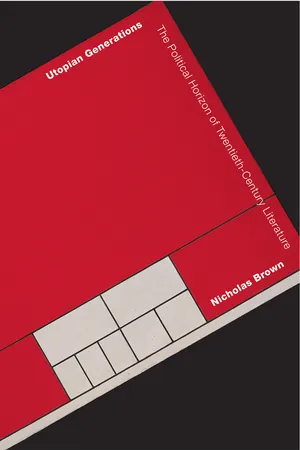
Utopian Generations develops a powerful interpretive matrix for understanding world literature--one that renders modernism and postcolonial African literature comprehensible in a single framework, within which neither will ever look the same. African literature has commonly been seen as representationally naïve vis-à-vis modernism, and canonical modernism as reactionary vis-à-vis postcolonial literature. What brings these two bodies of work together, argues Nicholas Brown, is their disposition toward Utopia or "the horizon of a radical reconfiguration of social relations.?
Grounded in a profound rethinking of the Hegelian Marxist tradition, this fluently written book takes as its point of departure the partial displacement during the twentieth century of capitalism's "internal limit" (classically conceived as the conflict between labor and capital) onto a geographic division of labor and wealth. Dispensing with whole genres of commonplace contemporary pieties, Brown examines works from both sides of this division to create a dialectical mapping of different modes of Utopian aesthetic practice. The theory of world literature developed in the introduction grounds the subtle and powerful readings at the heart of the book--focusing on works by James Joyce, Cheikh Hamidou Kane, Ford Madox Ford, Chinua Achebe, Wyndham Lewis, Ngugi wa Thiong'o, and Pepetela. A final chapter, arguing that this literary dialectic has reached a point of exhaustion, suggests that a radically reconceived notion of musical practice may be required to discern the Utopian desire immanent in the products of contemporary culture.
- 256 pages
- English
- ePUB (mobile friendly)
- Available on iOS & Android
eBook - ePub
About this book
Information
Publisher
Princeton University PressYear
2009Print ISBN
9780691122120
9780691122113
eBook ISBN
9781400826834
CHAPTER ONE
Introduction
Whoever hasn’t yet arrived at the clear realization that there might be a greatness existing entirely outside his own sphere and for which he might have absolutely no feeling; whoever hasn’t at least felt obscure intimations concerning the approximate location of this greatness in the geography of the human spirit: that person either has no genius in his own sphere, or else he hasn’t been educated yet to the niveau of the classic.
—Friedrich Schlegel, Critical Fragment 36
Modernism and African Literature
This book argues for establishing the interpretive horizon of twentieth-century literature at capitalism’s internal limit. In the classical Marxian conception this limit is the rift between capital and labor, but this rift knows many displacements, the most important of which is the division of the globe between wealthy nations and a much larger and poorer economic periphery. The literary texts primarily considered here come from each side of this divide: British modernism between the world wars, and African literature during the period of the national independence struggles. The following pages will insist that neither of these two literatures—each produced in a period of extraordinary political possibility—can be understood on its own; rather, the full meaning of each only emerges in relation to the other and to the rift, both internal and external, which they each try in different ways to represent.
But what does British modernism have to do with African literature? Provisional answers are not hard to come by. First, the prestige accorded modernist literary texts by colonial-style education at mid-century cannot be overestimated. The relationship to modernism of the African literature that emerged with the great national independence movements (a relationship not only to modernism proper but also to the entire new-critical canon, itself an enlarged and domesticated modernism then in full hegemonic bloom) is deeply ambivalent. The critical edge of the great modernisms presents a model, while their institutional weight as the vanguard of European culture presents both an obstacle and a formidable spur to new and sometimes aggressively oppositional literary production. One need only think here of the well-known kinship between négritude and European surrealism, but other examples come readily to mind.1 Indeed, each of the African writers considered in this book was explicitly engaged in the vital refunctioning of modernist tropes and strategies to suit sometimes contrary representational ends. Cheikh Hamidou Kane takes over the central problems of French and German existentialism only to resolve them in a completely novel way; Chinua Achebe invests the apocalyptic visions of Yeats and Eliot with new meaning; and Ngugi wa Thiong’o begins from a Brechtian theory of practice with which North American critical theory has never quite come to terms.
In what follows, however, these direct and sometimes genetic connections cannot be the primary or even initial point of analysis. In the context of African literature and modernism, we have been permanently warned away from influence study by Ayi Kwei Armah’s funny but devastating response to Charles Larson’s The Emergence of African Fiction, which claims to show Armah’s formal debt to James Joyce. Armah’s intervention made it clear that the “language of borrowing and influence is usually a none too subtle way Western commentators have of saying Africa lacks original creativity.”2 In the case of Larson’s analysis of Armah’s Fragments, the evidence of influence was demonstrably flimsy; but it is not clear even what one is to do with a genetic relationship that can be definitely established.3 The very language of “influence” is in any case misleading, since, as Borges once said, a writer creates his own precursors rather than the reverse. As Adorno put it in more agonistic terms, every act of imitation is at the same time a betrayal, and the mere fact of an “influence” is not enough to establish the movement of this dialectic in any particular case.4 The point, then, is not that this kind of literary history is totally irrelevant, but rather that its meaning is wholly contingent on literary interpretation: “To become good literary historians, we must remember that what we usually call literary history has little or nothing to do with literature and that what we call literary interpretation—provided only it is good interpretation—is in fact literary history.” 5 Our surest bet lies not with exploring empirical or genetic literary history but by asking what is historical about the works themselves. This book aims not simply to trace the common pathways that traverse modernism and African literature, though these are many, but to construct a framework within which these pathways make sense beyond mere similarity or influence, and within which the genuine difference they pass across will become apparent.
Considering the profound restructuring of African societies by the colonial economy—not least in the emergence of the class that will create the continent’s new literature—we might, in a second approach, point to another, richer set of connections between both sets of texts and the societies fromwhich they emerge. The mere fact that European imperialism names a key moment in the spread of capitalism as a global economic system already implies a certain baseline of universality. Amos Tutuola’s radically deterritoralized English, Wole Soyinka’s depiction of a social class deprived of its historical vocation, the emergent urban logic of Meja Mwangi’s Nairobi—all these have ready equivalents in canonical European literature. From this perspective Achebe, for example, appears closest not to Yeats and Eliot (to whom the titles of his early novels refer), but to the great nineteenth-century historical novelists, who also witnessed the long process of the “defeat of the gentile nations.” And yet, as far as our practice in this book is concerned, there can be no question of merely applying the methodological norms developed for one literature to the texts of the other. This is impossible for theoretical reasons—capitalism as a global economic system is also predicated on an uneven development that produces uncountable eddies and swirls in historical time, the literally unthinkable complexity of contemporary history that thwarts any overhasty universalizing gesture—but also on more empirical grounds. The vast graveyard of forgotten new-critical readings of postcolonial texts—not to mention the devastating blows dealt to such critical practice by critics as different as Chinweizu and Chidi Amuta in the 1980s—attests to the sterility of the transfer in one direction, and while the other has produced a number of fruitful recent studies of, for example, James Joyce as a postcolonial writer, the violence this approach inflicts on the Joycean text’s internal norms is palpable.
This book, then, reconstellates modernism and African literature in such a way as to make them both comprehensible within a single framework within which neither will look the same. This framework will hinge neither on “literary history” nor abstract “universal history” but on each text’s relation to history itself. In this context—though the demonstration will have to wait until later—Achebe can be considered most profitably in relationship with neither “The Second Coming” nor, say, Waverly, but rather with the work of Ford Madox Ford, a writer with whom he appears initially to have little in common. If African literature will appear in a new light when thus set beside canonical modernism, then modernism, in turn, will look rather different from the perspective of the period of African independence. Readers expecting a “theory of African literature” or a theory of canonical modernism are therefore bound to be disappointed. The wager of this book is that every discussion that isolates a “modernist tradition” or an “African tradition” (the very incommensurability of these terms should warn us of their insufficiency) carries with it an inherent falseness. Any attempt to discuss the latter without accounting for the process by which previously autonomous and hegemonic traditions assumed a position of subalternity (and therefore changed meaning absolutely) is to mythologize cultural continuity while ignoring the violence with which all cultural traditions have been violently opened up into world history. On the other hand, any “theory of modernism” that fails to take up this same history—the always encroaching movement of capital and the connection between this movement and colonialism, world war, and the containment of socialism, which will be thematized more explicitly as we approach our chapter on Wyndham Lewis—misses the very reason these texts are still so powerful today.
In any case, it is well known that attempts to produce a “theory of the tradition,” rather than reconstructing an autonomous heritage, tend to construct tradition according to the more or less commonly held norms of one critical movement or another.6 One could hardly do otherwise. The point is not to imagine that one could produce a purely innocent descriptive discourse, but to be explicit about the manner in which one is positing the contents of one’s own language.
In this book, literature as such names a certain mode of approaching problems and possibilities that are endemic to the development of capitalism. In the last instance, our reading of literary texts, in all their richness and complexity, will take the history of this development as its frame of reference. Renouncing the claim to be explicating some relatively autonomous tradition does not, then, prevent us from asking fundamental questions about modernism and African literature; it does mean that we will not be asking them about one or the other without reference to the history that brings them into relation with each other.
The framework constructed in this introductory chapter is grounded in what is meant to be an orthodox interpretation of the Marxist revision of the Hegelian dialectic. This is in some sense a “European” trajectory (if this label still applies to a tradition whose most important development in the latter half of the twentieth century was its appropriation and revision by anticolonial and anti-imperialist movements in Asia, Africa, and Latin America), and it is customary at some point for the Western writer to “acknowledge his subject position”—a sign of good intentions that is meant to excuse any subsequent lapses. The subject position from which this book is written—a position that is intellectual, political, and classed as well as racial, geographical, and gendered—is obvious enough, but good intentions count for nothing if one genuinely wants not to be counted among Armah’s “Western scholars, critics of African Literature included,” who are “nothing if not Westerners working in the interests of the West . . . committed to the values and prejudices of his own society, just as much as any other Western expert hustling Africa, be he a businessman, an economic adviser or a mercenary wardog” (44). What is required, if only as a beginning, is rather the attempt genuinely to understand what it would mean to continue the colonial dynamic on cultural or theoretical territory.
We owe the most significant and rigorous analysis of what is commonly called cultural imperialism to Paulin Hountondji, who, in a remarkable series of interventions spanning nearly two decades, has demonstrated that theoretical production as such—even when it is apparently centered in the Third World—tends to be structurally oriented toward the interests of the First World.7 Hountondji’s materialist account of the circulation of knowledge between the periphery and the core economies—explicitly inspired by Samir Amin’s account of the structural dependency of peripheral economies—primarily concerns scientific knowledge, but the thesis can be easily generalized.8 In cultural as in directly economic production, the Third World tends to provide raw material (local knowledges, African novels, musical idioms) that are shipped to the research centers of the First World to be converted into finished products (anthropology and pharmaceuticals, literary criticism, Paul Simon albums) that are sometimes reimported to the periphery. Hountondji’s argument, however, refuses to remain at the level of culture, ultimately referring this movement to the total functioning of the “worldwide capitalist system”9 in which it is caught up and which determines the circulation of knowledge at every point. This step is absolutely indispensable. For it cannot, then, simply be a matter of altering the circulation of knowledge without first taking account of that other thing that determines this circulation. If, failing this, we were to take the vulgar logic of cultural imperialism to its limit, we would arrive at something like a practice of “import substitution,” where weaknesses in First-World production are selectively exploited to develop a regional industry which, with a little luck, can eventually compete with the First-World product on the global market.While such a practice may have some positive effects, it mainly operates to the advantage of local owners of capital—cultural as well as economic. In other words, the struggle over who is entitled to appropriate local knowledge for his or her own theoretical discourse can easily become, as Chidi Amuta caustically puts it, “essentially an intra-class one, between bourgeois Western scholars and their African counterparts, over whose false consciousness should gain the upper hand.”10
The point is not to imagine that one is somehow outside this cycle or immune to its effects. Rather, if we adopt Hountondji’s goal as one of our own—“the collective appropriation of knowledge . . . by peoples who, until now, have constantly been dispossessed of the fruits of their labor in this area as in all others”11]—then we have no choice but to address that other thing—Capital—that determines the circulation of knowledge. Instead of merely acknowledging the author’s subject position or, on the contrary, perpetually worrying about the reaction of some imagined hysterical other, we will try to demonstrate that a Marxist framework is not only not Eurocentric, but the only conceptual framework that potentially avoids the pitfalls of both Eurocentrism and of the paradoxically Eurocentric refusal of Eurocentrism. This is not to say—far from it—that this potential has always been realized in Marxist criticism of postcolonial literature. But whatever objections there may be to the framework developed here, it seems unlikely that, at this late date, anyone will be particularly worried about the geographical origin of its basic conceptual tools.
How, then, to think capital and the relationship between modernism and African literature in a single thought? The most efficient way to broach this connection is through Marx’s well-known appropriation of the Goethean notion of world literature. Goethe writes:
For some time there has been talk of world literature, and properly so. For it is evident that all nations, thrown together at random by terrible wars, then reverting to their status as individual nations, could not help realizing that they had been subject to forei...
Table of contents
- Table of Contents
- Acknowledgments
- Chapter One Introduction
- Part One Subjectivity
- Chapter Two Ulysses: The Modernist Sublime
- Chapter Three Ambiguous Adventure: Authenticitys Aftermath
- Part Two History
- Chapter Four The Good Soldier and Parades End: Absolute Nostalgia
- Chapter Five Arrow of God: The Totalizing Gaze
- Part Three Politics
- Chapter Six The Childermass: Revolution and Reaction
- Chapter Seven Ngugi wa Thiongo and Pepetela: Revolution and Retrenchment
- Chapter Eight Conclusion: Postmodernism as Semiperipheral Symptom
- Notes
Trusted by 375,005 students
Access to over 1.5 million titles for a fair monthly price.
Study more efficiently using our study tools.
Frequently asked questions
Yes, you can cancel anytime from the Subscription tab in your account settings on the Perlego website. Your subscription will stay active until the end of your current billing period. Learn how to cancel your subscription
No, books cannot be downloaded as external files, such as PDFs, for use outside of Perlego. However, you can download books within the Perlego app for offline reading on mobile or tablet. Learn how to download books offline
Perlego offers two plans: Essential and Complete
- Essential is ideal for learners and professionals who enjoy exploring a wide range of subjects. Access the Essential Library with 800,000+ trusted titles and best-sellers across business, personal growth, and the humanities. Includes unlimited reading time and Standard Read Aloud voice.
- Complete: Perfect for advanced learners and researchers needing full, unrestricted access. Unlock 1.5M+ books across hundreds of subjects, including academic and specialized titles. The Complete Plan also includes advanced features like Premium Read Aloud and Research Assistant.
We are an online textbook subscription service, where you can get access to an entire online library for less than the price of a single book per month. With over 1.5 million books across 990+ topics, we’ve got you covered! Learn about our mission
Look out for the read-aloud symbol on your next book to see if you can listen to it. The read-aloud tool reads text aloud for you, highlighting the text as it is being read. You can pause it, speed it up and slow it down. Learn more about Read Aloud
Yes! You can use the Perlego app on both iOS and Android devices to read anytime, anywhere — even offline. Perfect for commutes or when you’re on the go.
Please note we cannot support devices running on iOS 13 and Android 7 or earlier. Learn more about using the app
Please note we cannot support devices running on iOS 13 and Android 7 or earlier. Learn more about using the app
Yes, you can access Utopian Generations by Nicholas Brown in PDF and/or ePUB format, as well as other popular books in Literature & African Literary Criticism. We have over 1.5 million books available in our catalogue for you to explore.