The Body Economic revises the intellectual history of nineteenth-century Britain by demonstrating that political economists and the writers who often presented themselves as their literary antagonists actually held most of their basic social assumptions in common. Catherine Gallagher demonstrates that political economists and their Romantic and early-Victorian critics jointly relocated the idea of value from the realm of transcendent spirituality to that of organic "life," making human sensations--especially pleasure and pain--the sources and signs of that value. Classical political economy, this book shows, was not a mechanical ideology but a form of nineteenth-century organicism, which put the body and its feelings at the center of its theories, and neoclassical economics built itself even more self-consciously on physiological premises.
The Body Economic explains how these shared views of life, death, and sensation helped shape and were modified by the two most important Victorian novelists: Charles Dickens and George Eliot. It reveals how political economists interacted crucially with the life sciences of the nineteenth century--especially with psychophysiology and anthropology--producing the intellectual world that nurtured not only George Eliot's realism but also turn-of-the-century literary modernism.
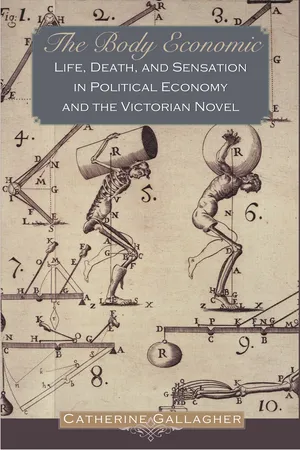
eBook - ePub
The Body Economic
Life, Death, and Sensation in Political Economy and the Victorian Novel
- 224 pages
- English
- ePUB (mobile friendly)
- Available on iOS & Android
eBook - ePub
The Body Economic
Life, Death, and Sensation in Political Economy and the Victorian Novel
About this book
Information
Publisher
Princeton University PressYear
2009Print ISBN
9780691136301
9780691123585
eBook ISBN
9781400826841
Chapter One
The Romantics and the Political Economists
How did political economy come to have such a bad odor among the most prominent literary figures of the early nineteenth century? Answering this question has lately proved more difficult than literary historians previously believed, for they used to be content to generalize about the natural antagonism between “organic” and “mechanistic” ways of thinking, or to gesture toward the rift between “enlightenment empiricism” and “Romantic idealism.” Now literary and intellectual historians, however, are piecing together a complex picture, which relies less heavily on the self-representations of the “Lake Poets,” especially Samuel Taylor Coleridge and Robert Southey.1 Instead of taking the antagonism for granted, scholars are analyzing it in some detail, and they are uncovering both the multiple contexts of the disagreements and some surprising commonalities between British political economy and Romanticism. In this chapter I will sketch the development of hostilities, from the outraged reaction to the first editions of Thomas Robert Malthus’s Essay on Population, through disagreements about the national economy during the Napoleonic War years, and into disputes (some might say misunder-standings) about the nature of labor, value, and happiness. But I will also explore the unacknowledged shared premises, the larger discursive agreements that made the terms of the controversies intelligible to both sides.
I hope to show that Romanticism and political economy should be thought of as competing forms of “organicism,”2 both of which flourished in Britishradical thought at the turn of the century, and both of which fostered skepticism toward what they presented as their immediate predecessors’ unrealistic faith in an idealized human rationality. The political economists, like the Romantics, privileged natural processes, operating according to intrinsic and lifelike dynamics, over what they regarded as artificial ones, mechanically constructed and willfully directed from without. Moreover, vital and natural processes served not only as analogies in the social visions of political economists and Romantics but also as the literal forces driving human behavior. Romantics and political economists attributed cohesion, conflict, change, and stability not to political direction from above but to the embodied experiences of the mass of the people: their lives and deaths, desires and frustrations, pains and pleasures.
Finally, I hope to show that Romantic notions of aesthetic value, as well as Romantic social commentary, connected and clashed with classical political economy’s theories of value because corporeal and sensational experience were central to both. Each posited necessary conjunctures between the expense of life and the production of value, between suffering and owning, between investing vital energy in an object and making it transferable to others, but they described the connections in irreconcilable ways. This chapter will look at several explanations for the collision between Romantic writers and political economists over these issues— for example, the Romantics tended to take a peculiar form of work (their own) as paradigmatic of labor in general— but the first thing to notice is that the conflict could never have been so sharp if they had not been fighting over common ground.
POPULATION: SEX AND FOOD
The earliest overt controversy between the two groups clearly reveals their joint preoccupation with organic life, for it concerns the basic bodily issues of sexuality, reproduction, and food.3 When Thomas Robert Malthus’s An Essay on Population (first published in 1797) provoked their indignation on these topics, Coleridge and Southey were not yet called “Romantics” and Malthus was not yet known as a political economist. Indeed, the resemblances among the three men might have seemed more obvious to contemporaries than their differences, for although the social thought of each was in flux, they were all affiliated with those circles loosely designated “radical.” In 1800 Coleridge may have abandoned his faith in the French Revolution, but Southey had not, and both men still hoped for democratic change in Britain, as did Malthus’s family and friends. His Essay was also the fruit of British radicalism, albeit of a different strain.
In the 1790s, while support for franchise reform was the definitive marker of radicalism, many varieties of the species flourished in relative harmony. Christians like Coleridge and Southey took inspiration from secularists like William Godwin, while Godwin, advocating an eventual voluntary sharing of wealth, seemed to resemble Jeremy Bentham, who put his trust in self-interest, because both supported the widest possible franchise on utilitarian grounds. In the new century, however, divisions among radicals were to become more fixed and obtrusive. In particular, the brand that came to be called “philosophical radicalism,” the Benthamite variety championing parliamentary reform while stressing self-interest, was increasingly distinguished from more communitarian radicalisms. And, although the classical canon of political economy was largely unwritten when the century began, its line of development in the next three decades continually intertwined the discipline with Benthamite presuppositions. Malthus (and the political economists who were to follow), therefore, advanced one tendency within British radicalism, Coleridge and Southey advanced another, and the growing antipathy between Romanticism and political economy can partly be traced to their earlier political commonality.
Malthus’s An Essay on Population and the reaction to it reveal not only that the antagonism between protopolitical economy and incipient Romanticism was internal to British radicalism at the turn of the century but also that several varieties of radical thought were placing a new emphasis on the lived experience, especially the sensational life, of the common people. The Essay was conceived inside this radical tradition and drew entirely from its stock of ideas, but it partly framed itself as a quarrel with one of radicalism’s greatest heroes, William Godwin. Malthus set out to prove that, contrary to some fatuous remarks made by Godwin in the Enquiry Concerning Political Justice and Its Influence on Morals and Happiness (1793), 4 there are known limits to the “future improvement of society”— a thesis that, as many early reviewers noted, was hardly controversial. But Malthus’s way of supporting his thesis and the practical consequence he drew from it were highly controversial, and both challenged optimistic expectations of human progress. His assertion that population increases always outstrip increases in the food supply unless they are brought into equilibrium through misery (starvation, sexual abstinence, late marriage) or vice (prostitution, birth control, infanticide) went directly against Godwin’s prediction that people would someday become so reasonable and temperate in their passions that they would be able to control reproduction at will. Godwin forecast a time when men and women, without the prodding of a government, would divide their wealth equitably, form virtuous attachments without the need for patriarchal marriage, and consider their offspring (whose numbers would be limited by the relative passionlessness of the prevailing manners) to be the responsibility of the community as a whole.
Instead of accusing Godwin of sedition and impiety, as conservative critics had, Malthus calmly demonstrated that Godwin’s utopian vision was impossible because it rested on the unsubstantiated premise that truly rational social arrangements would diminish the passion between the sexes. Malthus argued that sexual desire is as constant a feature of human nature as the need for food, and he is one of the first modern thinkers to insist that sexual intercourse is both ineradicable and essential to human happiness. Malthus strengthened the side of British radicalism that emphasized the motivating force of bodily pleasure and made the needs of desiring bodies the basis of economic thought. Healthy, procreative sexual passion, he insisted, “seems to be that sort of mixture of sensual and intellectual enjoyment particularly suited to the nature of man, and most powerfully calculated to awaken the sympathies of the soul and produce the most exquisite gratifications.”5 Godwin, he charged, was a desiccated, heartless repressor of this legitimate enjoyment: “Those who from coldness of constitutional temperament have never felt what love is, will surely be allowed to be very incompetent judges with regard to the power of this passion to contribute to the sum of pleasurable sensations of life” (76).
Malthus’s intention, historians now claim, was to refute Godwin within the assumptions of latitudinarian English natural theology, 6 but many of his contemporaries were scandalized by what appeared to be his sensual materialism, and he was immediately accused of adopting a base and irreligious view of human nature. That accusation, indeed, is reiterated four times in Robert Southey’s angry review of the second edition of the Essay. The review appeared in 1803, and it closely follows marginal notes that Coleridge made in his copy of Malthus, so it seems to reflect the views of both poets and exposes another fissure that had earlier been present within English radicalism between those whose social thought was religiously inflected and those who kept their discourse within secular confines. Even in their most revolutionary youth, Coleridge and Southey had spoken in the idiom of Protestant Dissenting radicalism, modeling their activities on those of the early Christian church, and advocating “The republic of God’s own making.”7 They made common cause with secularists in the eighteenth century because both opposed the Anglican Church establishment, but as early as 1796, Godwin’s sexual politics had already drawn a reproof from Coleridge, who accused him of pandering to sensuality8 — just the reverse of Malthus’s critique. And the rifts between Christian and freethinking radicals became more apparent in the next century. Coleridge and Godwin became friends again in the 1800s, but by that time, Godwin was moving away from his earlier atheism. So, although Southey’s review excoriates Godwin’s as well as Malthus’s thoughts on reproduction and sexuality, it continues a tendency within British radicalism that sought social change in conformity with a reformed and purified Christianity.
How, then, can I claim that Southey and Coleridge helped locate the happiness of the common body at the center of social discourse? The evidence, at first glance, would tend to point in the opposite direction, toward the promotion of spiritual over physical well-being. “The whole [of Malthus’s argument],” Southey claimed, “proceeds upon the assumption, that lust and hunger are alike passions of physical necessity, and the one equally with the other independent of the reason and the will.”9 He hammered away at the Essay’s apparent biological determinism, opposing it to a belief in the active power of Christian virtue: “There lives not a wretch corrupt enough of heart, and shameless enough of front to say that this is so: there lives not a man who can look upon his wife and his daughter, who can think upon his sister, and remember her who bore him, without feeling indignation and resentment that he should be insulted by so infamous an assertion” (296). Malthus’s sensualism, he insisted, is not only lewd but also blasphemous because it implies that God created human beings who are helplessly in the grip of an overpowering instinct and doomed either to misery or sinfulness. Southey the Christian radical sided with Godwin in blaming corrupt human institutions for the existence of misery and vice, for to blame the human organism is only, by extension, to blame God: “it remains to be seen . . . whether we are to complain of the folly of man, or of the will of God, for this is the alternative. Let not the impiety of the question be imputed to us!” (297).
The opposition between Christian free will10 and materialist determinism that Southey framed in this review may have obscured Malthus’s theological intentions, but it remained a continuous underlying current in the stream of attacks on political economy that flowed from the first generation of Romantic writers. It should not, however, lead us to underestimate the Romantics’ own commitments to increasing the material welfare, comfort, and pleasure of the general population. Southey accused Malthus of overstating the role of sexual feeling in human happiness, but he did not discount earthly pleasure as a primary goal or recommend that the poor should transcend their desires. Indeed, he censured Malthus’s pessimism about making significant improvements in the physical lives of the poor. Ironically, Malthus’s seemingly scientific sensualism (however integrated into a meliorist theodicy) guided him to bleak conclusions about the material advantages of political reform, whereas the poets’ volunteerism gave them faith in a more general future abundance. So in addition to attacking his sexual determinism in 1803, Southey excoriates Malthus’s seeming indifference to the physical plight of the poor. Malthus acknowledged that propertyless laborers (the vast majority of the population) disproportionately suffered the miseries attending the pressure of population. It was they who lacked the resources to raise healthy children and whose offspring went hungry or died in infancy. The vices of the rich (prostitution and birth control, for example, which acted as “preventive checks” to population) were too expensive for them, so their passion often had no outlet other than in reproductive sexuality, which resulted in the “positive checks” of starvation, disease, or infanticide. To decrease the burden of their misery, Malthus argued that they should be discouraged from marrying early and bearing many children; he thought they should be encouraged to suffer the unhappiness of abstinence instead of the greater wretchedness of starvation and death. Consequently, he opposed the practice of giving impoverished couples extra relief for each child they had, noting that, in the long term, such a policy only lowered wages by producing a suppl...
Table of contents
- Table of Contents
- ACKNOWLEDGMENTS
- Introduction
- Chapter One The Romantics and the Political Economists
- Chapter Two Bioeconomics and Somaeconomics: Life and Sensation in Classical Political Economy
- Chapter Three Hard Times and the Somaeconomics of the Early Victorians
- Chapter Four The Bioeconomics of Our Mutual Friend
- Chapter Five Daniel Deronda and the Too Much of Literature
- Chapter Six Malthusian Anthropology and the Aesthetics of Sacrifice in Scenes of Clerical Life
- Afterword
Trusted by 375,005 students
Access to over 1.5 million titles for a fair monthly price.
Study more efficiently using our study tools.
Frequently asked questions
Yes, you can cancel anytime from the Subscription tab in your account settings on the Perlego website. Your subscription will stay active until the end of your current billing period. Learn how to cancel your subscription
No, books cannot be downloaded as external files, such as PDFs, for use outside of Perlego. However, you can download books within the Perlego app for offline reading on mobile or tablet. Learn how to download books offline
Perlego offers two plans: Essential and Complete
- Essential is ideal for learners and professionals who enjoy exploring a wide range of subjects. Access the Essential Library with 800,000+ trusted titles and best-sellers across business, personal growth, and the humanities. Includes unlimited reading time and Standard Read Aloud voice.
- Complete: Perfect for advanced learners and researchers needing full, unrestricted access. Unlock 1.5M+ books across hundreds of subjects, including academic and specialized titles. The Complete Plan also includes advanced features like Premium Read Aloud and Research Assistant.
We are an online textbook subscription service, where you can get access to an entire online library for less than the price of a single book per month. With over 1.5 million books across 990+ topics, we’ve got you covered! Learn about our mission
Look out for the read-aloud symbol on your next book to see if you can listen to it. The read-aloud tool reads text aloud for you, highlighting the text as it is being read. You can pause it, speed it up and slow it down. Learn more about Read Aloud
Yes! You can use the Perlego app on both iOS and Android devices to read anytime, anywhere — even offline. Perfect for commutes or when you’re on the go.
Please note we cannot support devices running on iOS 13 and Android 7 or earlier. Learn more about using the app
Please note we cannot support devices running on iOS 13 and Android 7 or earlier. Learn more about using the app
Yes, you can access The Body Economic by Catherine Gallagher in PDF and/or ePUB format, as well as other popular books in Literature & Economic Theory. We have over 1.5 million books available in our catalogue for you to explore.