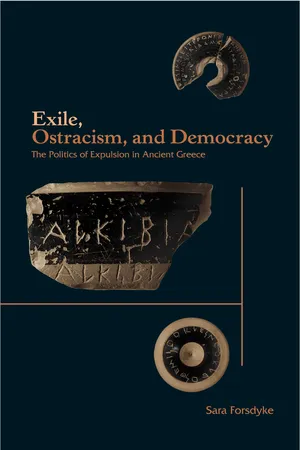
This book explores the cultural and political significance of ostracism in democratic Athens. In contrast to previous interpretations, Sara Forsdyke argues that ostracism was primarily a symbolic institution whose meaning for the Athenians was determined both by past experiences of exile and by its role as a context for the ongoing negotiation of democratic values.
The first part of the book demonstrates the strong connection between exile and political power in archaic Greece. In Athens and elsewhere, elites seized power by expelling their rivals. Violent intra-elite conflict of this sort was a highly unstable form of "politics that was only temporarily checked by various attempts at elite self-regulation. A lasting solution to the problem of exile was found only in the late sixth century during a particularly intense series of violent expulsions. At this time, the Athenian people rose up and seized simultaneously control over decisions of exile and political power. The close connection between political power and the power of expulsion explains why ostracism was a central part of the democratic reforms.
Forsdyke shows how ostracism functioned both as a symbol of democratic power and as a key term in the ideological justification of democratic rule. Crucial to the author's interpretation is the recognition that ostracism was both a remarkably mild form of exile and one that was infrequently used. By analyzing the representation of exile in Athenian imperial decrees, in the works of Herodotus, Thucydides, Plato, Aristotle, and in tragedy and oratory, Forsdyke shows how exile served as an important term in the debate about the best form of rule.
eBook - ePub
Exile, Ostracism, and Democracy
The Politics of Expulsion in Ancient Greece
- 376 pages
- English
- ePUB (mobile friendly)
- Available on iOS & Android
eBook - ePub
About this book
Information
Table of contents
- Table of Contents
- ACKNOWLEDGMENTS
- CHRONOLOGY
- Introduction Problems, Methods, Concepts
- Chapter One Setting the Stage Intra-elite Conflict and the Early Greek Polis
- Chapter Two The Politics of Exile and the Crisis of the Archaic Polis Four Case Studies: Mytilene, Megara, Samos, and Corinth
- Chapter Three From Exile to Ostracism The Origins of Democracy in Athens, circa 636–508/7
- Chapter Four Ostracism and Exile in Democratic Athens
- Chapter Five Exile and Empire Expulsion in Inter-State Politics
- Chapter Six Exile in the Greek Mythical and Historical Imagination
- CONCLUSION
- Appendix One: The Date of the Athenian Law of Ostracism
- Appendix Two: Ostracism outside Athens
- Appendix Three: Exile in Spartan Myth and History
- BIBLIOGRAPHY
Trusted by 375,005 students
Access to over 1.5 million titles for a fair monthly price.
Study more efficiently using our study tools.
Frequently asked questions
Yes, you can cancel anytime from the Subscription tab in your account settings on the Perlego website. Your subscription will stay active until the end of your current billing period. Learn how to cancel your subscription
No, books cannot be downloaded as external files, such as PDFs, for use outside of Perlego. However, you can download books within the Perlego app for offline reading on mobile or tablet. Learn how to download books offline
Perlego offers two plans: Essential and Complete
- Essential is ideal for learners and professionals who enjoy exploring a wide range of subjects. Access the Essential Library with 800,000+ trusted titles and best-sellers across business, personal growth, and the humanities. Includes unlimited reading time and Standard Read Aloud voice.
- Complete: Perfect for advanced learners and researchers needing full, unrestricted access. Unlock 1.5M+ books across hundreds of subjects, including academic and specialized titles. The Complete Plan also includes advanced features like Premium Read Aloud and Research Assistant.
We are an online textbook subscription service, where you can get access to an entire online library for less than the price of a single book per month. With over 1.5 million books across 990+ topics, we’ve got you covered! Learn about our mission
Look out for the read-aloud symbol on your next book to see if you can listen to it. The read-aloud tool reads text aloud for you, highlighting the text as it is being read. You can pause it, speed it up and slow it down. Learn more about Read Aloud
Yes! You can use the Perlego app on both iOS and Android devices to read anytime, anywhere — even offline. Perfect for commutes or when you’re on the go.
Please note we cannot support devices running on iOS 13 and Android 7 or earlier. Learn more about using the app
Please note we cannot support devices running on iOS 13 and Android 7 or earlier. Learn more about using the app
Yes, you can access Exile, Ostracism, and Democracy by Sara Forsdyke in PDF and/or ePUB format, as well as other popular books in History & Greek Ancient History. We have over 1.5 million books available in our catalogue for you to explore.