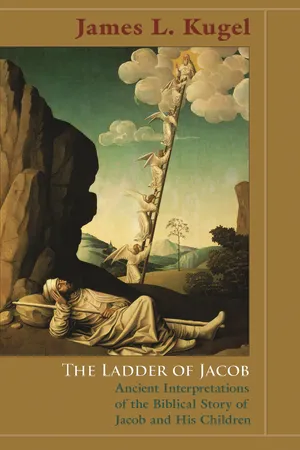
Rife with incest, adultery, rape, and murder, the biblical story of Jacob and his children must have troubled ancient readers. By any standard, this was a family with problems. Jacob's oldest son Reuben is said to have slept with his father's concubine Bilhah. The next two sons, Simeon and Levi, tricked the men of a nearby city into undergoing circumcision, and then murdered all of them as revenge for the rape of their sister. Judah, the fourth son, had sexual relations with his own daughter-in-law. Meanwhile, jealous of their younger sibling Joseph, the brothers conspired to kill him; they later relented and merely sold him into slavery. These stories presented a particular challenge for ancient biblical interpreters. After all, Jacob's sons were the founders of the nation of Israel and ought to have been models of virtue.
In The Ladder of Jacob, renowned biblical scholar James Kugel retraces the steps of ancient biblical interpreters as they struggled with such problems. Kugel reveals how they often fixed on a little detail in the Bible's wording to "deduce" something not openly stated in the narrative. They concluded that Simeon and Levi were justified in killing all the men in a town to avenge the rape of their sister, and that Judah, who slept with his daughter-in-law, was the unfortunate victim of alcoholism.
These are among the earliest examples of ancient biblical interpretation (midrash). They are found in retellings of biblical stories that appeared in the closing centuries BCE--in the Book of Jubilees, the Aramaic Levi Document, the Testaments of the Twelve Patriarchs, and other noncanonical works. Through careful analysis of these retellings, Kugel is able to reconstruct how ancient interpreters worked. The Ladder of Jacob is an artful, compelling account of the very beginnings of biblical interpretation.
ne question that troubled ancient readers of the Bible was that of the purpose of the book of Genesis. This first book of the Torah (Pentateuch) was in some ways the most problematic. Those that followed—Exodus, Leviticus, Numbers, Deuteronomy—all contain divinely given laws, so their purpose was clear enough: they were written in order to guide people along the proper path in life. But Genesis has no laws or commandments to speak of; it is a collection of stories about Israel’s ancient ancestors, starting with Adam and Eve and leading up to the founders of the Israelite nation, Jacob and his twelve sons. Now, history may be interesting, even important, but to a certain way of thinking, history per se does not deserve a place in the Torah. Why, then, was the book of Genesis included?1
Various answers were given to this question in ancient times.
The author of the book of Jubilees (early second century B.C.E.), for example, understood Genesis to be a crypto-halakhic work; that is, although it has no overt laws per se, he maintained, its stories nonetheless contain legal teachings in hidden form, alluding here and there to divine commandments and practices that had been instituted with Israel’s ancestors long before the great revelation of biblical law at Mount Sinai. Philo of Alexandria (ca. 20 B.C.E to ca. 30 C.E.), somewhat analogously, saw the various people whose lives are recounted in Genesis as walking embodiments of the laws that were to be given later on at Mount Sinai. Many writers from the time of Philo and afterward, including the founders of Christianity and rabbinic Judaism, saw the heroes and heroines of Genesis as moral exemplars, whose lives might serve as models for generations to come. This last, indeed, has been the dominant approach to the book of Genesis from late antiquity almost to the present day.
But when it comes down to cases, this last approach runs into problems, particularly with regard to Jacob and his family. Jacob himself begins life as a bit of a sharpster: he cheats his brother Esau out of his rightful inheritance as the firstborn of the family, then tricks his poor, blind father into giving him a paternal blessing intended for Esau. Next Jacob travels to his uncle Laban’s house, where he ends up acquiring, apparently by somewhat questionable methods, most of Laban’s flocks (a prime form of wealth in ancient Israel). Thereafter he departs, like a thief in the night, for his homeland of Canaan. Meanwhile, Jacob’s wife Rachel, Laban’s daughter, is shown in a hardly better light; the narrative reports that she stole her father’s sacred images (teraphim), then hid them in her saddlebags and lied to him to prevent their discovery. Of Jacob’s children, one ends up sleeping with his father’s concubine and another ends up having relations with his own son’s wife. When Jacob’s only daughter ends up being raped, her brothers respond by invading the rapist’s town and killing every man in it, subsequently plundering all the townsmen’s flocks and possessions, including wives and children.Sometime after that, Jacob’s sons seize their younger brother Joseph, strip off his clothes, and throw him into a pit with the intention of killing him; then they relent and merely sell him as a slave to a passing caravan. “Dysfunctional” is probably the first word an observer would use to describe such a family in modern times; but whatever word is used, one would be hard-pressed, on the face of things, to claim that these stories about Jacob and his children could ever have been intended to provide readers with a set of moral exempla by which to steer their own course in this world.
The logical next sentence in this exposition ought to be, “Enter the biblical interpreter.” If I hesitate to write it, it is because I do not wish to give readers the impression that ancient biblical interpretation is principally a matter of apologetics, touching up the biblical portrayal of various figures to remove most of their faults and so make them appropriate role models for the Bible’s readers. Interpreters did indeed do such things sometimes, but apologetics was hardly their main purpose. Principally, they were interested in making sense of biblical narratives, laws, prophecies, and prayers; in particular, they addressed themselves to narrative gaps and other omissions, to apparent contradictions, and sometimes to historical references or words that were no longer understood. The questions they sought to answer—particularly the most ancient of ancient interpreters—were, Why, and how, did X do what he did? How am I to go about carrying out this law today? What was this prophet talking about, and what does it matter to us? Or sometimes simply, What do these words mean?
It is true, however, that the search for answers to such questions was hardly conducted according to the rules of modern biblical interpretation. Ancient interpreters approached their task with certain presuppositions, and some have already been hinted at above. The Bible, and particularly its first five books, comprised for them a divinely given guide; therefore, everything within it had a lesson to impart. The Torah was, in this sense, a supremely relevant book and not just a remnant from the ancient past. At the same time, its teachings were not always obvious; indeed, ancient interpreters assumed that much of the Bible spoke cryptically, saying X when what it really meant was Y. The third presupposition was that the Bible was one harmonious, perfect document. That is, although written down over a long period of time, by different authors in different circumstances, it was nonetheless without mistakes or inconsistencies or internal contradictions; indeed, in the extreme formulation, no word of it was extraneous. The fourth presupposition was that the biblical text as a whole, despite its references to human authors and its apparent distinction between words specifically attributed to God and the rest of its words, had altogether come from God or at God’s command or inspiration, so that it was essentially a divine text, the very word of God. It is these four assumptions that animate all of ancient biblical interpretation.2
THE DEVELOPMENT OF EXEGETICAL MOTIFS
The present volume consists of a series of studies of ancient biblical interpretation, all of which center on the person of Jacob and his immediate family. Its particular focus is not so much on the what of ancient biblical interpretation (a subject I have tried to survey in some detail elsewhere)3 as on the how of its development, including, prominently, an attempt to untangle the interrelationship of various interpretive texts and traditions. In order to pursue this subject, it may be well to define here some of the terms frequently used in the following chapters.
Ancient biblical interpretation is an interpretation of biblical verses, not of whole chapters or stories or larger units. Even when interpreters had their eyes on the larger context, they always framed the question they sought to answer in terms of a specific verse, or more typically, one or two words prominent in that verse. In other words, they asked, Why does Jacob set up a pillar
in Gen. 28:18 instead of building an altar and sacrificing to God? What is the connection between the brief account of Reuben’s sin with Bilhah in Gen. 35:22 and the next verse, “And Jacob had twelve sons”? What does God mean by referring to Jacob as his “firstborn son” in Exod. 4:22? The answers given to such questions usually went well beyond the verses mentioned and touched on wider issues in the sequence of events in the narrative—indeed, on Jacob’s overall character in Genesis and even such matters as the election of Israel, God’s role in human affairs, and sin and forgiveness—but the starting point for any evocation of such larger issues was always the precise wording of a particular phrase or verse. (This phrase or verse may also be referred to as the biblical site of an interpretive tradition.)
So it was that ancient biblical interpretation traveled in little packets, called exegetical motifs . An exegetical motif is an explanation of the meaning of a biblical verse, especially a potentially problematic one, or even of a phrase or a word within that verse. In this book, exegetical motifs are given descriptive titles, enclosed in quotation marks: “Angels Descended to Admire Jacob,” “Rise and Fall of Empires,” “Killed One Each,” “City with a Criminal Past,” and so forth.4 The explanations of biblical verses embodied in these motifs were passed on orally, from person to person and from generation to generation, as an accompaniment to the biblical text itself. Thus, if a person were to ask, “How did two men manage to conquer and kill an entire city?” the answer would probably be some version of the exegetical motif, “Swords from Heaven,” a motif that interpreted Gen. 34:25 as hinting that Simeon and Levi had acquired special armaments that allowed them to accomplish this improbable feat. Similarly, the answer to “Why were all the men of Shechem killed because of the rape of Dinah?” would be framed in terms of one or another exegetical motif dealing with a specific verse, for example, “The Other Shechemites Participated,” a motif built on a particular word in Gen. 34:27.
Sometimes, the same basic explanation of the meaning of a particular verse can exist in different forms; these are called variants of the same basic motif. For example, the basic motif “Staircase of History” has two variants, one involving a series of twelve successive periods of domination, the second involving four foreign empires that were to dominate Israel. Often, two or more different motifs were created for the same verse; these are called rival motifs. For example, “Staircase of History” and “Rise and Fall of Empires” are two rival motifs both seeking to explain a certain detail in the account of Jacob’s dream in Genesis 28.
Exegetical motifs are explanations of verses—all kinds of verses, verses found in laws, prophecies, songs, and so forth. When they are found in biblical narrative, they often give rise to narrative expansions, that is to say, little bits of narrative that are added to the retelling of a biblical story. For example, the motif “Saw Bilhah Bathing”—which originated as an explanation of a problematic phrase in Gen. 49:4—gave rise to a narrative expansion in the book of Jubilees, which, in retelling the biblical story, specifies that on one occasion Reuben had seen his father’s concubine bathing in a certain place and that it was this that caused him later to sin. An exegetical motif is by nature abstract: it is an idea, a way of explaining a verse. A narrative expansion is always specific, the particular words of a particular text in which an exegetical motif is embodied. For example, the narrative expansion of the motif “Saw Bilhah Bathing” in the book of Jubilees is essentially the same as the narrative expansion of “Saw Bilhah Bathing” in the Testament of Reuben—no surprise, since the author of the latter was apparently well acquainted with the former and copied much material. But sometimes narrative expansions will differ in one or more elements, significant details that distinguish one narrative expansion from another. For example, the motif “Bilhah Was Asleep,” common to these same two texts, is embodied in two somewhat different narrative expansions: in the Testament of Reuben it is specified that Bilhah was intoxicated and unconscious, whereas this element is not present in Jubilees.
Ancient biblical interpretation did not develop overnight but over the course of several centuries. So it was that the existence of one exegetical motif often contributed to the creation of another. The motif “Abraham Saw a Dire Future,”5 aimed at explaining Gen. 15:12, probably influenced the creation of the “Rise and Fall of Empires” and “Staircase of History” motifs, although the latter two pertained to an entirely different biblical narrative. Sometimes the same motif will be applied to two different sites, that is, it may be offered as an explanation of two quite separate verses (often with less than perfect results): this is the phenomenon of midrashic doublets. It also happens that an exegetical motif originally designed to explain one biblical verse will come to be associated—wrongly—with another site entirely. This is called transfer of affects.6
Finally, it should be noted that ancient interpreters—the creators of what were to become interpretive traditions—were themselves usually very respectful of earlier interpreters and their traditions. Thus, if interpreters were aware of two rival motifs, each of which explained a certain verse in its own way, they often would incorporate both in their retelling of a biblical story. The same might be true even of two narrative expansions embodying the same exegetical motif but differing from each other in one or more elements; a later ancient interpreter might blend, or simply confuse, the two previous narrative expansions in his own, new retelling. So it was that the phenomenon of overkill was created, whereby a single retelling of a biblical text may contain two quite independent explanations of how an event occurred, or wh...
Table of contents
Cover
Title
Copyright
Dedication
Contents
Acknowledgments
List of Abbreviations
Chapter One Jacob and the Bibles Ancient Interpreters
Chapter Two The Ladder of Jacob
Chapter Three The Rape of Dinah, and Simeon and Levis Revenge
Chapter Four Reubens Sin with Bilhah
Chapter Five How Levi Came to Be a Priest
Chapter Six Judah and the Trial of Tamar
Chapter Seven A Prayer about Jacob and Israel from the Dead Sea Scrolls
Notes
Index
Trusted by 375,005 students
Access to over 1.5 million titles for a fair monthly price.
Study more efficiently using our study tools.
Frequently asked questions
Yes, you can cancel anytime from the Subscription tab in your account settings on the Perlego website. Your subscription will stay active until the end of your current billing period. Learn how to cancel your subscription
No, books cannot be downloaded as external files, such as PDFs, for use outside of Perlego. However, you can download books within the Perlego app for offline reading on mobile or tablet. Learn how to download books offline
Perlego offers two plans: Essential and Complete
Essential is ideal for learners and professionals who enjoy exploring a wide range of subjects. Access the Essential Library with 800,000+ trusted titles and best-sellers across business, personal growth, and the humanities. Includes unlimited reading time and Standard Read Aloud voice.
Complete: Perfect for advanced learners and researchers needing full, unrestricted access. Unlock 1.5M+ books across hundreds of subjects, including academic and specialized titles. The Complete Plan also includes advanced features like Premium Read Aloud and Research Assistant.
Both plans are available with monthly, semester, or annual billing cycles.
We are an online textbook subscription service, where you can get access to an entire online library for less than the price of a single book per month. With over 1.5 million books across 990+ topics, we’ve got you covered! Learn about our mission
Look out for the read-aloud symbol on your next book to see if you can listen to it. The read-aloud tool reads text aloud for you, highlighting the text as it is being read. You can pause it, speed it up and slow it down. Learn more about Read Aloud
Yes! You can use the Perlego app on both iOS and Android devices to read anytime, anywhere — even offline. Perfect for commutes or when you’re on the go. Please note we cannot support devices running on iOS 13 and Android 7 or earlier. Learn more about using the app
Yes, you can access The Ladder of Jacob by James L. Kugel in PDF and/or ePUB format, as well as other popular books in Theology & Religion & Biblical Commentary. We have over 1.5 million books available in our catalogue for you to explore.