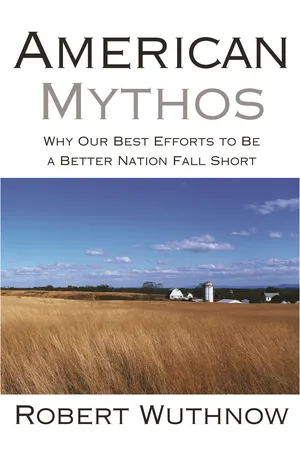
America was built on stories: tales of grateful immigrants arriving at Ellis Island, Horatio Alger-style transformations, self-made men, and the Protestant work ethic. In this new book, renowned sociologist Robert Wuthnow examines these most American of stories--narratives about individualism, immigration, success, religion, and ethnicity--through the eyes of recent immigrants. In doing so, he demonstrates how the "American mythos" has both legitimized American society and prevented it from fully realizing its ideals.
This magisterial work is a reflection and meditation on the national consciousness. It details how Americans have traditionally relied on narratives to address what it means to be strong, morally responsible individuals and to explain why some people are more successful than others--in short, to help us make sense of our lives. But it argues that these narratives have done little to help us confront new challenges. We pass laws to end racial discrimination, yet lack the resolve to create a more equitable society. We welcome the idea of pluralism in religion and values, yet we are shaken by the difficulties immigration presents. We champion prosperity for all, but live in a country where families are still homeless.
American Mythos aptly documents this disconnect between the stories we tell and the reality we face. Examining how cultural narratives may not, and often do not, reflect the reality of today's society, it challenges readers to become more reflective about what it means to live up to the American ideal.
- 304 pages
- English
- ePUB (mobile friendly)
- Available on iOS & Android
eBook - ePub
About this book
Information
Publisher
Princeton University PressYear
2009Print ISBN
9780691138558
9780691125046
eBook ISBN
9781400827022
CHAPTER 1

DEEP CULTURE AND
DEMOCRATIC RENEWAL
How does a society renew itself? What exactly does renewal mean? The news media daily tell us of serious national problems that require our attention. The message of these headlines is that the public, our leaders, and we individually must rekindle our efforts to solve these problems. Today’s newspaper, for instance, informs me that the number of Americans unable to find jobs has been growing even though con-sumer spending, factory orders, new equipment, and a rising stock market all point to a stronger economy. The question is whether our commitment to full employment is flagging and, if so, what we should do about it. Lawmakers are debating whether to support another round of efforts to pass gun control legislation, while a suspect in one western state is accused of having murdered forty-eight people. Disgruntled personnel at the Justice Department have released an internal memo suggesting that racial discrimination is still a problem in that agency. U.S. officials question how long the military may have to remain in one of the countries the United States has invaded; other officials are being accused of cronyism in handing out government contracts. Public opinion polls sup-ply further indications of the problems we experience. When asked what the most important problem is, the public typically puts economic concerns, such as unemployment, taxes, the national deficit, and inflation, at the top of the list, followed by worries about corporate corruption, terrorism, crime, and the dearth of affordable health care. Yet the question of renewal transcends such specific problems as these. Concerns about unemployment, crime, and cronyism come to our attention through journalistic exposés and sometimes through routine statistical investigations. Social science sometimes plays a role in identifying the scope and sources of social problems. Under favorable circumstances, task forces are formed and legislation is passed to remedy these problems. However, the question of renewal is not so easily addressed. It implies a need to think about the whole of society, rather than the specific problems trumpeted in the daily press.
The United States has a well-established tradition of thinking about renewal in somewhat broader terms than those of the morning’s head-lines. Much of this thinking has taken shape through social reform movements. Many of the framers of the Constitution were still alive when the first national reform organizations began demanding that the nation turn from its erroneous ways. Bible societies emerged in the early decades of the nineteenth century to redress the worrisome state of morals on the expanding frontier. Antislavery agitators called for the abolition of what they described as an evil institution. In subsequent decades, other reform movements emerged—suffragists, free traders, missionaries, nativists, the single tax movement, the anti-imperialist league, prohibition, and of course the labor movement. As a society, we have often held the reformer in high regard. “Though the life of the Reformer may seem rugged and arduous, it were hard to say considerately that any other were worth living at all,” wrote Horace Greeley in 1869. “The earnest, unselfish Reformer—born into a state of darkness, evil, and suffering, and honestly striving to replace these by light, and purity, and happiness—he may fall and die, as so many have done before him, but he cannot fail.”1 Reform movements, as Greeley asserts, are a struggle between good and evil. Their leaders call for renewed dedication against the forces of darkness, often drawing explicitly on the religious imagery that pits evil and darkness against goodness and light. Historians suggest that the reform tradition has been especially strong because the nation’s self-identity has been so closely associated with this biblical imagery. The United States was to be a new Eden, a paradise in the wilderness, and a place where life would be better than it had been before, and where God’s purposes could be more fully realized. Americans, the literary critic R.W.B. Lewis wrote, saw “the world as starting up again under fresh initiative, in a divinely granted second chance for the human race, after the first chance had been so disastrously fumbled in the darkening Old World.”2 America was, in this view, itself an important instance of social and cultural renewal. Yet the business of reform is usually concerned with correcting a specific wrong, such as slavery or prostitution, rather than renewing an entire society. Especially in the more secular context of contemporary politics, reform movements are like task forces and policy recommendations, only rooted more broadly in grassroots mobilization.
The question of renewal is less about politics and fundamentally more about culture. It is concerned with basic values and with taken-for-granted understandings of what it means to be good people and to live responsibly in a good society. Renewal in this sense is seldom concerned with anything as specific as public policy or social reform, although it may accompany both of these.3 Renewal can sometimes be associated with a particular call by a community leader or an appeal by a public figure, such as a television preacher calling on the nation to repent. How-ever, cultural renewal is usually harder to identify because it consists of many calls and many appeals, often focusing on specific problems but implicitly raising hope that we can be better in the future than we have been in the past.
The search for renewal arises from profound unease about the way things are going, as when a public opinion poll finds that a large segment of the population believes the nation is on the wrong track. “It’s clear that the true problems of our nation are much deeper—deeper than gasoline lines or energy shortages, deeper even than inflation or recession,” President Carter said in his famous “malaise speech” on July 15,1979. “The threat is nearly invisible in ordinary ways. It is a crisis that strikes at the very heart and soul and spirit of our national will.” When the problem is a matter of the heart, the call for renewal becomes an appeal to reexamine our deepest commitments—“the path of common purpose and the restoration of American values,” Carter said.4
The search for renewal is often prompted by an accumulation of bad news suggesting that something more is wrong than any of the specific indicators suggest—indicators such as declining voter participation, weakening involvement in voluntary associations, rising crime rates, and high levels of child and spousal abuse. Carter’s speech was inspired not only by energy shortages and inflation, but also by the lingering mistrust of government engendered by the Watergate episode and America’s worsening situation in the Middle East. On such occasions, it is common for writers and public leaders to ask whether something is amiss with how we are spending our time and how we are raising our children. In their widely read Habits of the Heart, the sociologist Robert N. Bellah and his coauthors argued that America was in growing jeopardy from what they termed “expressive individualism,” a public language of feelings and self-interest that made it difficult even to speak intelligently about the common good.5 They were not arguing that tax reforms or better leadership could heal the nation’s woes; the problem was deeper, buried in cultural assumptions and in language so familiar that we failed to realize its consequences. The book’s popularity suggested that it resonated with many Americans’ intensifying worries about the direction of our society. As the twentieth century ended, many observers also wrote about the need to renew our communities and our sense of civic purpose. Few of these writings were as empirically grounded as the political scientist Robert D. Putnam’s Bowling Alone, which examined numerous indicators of declining civic participation and called for Americans to rebuild their communities one church picnic, one soup kitchen, and one bowling league at a time.6
In recent years, questions about the need for renewal have also increasingly arisen from reports about how our nation is perceived abroad. It is harder to be complacent about the American way of life when polls in other nations show widespread criticism, not only of American policy, but also of American lifestyles and values.7 The public’s response may be to hunker down or to argue defensively that others are just envious of our freedom and affluence. Such criticism nevertheless strikes a nerve. If we truly want to be a good people, we may respond by asking how we can come closer to achieving that ideal.
Apart from specific problems or criticisms, the question of renewal is evoked by the progression of life itself. Things tend to wind down or become outdated. We realize this at least in retrospect. We understand that social life is no longer centered in small towns and rural communities; somewhere along the way, we had to renew our patterns of life, just as we do now in coming to terms with new information technologies and globalization. We know, in addition, that institutions ossify. People fall into routines, and organizations—like the postal service or automobile manufacturers—develop structures that are difficult to change. We need ways of reinvigorating institutions, of rekindling our commitment to making them work as well in the future as they have in the past—if not better.
Usually the call for renewal comes when something is clearly awry, such as declining civic participation, an economic crisis, or mistrust of government officials. In those instances, it becomes possible to make the case for renewal by pointing to empirical evidence showing that things have gotten worse—that there is a downtrend in voter participation, for example, or an increase in crime. Social research serves usefully for making normative arguments. However, questions about the fundamental values of a society can be raised even more forcefully when our best efforts seem to fall short. America’s military intervention in Afghanistan and Iraq after the September 11,2001,attacks is an interesting case in point. The horrific events of that day inspired the Bush administration to resolve that its number one priority would be protecting the nation from terrorist offensives in the future. To that end, and with overwhelming public support, a new administrative agency was formed to coordinate homeland security. American foreign policy was also redefined. Instead of relying on economic sanctions or UN resolutions to deal with potential threats from abroad, and instead of waiting to wage war until there was imminent danger, the United States would now engage in preemptive strikes against governments that harbored terrorists or that stockpiled weapons of mass destruction. Troops were sent almost immediately to Afghanistan and subsequently to Iraq. Billions of dollars were authorized to be spent domestically and abroad on intelligence and national security, on the military, and on reconstruction in Afghanistan and Iraq. Yet it soon became clear that the money, leadership, and national will that had inspired these programs were not producing the desired results. Terrorist groups attracted more recruits than ever, and democratic government in the Middle East proved more elusive than anticipated. It became easy for critics of the Bush administration to argue that its policies were misguided in the first place or had been initiated without sufficient planning. It was just as easy for defenders of administration policies to argue that more resources over a longer time span were needed. However, it was also difficult to ignore the fact that the more Americans tried to effect change with respect to homeland security and the Middle East, the more things stayed the same. We had tried hard to make the world better, or at least safer, and yet our best efforts fell short.
In the most favorable interpretation of these events, we were a democratic society, inspired both by democratic ideals and by a resolve to protect ourselves from terrorist attacks; we were a rich society with unrivaled military power, and we hired the brightest and best-trained officials we could find to lead our efforts. Yet we failed to achieve our objectives. With perfect hindsight, it is clear that our options were limited. More money could have been spent and a different administration could have been in power—the results would probably have been much the same, for no single nation, no matter how powerful, can dictate how the rest of the world should behave. That much is understood.
However, our national efforts to create a better world are also con-strained by our assumptions and values. We are a free society in which freedom of travel, freedom to engage in economic transactions, and freedom from government surveillance of our private lives are deeply valued. We are also a society with vested economic interests in the Middle East, above all in protecting our access to its supply of oil. These are what social scientists call structures—social arrangements, especially of an economic and political sort, that limit the range of options available even to the best-intentioned people and their leaders. Less easily identified are the cultural assumptions that are often just as powerful as the economic and political structures. Cultural assumptions are seldom articulated very clearly or explicitly. They are more likely to appear between the lines or in stories and myths. America’s assumptions about the Middle East, for instance, have been most evident in what the American studies scholar Melani McAlister calls “epic encounters.”8 These are narratives told in religious settings and in motion pictures, as much as in public policy, about the Holy Land, Mesopotamia, and Egypt. They have been told in different ways to different generations, but there are also continuities. McAlister suggests that in recent decades these stories have been greatly influenced by changing views of race, gender, and diversity, and yet the narratives have been powerful enough to incorporate these new ideas without challenging how we think about the Middle East. For instance, our sense of superiority with respect to Arabic culture has, if anything, been reinforced by perceptions that we outdo them in promoting gender and racial equality.
What I am suggesting is that the power of deeply held cultural assumptions may be especially evident when a society mobilizes itself to achieve some laudable end, even to the point of committing considerable resources, and still finds itself a long way from achieving its ideals. In recent memory, the civil rights movement is probably the clearest example of what I have in mind. That movement mobilized a large number of people, gained widespread media attention, and resulted in major legislation concerned with, among other things, ending school segregation and eliminating discrimination in housing and employment. Although there was resistance to these changes at the time, hardly anyone now thinks they should not have been made. We knew that racial discrimination was in clear violation of the ideals of equality and justice on which the nation was founded, and we have been able in retrospect at least to regard the civil rights movement as an important step toward more closely realizing those ideals. Yet we also know that those efforts have not fully succeeded. Racism is still a significant part of our culture. We may blame the problem on history or on human nature, and we may argue about specific policies, such as affirmative action, but we know there is more to the problem than just rolling up our sleeves and formulating better policies.
RENEWALAND DEMOCRACY
The question of renewal is especially pertinent in a democratic society. Although democracies have mechanisms for renewing themselves through an orderly process of elections and representation, they are also precarious. I do not mean that well-established democracies like the United States are in danger of actually collapsing. This happens rarely, if ever.9 I mean rather that the quality of life in a democracy erodes into something less than what democracy was meant to preserve. That has long been a fear among observers of democracy. In the eighth book of the Republic, for instance, Plato described democracy as “the fairest of States . . . an embroidered robe which is spangled with every sort of flower,” but he also warned of democracy’s succumbing to the temptations of power and money that lead to oligarchy, and the “freedom and libertinism of useless and unnecessary pleasures” that result in anarchy. It is from such observations that we inherit the concern that democracy is fragile and that it must renew itself periodically, fortifying the character of its citizens against the desire to rule absolutely or to follow too readily. Complacency is especially to be guarded against, for it turns citizens into drones who “keep buzzing about the bema” without engaging seriously in the give-and-take that must be present for differing opinions and interests to be properly represented.10
The founders of America’s government were keenly aware that theirs was a precarious experiment. “Remember, democracy never lasts long,” John Adams wrote. “It soon wastes, exhausts and murders itself. There never was a democracy yet that did not commit suicide.”11 James Madison, who described democracies as “spectacles of turbulence and contention,” was equally doubtful about their longevity. They “have in general been as short in their lives as they have been violent in their deaths,” he wrote.12 Madison’s solution to the problems posed by pure...
Table of contents
- Table of Contents
- ACKNOWLEDGMENTS
- INTRODUCTION
- CHAPTER 1 Deep Culture and Democratic Renewal
- CHAPTER 2 Quandaries of Individualism
- CHAPTER 3 The Justice of Privilege
- CHAPTER 4 Self-Made Men and Women
- CHAPTER 5 In America, All Religions Are True
- CHAPTER 6 Ethnic Ties That Bind (Loosely)
- CHAPTER 7 Saving Ourselves from Materialism
- CHAPTER 8 Venues for Reflective Democracy
- APPENDIX
- NOTES
- SELECTED BIBLIOGRAPHY
Trusted by 375,005 students
Access to over 1.5 million titles for a fair monthly price.
Study more efficiently using our study tools.
Frequently asked questions
Yes, you can cancel anytime from the Subscription tab in your account settings on the Perlego website. Your subscription will stay active until the end of your current billing period. Learn how to cancel your subscription
No, books cannot be downloaded as external files, such as PDFs, for use outside of Perlego. However, you can download books within the Perlego app for offline reading on mobile or tablet. Learn how to download books offline
Perlego offers two plans: Essential and Complete
- Essential is ideal for learners and professionals who enjoy exploring a wide range of subjects. Access the Essential Library with 800,000+ trusted titles and best-sellers across business, personal growth, and the humanities. Includes unlimited reading time and Standard Read Aloud voice.
- Complete: Perfect for advanced learners and researchers needing full, unrestricted access. Unlock 1.5M+ books across hundreds of subjects, including academic and specialized titles. The Complete Plan also includes advanced features like Premium Read Aloud and Research Assistant.
We are an online textbook subscription service, where you can get access to an entire online library for less than the price of a single book per month. With over 1.5 million books across 990+ topics, we’ve got you covered! Learn about our mission
Look out for the read-aloud symbol on your next book to see if you can listen to it. The read-aloud tool reads text aloud for you, highlighting the text as it is being read. You can pause it, speed it up and slow it down. Learn more about Read Aloud
Yes! You can use the Perlego app on both iOS and Android devices to read anytime, anywhere — even offline. Perfect for commutes or when you’re on the go.
Please note we cannot support devices running on iOS 13 and Android 7 or earlier. Learn more about using the app
Please note we cannot support devices running on iOS 13 and Android 7 or earlier. Learn more about using the app
Yes, you can access American Mythos by Robert Wuthnow in PDF and/or ePUB format, as well as other popular books in Social Sciences & North American History. We have over 1.5 million books available in our catalogue for you to explore.