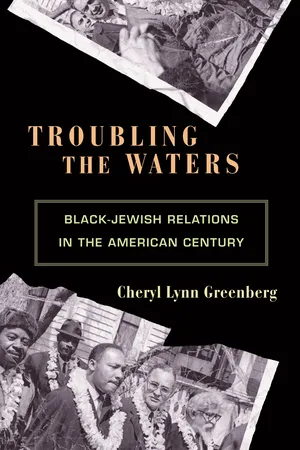
Was there ever really a black-Jewish alliance in twentieth-century America? And if there was, what happened to it? In Troubling the Waters, Cheryl Greenberg answers these questions more definitively than they have ever been answered before, drawing the richest portrait yet of what was less an alliance than a tumultuous political engagement--but one that energized the civil rights revolution, shaped the agenda of liberalism, and affected the course of American politics as a whole.
Drawing on extensive new research in the archives of organizations such as the NAACP and the Anti-Defamation League, Greenberg shows that a special black-Jewish political relationship did indeed exist, especially from the 1940s to the mid-1960s--its so-called "golden era"--and that this engagement galvanized and broadened the civil rights movement. But even during this heyday, she demonstrates, the black-Jewish relationship was anything but inevitable or untroubled. Rather, cooperation and conflict coexisted throughout, with tensions caused by economic clashes, ideological disagreements, Jewish racism, and black anti-Semitism, as well as differences in class and the intensity of discrimination faced by each group. These tensions make the rise of the relationship all the more surprising--and its decline easier to understand.
Tracing the growth, peak, and deterioration of black-Jewish engagement over the course of the twentieth century, Greenberg shows that the history of this relationship is very much the history of American liberalism--neither as golden in its best years nor as absolute in its collapse as commonly thought.
eBook - ePub
Troubling the Waters
Black-Jewish Relations in the American Century
- 368 pages
- English
- ePUB (mobile friendly)
- Available on iOS & Android
eBook - ePub
About this book
Information
Publisher
Princeton University PressYear
2010Print ISBN
9780691146164
9780691058658
eBook ISBN
9781400827077
CHAPTER ONE
Settling In
Writers discussing “black-Jewish relations” often treat the subject as timeless. Both those who argue for a “natural alliance” of African Americans and American Jews and those positing a more pernicious relationship imply almost by definition a longstanding and ongoing special connection felt by members of the two communities. Whatever the truth of such claims in the twentieth century, they are certainly false for the past, as a quick historical look will reveal. At the same time, many of the components that would shape the future relationship between black and Jewish Americans, for good and for ill, can already be seen in their distinct but overlapping histories. We begin, then, with the prehistory of black-Jewish relations in the American Century.
For most of the nation’s history, demographics limited contact between the two communities. Jews were always a tiny minority of the American population. On the eve of the American Revolution, only approximately two thousand Jews lived in what would become the United States, primarily migrants from Spain and Portugal (Sephardic Jews). By the mid–nineteenth century their ranks had been swelled by Jews from northern and central, primarily German-speaking, Europe (Ashkenazic Jews). At the start of the Civil War the Jewish population numbered between 150,000 and 200,000, less than one percent of the U.S. population.1 Furthermore, most resided north of the Mason-Dixon line, while all but 200,000 of the 4.5 million African Americans lived in the South.
Not only were Jews few in number, they played almost no role in public debates over race during the period of slavery; in both the North and the South their activities were indistinguishable from those of other whites around them. Southern Jews feared that challenging racial hierarchies so central to southern white identity would fan the flames of anti-Semitism. Virtually no Jewish leaders there, either religious or lay, publicly opposed slavery. David Einhorn of Baltimore, the one southern rabbi who did (in 1861), had immigrated from Germany as an adult. And as a result of his pronouncements he was forced to flee the city for his own safety, both justifying and reinforcing Jewish fears of speaking out against the South’s “peculiar institution.” Other Jews supported slavery not merely by their silence but by their actions as well, suggesting most did not see it as a particularly Jewish moral concern. Approximately a quarter of southern Jews held slaves, and since others worked as tradesmen or businessmen, their livelihood was deeply intertwined with the slave system.2
Northern Jews showed the same ambivalence toward abolition as did the non-Jewish white majority. While most northerners held racist views about the abilities of African Americans and the undesirability of mingling with them, it was far safer to express antislavery sentiment in the North by the 1850s than in the South, especially if couched in vague and antiexpansionist terms. Nevertheless, few northern Jews did so publicly, and fewer still joined the abolitionist cause, although more spoke out after the war began. No “special relationship” between blacks and Jews, no universalist ethic, led Jews, North or South, to challenge this violation of human rights. In most respects these Jewish immigrants considered themselves as much German as Jewish, and sought to blend into the larger white community with as little fuss as possible beyond establishing Jewish service institutions and defending their right to worship as they chose.
There is little evidence that African Americans, slave or free, felt any particular bond with contemporary Jews either. While slave spirituals such as “I Am Bound for the Land of Canaan” suggest a deeply rooted sense of identity with the children of Israel, this was by and large a connection felt with biblical, not actual, Jews, who, after all, had not given any reason for black people to establish a more current sense of commonality. And African American religion contained as much anti-Semitic sentiment as did the white Protestant churches from which black people had learned it. Those who longed for a present-day Moses also sang “De Jews done killed poor Jesus.”
Such attitudes proved quite durable, lasting beyond emancipation and into the next century.3 While more Jewish than white gentile businesses proved willing to serve black people after the Civil War, so few Jews lived in the South that most African Americans had no direct interactions with them that might counteract these stereotypes. Thus, few Jews or African Americans drew substantive connections between the experiences of their two peoples before the end of the nineteenth century. It was at this point that two massive migration streams intersected: African Americans and eastern European Jews both moving to northern and urban areas. In those earliest years, simultaneous cooperation and conflict characterized black-Jewish interactions, an unstable combination that remained at the heart of their relationship for the entire century to come. Both communities recognized reasons to cooperate, but also found themselves at odds given the asymmetries between them in class, historical experience, and racial identity.
Great Migrations I: “The standing of a man and a citizen”
The combination of what migration scholars have called push and pull factors propelled hundreds of thousands of African Americans from the southern countryside and towns toward what they hoped would be better lives in the North and in the city. Jim Crow, racism, and debt peonage or sharecropping kept black southerners from achieving economic stability in the South, while the ubiquitous threat of racial violence and lynching made living there dangerous for those who desired equal opportunity. For thousands, the North seemed a happier choice. The growing reliance on mechanization and a series of natural catastrophes, including floods in Mississippi and the spread of the boll weevil, pushed African Americans from the land as well.
At the same time, northern and urban opportunities beckoned. Industrialization increased the need for factory laborers, a process accelerated by World War I as war production expanded and one major source of labor recruits, European immigrants, was cut off. Immigration restrictions imposed in 1921 and tightened in 1924 maintained the labor shortage, and northern industrialists energetically wooed southern black workers to meet their labor needs.
But African Americans who came north acted as agents of change, not merely as pawns in a national economic process. This migration was a social movement, shaped by internal information networks and community ties. African Americans who had already come to northern centers wrote home of the comparative social freedom and economic opportunity they enjoyed, prompting thousands of friends and family members to join them. “Tell your husband work is plentiful here and he wont have to loaf if he want to work,” wrote a woman newly arrived in Chicago. A new migrant to Philadelphia hadn’t “heard a white man call a colored a nigger … since I been in the state of Pa. I can ride in the electric street … cars any where I get a seat.… I am not crazy about being with white folks, but if I have to pay the same fare I have learn to want the same acomidation.” The black press also encouraged the migration, none with more enthusiasm than the Chicago-based Defender. “Our entrance into factories, workshops and every other industry open to man places us on an entirely different footing,” it exulted in 1918. Many migrants recognized the price they paid for such advantages, but remained nonetheless. “I am doing well no trouble what ever except i can not raise my children here like they should be this is one of the worst places in principle you ever look on in your life but it is fine place to make money,” one Cleveland resident observed.4
Although women as well as men moved north looking for better jobs and greater equality, the link between employment opportunities, full citizenship, and manhood was raised again and again. “I just begin to feel like a man,” a Philadelphia migrant wrote. “I have registered—Will vote the next election and there isnt any ‘yes sir’ and ‘no sir.’” “[W]ith the right to vote goes everything: Freedom, manhood, the honor of your wives, the chastity of your daughters, the right to work, and the chance to rise,” promised W.E.B. Du Bois at the 1906 meeting of the Niagara Movement (out of which would spring the NAACP). The Defender opined, “Every black man for the sake of his wife and daughters especially should leave even at a financial sacrifice every spot in the south where his worth is not appreciated enough to give him the standing of a man and a citizen.”5
Thousands took such advice. In each decade between 1890 and 1910, almost 170,000 African Americans left the South. Between 1910 and 1920, that figure jumped to 454,000; in the decade following it reached 749,000. This was the Great Migration. Between 1910 and 1920 Chicago’s black population increased 148 percent and Detroit’s 611 percent. Black New York, Pittsburgh, and Philadelphia expanded similarly. This was also an urban migration; even southern cities saw a rise in their black population while the southern countryside saw pronounced declines. Norfolk, Virginia’s black population rose by 73.3 percent between 1910 and 1920; Atlanta experienced a 21 percent rise in the same decade and another 43.4 percent in the decade following. Similar increases in Baltimore, Birmingham, Houston, and Memphis suggest these cities’ experiences were not idiosyncratic. Meanwhile, white farmers in parts of Texas, Mississippi, Georgia, Kentucky, and Louisiana complained of severe labor shortages.6 And in some northern cities, especially New York, the southern migration joined with a substantial inflow of Caribbean immigrants.
Despite the relative security and prosperity the North offered, life for African Americans and West Indians remained insecure and far more constrained than it was for whites, including immigrants. Not only did rural agricultural workers lack needed urban and industrial skills, racism limited their opportunities to obtain them. Even for those with skills (and recent scholarship suggests that a substantial proportion of these migrants and immigrants were not “peasants” but laborers of varying skill levels), most occupations remained closed to them, and job and class mobility proved virtually impossible.7 Generally they received only the lowest and least-skilled jobs. In cities with large immigrant populations, even some unskilled industrial jobs were closed to them, leaving many with access to employment only in the service sector. Whatever their jobs, black workers often received lower wages than those paid to similarly employed white workers. One New York employment agency posted two jobs: “An elevator boy wanted—Colored; hours 8 A.M. to 8 P.M. daily, $65 per month. Elevator boy wanted—white; hours 8 A.M. to 7 P.M. daily; $90 per month.” Adam Clayton Powell Sr., pastor of the Abyssinian Baptist Church there, observed, “Even in New York it costs an elevator man 365 hours of extra labor and $300 a year to be colored.”8 Some few achieved professional degrees despite overwhelming racial and economic barriers but because they could generally practice only within their own, poorer, community, their income was similarly incommensurate with that of whites in the same occupations.
Residential patterns were also largely determined by race. Most landlords would rent to black people only if they could not find white tenants, making only the worst areas available for black settlement: the South Side in Chicago or the Black Bottom and the ironically named Paradise Valley in Detroit. These already substandard neighborhoods worsened with overcrowding and the poverty of their inhabitants, problems compounded by the unconcern of local politicians and service organizations who provided poorer services to black areas. Morbidity and mortality rates were far higher in black districts, and mobility out of these slums far harder to achieve.9
Because white landlords and neighboring communities only saw race, black people from all classes and occupations, the native-born and the foreign-born, long-term residents and new southern migrants, were forced to share physical, if rarely social, space. Differences of culture, politics, and behavior often led to misunderstanding and anger. Long-settled residents looked with suspicion on those unused to city life. Many blamed the newcomers for the worsening conditions and an increase in discrimination. Prewar black Chicagoans “were just about civilized and didn’t make apes out of themselves like the ones who came here during 1917–18,” complained a longtime black resident. “We all suffer for what one fool will do.” Mary White Ovington, one of the NAACP’s founders, warned of the “surplus women” among the migrants who “play havoc with their neighbors’ sons, even with their neighbors’ husbands.” Most black residents understood the motives behind the newcomers’ decision to migrate, but worried about the impact their number and their rural ways would have on race relations. The Detroit Urban League’s director explained that migrants did not receive a particularly warm welcome “from the great majority of colored citizens of the better class.… They try to decide whether his coming is a benefit or an injury to them.”10
Perhaps even sharper divisions were drawn between the native and foreign-born. African Americans resented what they saw as arrogance and political radicalism in the foreign-born, who in turn criticized the native-born as lazy and passive. Paule Marshall reported that the West Indian women she grew up among considered themselves “different and somehow superior … more ambitious than black Americans, more hard working”; foreign-born Ray from Claude McKay’s Home to Harlem felt “superior to ten millions of suppressed Yankee ‘coons.’” They found in African American worship services “over-emotionalism which dangerously borders on fanaticism.” For their part, African Americans complained about West Indian “rabble rousers” and made derogatory comparisons between these entrepreneurial “monkey chasers” and Jews. Certainly most understood that both suffered from white racism; that did not prevent a certain amount of nativist suspicion or sense of competition and resentment.11
Beyond divisions based on geographic origins were those of class. Social relations rarely transcended class lines; the well-to-do traveled in exclusive circles, seeming disdainful or patronizing to the poor. Black New York social workers taught immigrant girls “neatness, orderliness and decorum, while they have learned to ply the busy needle” while the wealthier resided in architect-designed brownstones in “Sugar Hill” or “Strivers’ Row.”12
Nevertheless, African American urban residents were not merely victims of racism or intraracial strife. Their neighborhoods, constrained though they were by poverty and discrimination, and divided though they were by class, nativity and culture, nonetheless offered opportunities for community building impossible in more rural settings. This was particularly true in the North. In the absence of legal bars to black voting or the quasi-legal apparatus of violent intimidation, concentrated black communities became potent voting blocs when not gerrymandered into impotence. Black newspapers and magazines like the Chicago Defender, New York Age, Baltimore Afro-American, and Pittsburgh Courier enjoyed wide circulation, supported by large populations facing similar obstacles and sharing similar concerns. Black urban churches, so often crucibles of community and politics, could attract huge congregations that would become seedbeds ...
Table of contents
- Cover Page
- Series Page
- Title Page
- Copyright
- Dedication
- Epigraph
- Contents
- Acknowledgments
- Introduction
- Chapter One. Settling In
- Chapter Two. Of Our Economic Strivings
- Chapter Three. Wars and Rumors of Wars
- Chapter Four. And Why Not Every Man?
- Chapter Five. Red Menace
- Chapter Six. Things Fall Apart
- Abbreviations
- Notes
- Index
- Series List
Trusted by 375,005 students
Access to over 1.5 million titles for a fair monthly price.
Study more efficiently using our study tools.
Frequently asked questions
Yes, you can cancel anytime from the Subscription tab in your account settings on the Perlego website. Your subscription will stay active until the end of your current billing period. Learn how to cancel your subscription
No, books cannot be downloaded as external files, such as PDFs, for use outside of Perlego. However, you can download books within the Perlego app for offline reading on mobile or tablet. Learn how to download books offline
Perlego offers two plans: Essential and Complete
- Essential is ideal for learners and professionals who enjoy exploring a wide range of subjects. Access the Essential Library with 800,000+ trusted titles and best-sellers across business, personal growth, and the humanities. Includes unlimited reading time and Standard Read Aloud voice.
- Complete: Perfect for advanced learners and researchers needing full, unrestricted access. Unlock 1.5M+ books across hundreds of subjects, including academic and specialized titles. The Complete Plan also includes advanced features like Premium Read Aloud and Research Assistant.
We are an online textbook subscription service, where you can get access to an entire online library for less than the price of a single book per month. With over 1.5 million books across 990+ topics, we’ve got you covered! Learn about our mission
Look out for the read-aloud symbol on your next book to see if you can listen to it. The read-aloud tool reads text aloud for you, highlighting the text as it is being read. You can pause it, speed it up and slow it down. Learn more about Read Aloud
Yes! You can use the Perlego app on both iOS and Android devices to read anytime, anywhere — even offline. Perfect for commutes or when you’re on the go.
Please note we cannot support devices running on iOS 13 and Android 7 or earlier. Learn more about using the app
Please note we cannot support devices running on iOS 13 and Android 7 or earlier. Learn more about using the app
Yes, you can access Troubling the Waters by Cheryl Lynn Greenberg in PDF and/or ePUB format, as well as other popular books in History & Jewish History. We have over 1.5 million books available in our catalogue for you to explore.