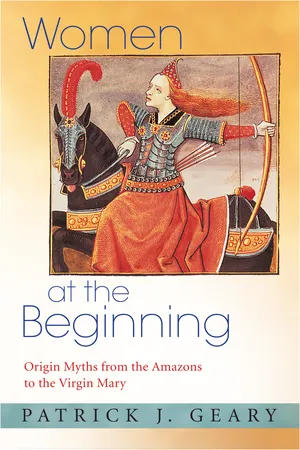
In these four artfully crafted essays, Patrick Geary explores the way ancient and medieval authors wrote about women. Geary describes the often marginal role women played in origin legends from antiquity until the twelfth century.
Not confining himself to one religious tradition or region, he probes the tensions between women in biblical, classical, and medieval myths (such as Eve, Mary, Amazons, princesses, and countesses), and actual women in ancient and medieval societies. Using these legends as a lens through which to study patriarchal societies, Geary chooses moments and texts that illustrate how ancient authors (all of whom were male) confronted the place of women in their society.
Unlike other books on the subject, Women at the Beginning attempts to understand not only the place of women in these legends, but also the ideologies of the men who wrote about them. The book concludes that the authors of these stories were themselves struggling with ambivalence about women in their own worlds and that this struggle manifested itself in their writings.
Women and Origins in Antiquity and the Early Middle Ages
Why concentrate on women at the beginning if what we want to understand is rather the development of mental horizons across centuries of theMiddle Ages?What is it about beginnings that draws us? Do beginnings contain an embryo of that which is to come, some essential DNA of the future of a society, a movement, or a people that determines forever its ultimate meaning?
Idols and Idolaters
Marc Bloch, the great twentieth-century historian, resistance fighter, and martyr, dedicated a section of his unfinished essay, Apologie pour l’histoire, or The Historian’s Craft, to what he called “The Idol of Origins.”1 He observes that historians, himself included, have a tendency to prioritize both the most recent and the most distant pasts to the point of hypnotism. He goes on to ask what exactly one means by origins and what the obsession with origins on the part of historians is actually all about. If one meant simply the start, such an interest would be acceptable, although he warns that the start of things is alwaysextremely difficult to determine, and thus such investigations are generally futile. However, he suggests, when historians ask about origins we really mean causes, specifically causes that explain; and what is worse, all too often we are searching for causes that explain everything. “There,” he says, “lies the ambiguity, and there the danger!”2
We do well to recognize this danger at the beginning of an investigation into women at the origin: at the origin of families, of nations, of religions, of peoples. By asking about how women are represented in the foundation legends of social phenomena, are we seeking something timeless, essential, and explanatory, either about human societies in general or about the particular cultures that created them? Are we examining something essential about the very nature of gender constructions in human society? Or are we looking for a key to understanding the actual place of women in the formation and coherence of these cultures? There are serious people who would answer a resounding yes to all of these questions. For some, legends of women at the beginning form a pentimento, an overpainted but still dimly perceptible recollection of an age of matriarchy.3 For such scholars, the study of women at the beginning is just what it says it is: an examination into the condition of women who gave birth to social forms only to find themselves and their daughters suppressed, marginalized, and silenced by their male offspring.4
For others, the study of women at the beginning is an attempt to discover, within genealogies, origin legends, and chronicles, the lived reality of women at the earliest periods of specific social and cultural constellations. Do such texts actually reflect social roles and options in emerging communities? Should the persistent accounts of Amazons among barbarian peoples in antiquity and the early Middle Ages, for example, be taken seriously as evidence that women fought alongside their men in these societies?
This is by no means an unreasonable suggestion. As we shall see in greater detail in chapter 2, Amazons figure prominently not only in classical ethnographic accounts and origin legends from the time of Herodotus through the Middle Ages but also in Roman and medieval accounts of campaigns against “barbarian” Celts, Germanic enemies, and Steppe peoples.5 Moreover, archaeological evidence of women buried with weapons occurs in ancient and medieval tombs from the area of the Black Sea.6 In light of such evidence, perhaps descriptions of Amazons are simply reflections of reality.
One can ask similar questions about the magical women who appear in other origin legends. If Libuše, the legendarymother of the Czech people, is described as a phitonissa, a seer, and if we hear that a phitonissa accompanied a Polish army as late as 1209,7 ought we to conclude that the twelfth-century chronicle of Cosmas of Prague provides us with an accurate insight into the early role of women as prognosticators in west Slavic societies?
These questions are legitimate, and yet they risk, I believe, the dangers enunciated by Marc Bloch. Such a search for “women at the beginning” all too easily can become not so much a search for the start as an essentialized search for the root causes of gender divisions, patriarchy, and societal forms. All too often such investigations, unconsciously or not, posit what was at the beginning as what was right, and understand the contrast between these projected images of founding women and subsequent gender roles as a falling away, a perversion, or a loss. Whether or not such judgments are valid, they are not historical judgments.
Thus I will pursue neither the big questions of what origin legends can tell us about prepatriarchal societies nor whether they can actually tell us about the original gender boundaries of these societies. I will not look for the “facts” in depictions ofwomen as saints or monsters, clairvoyants or warriors. However, this does not mean that in what follows I am not interested in the Idol of Origins. In fact, this is exactly my prey, but in a different way: I pursue not the idol but the idolaters.
The compilers, authors, genealogists, theologians, and lawyers who compiled these originmyths were for the most part engaged in exactly what Bloch warns against: these authors are never interested in the search for origins as a search for the start. Their goal is always the present and future: their investigations are precisely intended to explain—to explain causes, to explain essences, to explain how the world was and how it should be. For these authors, the origins of a people, a family, a nation, does indeed hold great meaning for the present and future; the model of generation, of descent, whether physical or moral, is essential not only for identity but for value. As the German scholar Gerd Melville suggests, “The period that reaches from the origins to the present must be presented as an uninterrupted series of concrete acts that honor primordial qualities.”8 And yet, these explorations of origins are in constant tension between their sources and their contemporary milieus. But here lies a basic problem: their sources, whether oral or written, indigenous or classical, derive from worlds very different from the author’s own, presenting values, behavior, and patterns at odds with what, from the perspective of these authors, ought to be. And yet hallowed as sacred scripture, as classics of Greco-Roman culture, or venerable tradition, these traditions could not be simply rejected or suppressed: somehow they had to be given contemporary meaning. The result is paradox, a tension, between incomprehensible tradition and the urgency for meaning.
And nowhere is the paradox greater than in the place of women in these origins, because this meaning involves, explicitly or implicitly, gendered power relations that these authors experience in their own worlds.
The Classical Heritage
Medieval textual culture depends enormously on the twin heritages of classical and biblical antiquity.Medievals were never slavish in their uses of either, no matter how adamantly they pretended to be so. Nevertheless, models, themes, and possibilities of describing the human condition, including human origins, derive in large part from this inheritance. And yet the distance between classical gender assumptions and those of even learned medieval authors is vast. The differences can only be appreciated if we begin with antiquity, when beginnings were clearly an affair of men.
Beginnings should begin with men. From the fifth century B.C.E., as western Eurasian societies thought about the continuities between the past and the present, their intellectuals, almost exclusively men, understood these continuities as generations of men. They are the appropriate subject of history; they provide the continuity in genealogy; they give order and meaning across time. As the Glossa ordinaria, echoing St. Ambrose and others put it, “Non est consuetudo Scripturarum, ut ordo mulierum in generationibus texatur” (It is not the custom of the sacred scriptures that the order of women would be woven into generations).9Organizing the past in terms of generations was the fundamental mode of historical thinking. As the American philologist R. Howard Bloch suggests, “From the fourth century on, the defining mode of universal history was that of genealogy,” and fathers were “the prime subject of historical enunciation and children its object.”10 Bloch was writing about the fourth century C.E., but his comments are just as applicable to antiquity as well. But in such a conception of history, one must ask what then were mothers, either historically or grammatically?
Certainly, prior to the brave new world of cloning, reproduction, biological or cultural, demanded not only men but women. And just as certainly, authors assiduously tracing the grammar of universal history were well aware of women exercising great authority not only in the distant past but in their own times. Writing about women, power, and generation at the beginning became a way of writing about women, power, and generation in the present. If the complexities of women’s roles in generation, legitimization, and power could not be resolved, at least exemplary accounts could be means of expressing the paradoxes of the problem and perhaps of resolving in the past what could not be resolved in the present.
Women and Power in Classical Antiquity
Classical ethnography is essential for the understanding of the long history of women’s place in European origin legends, and this tradition starts with Herodotus.11 His reports on the origins of the Scyths provide fundamental models of origin traditions, both in general and in the way that he uses the females in the Greek version of the Scythian origin to marginalize this society, that were repeated by later Greek, Roman, and Byzantine chroniclers, and ultimately transmitted indirectly to Western medieval authors. Herodotus offers three versions of the Scythian ethnogenesis. The first and most famous account is what he describes as the Scyths’ own story, which begins with one Targitaus, said to be the son of Zeus and an unnamed daughter of the River Dorysthenes (the Dnieper). They produced three sons,
,
, and
, each of whom is credited with being the father of a Scythian genus, although the youngest,
, alone received divine approval to be made king.12 In this version, nothing is said about the female river spirit—the emphasis of the story is elsewhere and may well reflect an internal understanding of Scythian self-identity, tied to an agricultural rather than pastoral society, although apparently misunderstood or misrepresented by Herodotus.
The account of the origins of the Scyths that Herodotus attributed to the Pontic Greeks is much more concerned with the mother of the Scyths, but a mother who embodies their marginalization from the human race. We hear that Heracles came into the country now called Scythia, driving the cattle he had obtained from Geryon, and fell asleep. While he slept, his mares, that had been yoked to his chariot, disappeared. Searching for them he found in a cave a creature of double form, half woman and half serpent. She told Heracles that she had his mares but would not return them unless he had intercourse with her. This he did. The result was three sons, Agathyrsus, Gelonus, and Scythes, the youngest, who alone passed a test of strength and became the father of the Scyths.
The third account, which Herodotus prefers, actually is not an origin story at all but expla...
Table of contents
Table of Contents
Acknowledgments
Introduction
CHAPTER ONE Women and Origins in Antiquity and the Early Middle Ages
CHAPTER TWO Writing Women Out: Amazons and Barbarians
CHAPTER THREE A Tale of Two Judiths
CHAPTER FOUR Writing Women In: Sacred Genealogy and Gender
EPILOGUE Women at the End
Notes
Suggestions for Further Reading
Trusted by 375,005 students
Access to over 1.5 million titles for a fair monthly price.
Study more efficiently using our study tools.
Frequently asked questions
Yes, you can cancel anytime from the Subscription tab in your account settings on the Perlego website. Your subscription will stay active until the end of your current billing period. Learn how to cancel your subscription
No, books cannot be downloaded as external files, such as PDFs, for use outside of Perlego. However, you can download books within the Perlego app for offline reading on mobile or tablet. Learn how to download books offline
We are an online textbook subscription service, where you can get access to an entire online library for less than the price of a single book per month. With over 1.5 million books across 990+ topics, we’ve got you covered! Learn about our mission
Look out for the read-aloud symbol on your next book to see if you can listen to it. The read-aloud tool reads text aloud for you, highlighting the text as it is being read. You can pause it, speed it up and slow it down. Learn more about Read Aloud
Yes! You can use the Perlego app on both iOS and Android devices to read anytime, anywhere — even offline. Perfect for commutes or when you’re on the go. Please note we cannot support devices running on iOS 13 and Android 7 or earlier. Learn more about using the app
Yes, you can access Women at the Beginning by Patrick J. Geary in PDF and/or ePUB format, as well as other popular books in History & World History. We have over 1.5 million books available in our catalogue for you to explore.