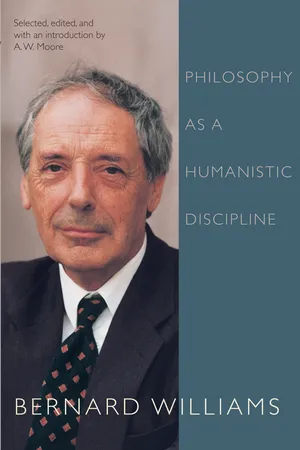
What can--and what can't--philosophy do? What are its ethical risks--and its possible rewards? How does it differ from science? In Philosophy as a Humanistic Discipline, Bernard Williams addresses these questions and presents a striking vision of philosophy as fundamentally different from science in its aims and methods even though there is still in philosophy "something that counts as getting it right." Written with his distinctive combination of rigor, imagination, depth, and humanism, the book amply demonstrates why Williams was one of the greatest philosophers of the twentieth century.
Spanning his career from his first publication to one of his last lectures, the book's previously unpublished or uncollected essays address metaphysics, epistemology, and ethics, as well as the scope and limits of philosophy itself. The essays are unified by Williams's constant concern that philosophy maintain contact with the human problems that animate it in the first place. As the book's editor, A. W. Moore, writes in his introduction, the title essay is "a kind of manifesto for Williams's conception of his own life's work." It is where he most directly asks "what philosophy can and cannot contribute to the project of making sense of things"--answering that what philosophy can best help make sense of is "being human."
Philosophy as a Humanistic Discipline is one of three posthumous books by Williams to be published by Princeton University Press. In the Beginning Was the Deed: Realism and Moralism in Political Argument was published in the fall of 2005. The Sense of the Past: Essays in the History of Philosophy is being published shortly after the present volume.
- 264 pages
- English
- ePUB (mobile friendly)
- Available on iOS & Android
eBook - ePub
Philosophy as a Humanistic Discipline
About this book
Information
Publisher
Princeton University PressYear
2009Print ISBN
9780691134093
9780691124261
eBook ISBN
9781400827091
Topic
PhilosophySubtopic
Philosophy History & TheoryTable of contents
- Table of Contents
- Preface
- Introduction
- Part One: Metaphysics and Epistemology
- One Tertullians Paradox (1955)
- Two Metaphysical Arguments (1957)
- Three Pleasure and Belief (1959)
- Four Knowledge and Reasons (1972)
- Five Identity and Identities (1995)
- Part Two: Ethics
- Six The Primacy of Dispositions (1987)
- Seven The Structure of Hares Theory (1988)
- Eight Subjectivism and Toleration (1992)
- Nine The Actus Reus of Dr. Caligari (1994)
- Ten Values, Reasons, and the Theory of Persuasion (1996)
- Eleven Moral Responsibility and Political Freedom (1997)
- Twelve Tolerating the Intolerable (1999)
- Thirteen The Human Prejudice (unpublished)
- Part Three: The Scope and Limits of Philosophy
- Fourteen Political Philosophy and the Analytical Tradition (1980)
- Fifteen Philosophy and the Understanding of Ignorance (1995)
- Sixteen Philosophy as a Humanistic Discipline (2000)
- Seventeen What Might Philosophy Become? (unpublished)
- Bernard Williams:Complete Philosophical Publications
Trusted by 375,005 students
Access to over 1.5 million titles for a fair monthly price.
Study more efficiently using our study tools.
Frequently asked questions
Yes, you can cancel anytime from the Subscription tab in your account settings on the Perlego website. Your subscription will stay active until the end of your current billing period. Learn how to cancel your subscription
No, books cannot be downloaded as external files, such as PDFs, for use outside of Perlego. However, you can download books within the Perlego app for offline reading on mobile or tablet. Learn how to download books offline
Perlego offers two plans: Essential and Complete
- Essential is ideal for learners and professionals who enjoy exploring a wide range of subjects. Access the Essential Library with 800,000+ trusted titles and best-sellers across business, personal growth, and the humanities. Includes unlimited reading time and Standard Read Aloud voice.
- Complete: Perfect for advanced learners and researchers needing full, unrestricted access. Unlock 1.5M+ books across hundreds of subjects, including academic and specialized titles. The Complete Plan also includes advanced features like Premium Read Aloud and Research Assistant.
We are an online textbook subscription service, where you can get access to an entire online library for less than the price of a single book per month. With over 1.5 million books across 990+ topics, we’ve got you covered! Learn about our mission
Look out for the read-aloud symbol on your next book to see if you can listen to it. The read-aloud tool reads text aloud for you, highlighting the text as it is being read. You can pause it, speed it up and slow it down. Learn more about Read Aloud
Yes! You can use the Perlego app on both iOS and Android devices to read anytime, anywhere — even offline. Perfect for commutes or when you’re on the go.
Please note we cannot support devices running on iOS 13 and Android 7 or earlier. Learn more about using the app
Please note we cannot support devices running on iOS 13 and Android 7 or earlier. Learn more about using the app
Yes, you can access Philosophy as a Humanistic Discipline by Bernard Williams, A. W. Moore, A. Moore in PDF and/or ePUB format, as well as other popular books in Philosophy & Philosophy History & Theory. We have over 1.5 million books available in our catalogue for you to explore.