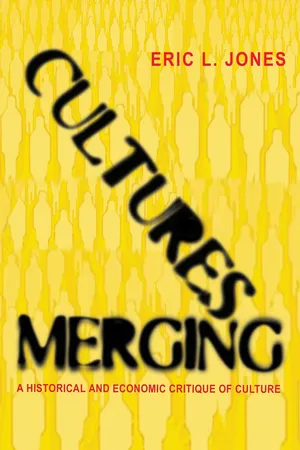
"Economists agree about many things--contrary to popular opinion--but the majority agree about culture only in the sense that they no longer give it much thought." So begins the first chapter of Cultures Merging, in which Eric Jones--one of the world's leading economic historians--takes an eloquent, pointed, and personal look at the question of whether culture determines economics or is instead determined by it.
Bringing immense learning and originality to the issue of cultural change over the long-term course of global economic history, Jones questions cultural explanations of much social behavior in Europe, East Asia, the United States, Australia, and the Middle East. He also examines contemporary globalization, arguing that while centuries of economic competition have resulted in the merging of cultures into fewer and larger units, these changes have led to exciting new syntheses.
Culture matters to economic outcomes, Jones argues, but cultures in turn never stop responding to market forces, even if some elements of culture stubbornly persist beyond the time when they can be explained by current economic pressures. In the longer run, however, cultures show a fluidity that will astonish some cultural determinists. Jones concludes that culture's "ghostly transit through history" is much less powerful than noneconomists often claim, yet it has a greater influence than economists usually admit.
The product of a lifetime of reading and thinking on culture and economics, a work of history and an analysis of the contemporary world, Cultures Merging will be essential reading for anyone concerned about the interaction of cultures and markets around the world.
Economists agree about many things—contrary to popular opinion—but the majority agree about culture only in the sense that they no longer give it much thought. The hope that a strong relationship would be found between economic and cultural change mostly faded during the 1960s and 1970s. Those who still believe that culture is formative, whether they are “real people” or the culturally inclined minority of economists, take culture as primary and the economy as secondary, seldom considering that it could be culture which is secondary. On the other hand, the majority of economists, who are trained to expect substitution among variables, find the notion of culture as fixed for all time an arbitrary idea. They see no reason to believe that culture is primordial and impervious to economic inducements. After reviewing numerous propositions about the influence of values on Indian economic development, Das gupta remarked that “no theorems follow from such intangible associations.”1
Thus, no major schools of thought in recent years locate the explanation of economic development in culture, with a couple of exceptions. The first of these consists of some institutional economists, exemplified perhaps by Anne Mayhew’s presidential address to the Annual Meeting of the Association for Evolutionary Economics in 1986. It was called “Culture: Core Concept under Attack” and opened, “I begin with the proposition that the concepts of culture and instrumental valuation are the concepts from which all the rest of institutional economics flow.”2 Mayhew argued that analysis must start from the position that we are bound by our cultural patterns. All that need be said for the moment about positions of this type is that they have not been generally or even widely adopted within economics.
The second exception consists of economists in the tradition of Max Weber, who are interested in the nexus between East Asian beliefs, business practices, and economic growth. An example from this school is the historical work of Michio Morishima. Although he is a leading technical economist, his explanation of the Japanese Miracle is Weberian.3 Yet even he eventually temporizes and relies on the reciprocity between culture and economics, saying on the one hand that ideologies given by Japan’s history “constrained” (directed?) economic activity but on the other that ideology can be altered by the economy. This throws us back on a historical analysis to trace the actual direction of influence.
Most economists adopt the position I have called elsewhere “cultural nullity.”4 Strictly speaking, this can take more than one form and is often adopted unconsciously. One version is vague about whether cultures really exist but assumes that, even if they do, they are so marginal to economic concerns that they may be safely ignored. Another version accepts that cultures do exist but hypothesizes that they are creatures of the economy, able to adjust so painlessly to changing incentives that in this case, too, they may be ignored. The latter position fails, however, to grapple with one of the main difficulties encountered in completely dismissing culture: the fact that markets are not self-enforcing and depend on customary rules for creating trust.
As Mark Casson has observed, the professional culture of economists prevents most of them from seeing that culture matters at all.5 The topic has been left to other disciplines, together with journalists, travelers, expatriates, and business commentators, all of whom are prone to note that “in reality,” as it were, there are important local or traditional peculiarities of dress, diet, and social habits, plus influential beliefs and values. A type of nonmarket fundamentalism prevails among sociologists and anthropologists, which can be illustrated by an exchange between the philosopher Roger Scruton and the sociologist Brigitte Berger.6 Speaking of Russia and Eastern Europe, Scruton urged that law should be established before any attempt to introduce the market economy. Berger interjected that for law to be accepted, culture must first be transformed. The sociologist Claudio Veliz lent support to her approach by asserting that the free market is itself a cultural artifact: witness its failure to take hold in Latin America despite prolonged experimentation in the nineteenth century. This is essentially a substantivist opinion.
Those economists who are still aware of the dispute in the 1960s between formalism and substantivism assume that it was decided in favor of formalism, whereas noneconomists believe the opposite.7 Formalism implies that economic theory has universal scope. A careful economist has made the point that introducing cultural difference is a form of relativism which disrupts the universal character of analysis. 8 The burden of substantivism is that each culture maximizes its own values and therefore cannot be analyzed by the modes of economics. These are portrayed as spuriously universal and crassly Western in their individualism and market orientation. A more reasonable position might be that, since economics is the analysis of an abstract category of behavior—choice—its techniques are culturally neutral and universal by definition. If some economists neglect to allow for the legal, religious, and social impediments to full
blown market behavior outside Western society, that is a weakness on their part, not on the part of the science.
In the substantivist canon a specific type of economy is embedded in each and every culture. The extreme holders of this view stigmatize any attempt to extend market economics beyond the West as disrupting other cultures for profit (they scarcely admit the role of profit in encouraging the taking of socially desirable risk). All cultures embody the inalienable rights of those born into them and deserve protection for that reason. Trying to integrate other cultures with the international economy (globalization) is wrong, and any hint that each culture may not be distinct is “racist,” a term which is too often used as mere abuse. This syndrome amounts to cultural relativism in holding that every culture is unique, and desirably unique.
One of the most eloquent voices raised against this position is that of a retired anthropologist, Roger Sandall, who claims that when he was a university teacher he would have been unable to publish what he has since written, so far was it contrary to the culturally relativist mood of the times.9 Sandall documents how ludicrous was the indiscriminate praise for non-Western cultures, pointing instead to the horrors of corruption and even massacre that occurred in them, the absence of much contribution to world economic or scientific advance, and the ecological destruction readily wrought by primitive agriculture long before European colonists hove onto the scene.10 Lest Sandall’s publication seem the work of an isolated contrarian, a wider shift in opinion is indicated by the fact that indigenous African writers have started to discard the view that the ills of their continent can be sheeted home to colonialism. Some of them may now be found criticizing what they represent as internal defects of apathy, fatalism, convivial excess, conflict avoidance, reliance on superstitious explanations, and lack of a notion of personal merit. This litany would have been unthinkable during the last third of the twentieth century and would probably still be unacceptable had it originated with non-African writers. The new self-critical approach is epitomised by Daniel Etounga-Manguelle, who recommends learning from other civilizations the way East Asia did and not hankering after an “African way.”11
Cultural relativism takes little account of its own economic implications—the costs that ensue (and fall most heavily on the poor) from insisting on cultural separateness and hence segregated markets. Cultural relativism is thus congruent with what is discussed below as “cultural fixity.” No attempt is made to face up to the reality that cultures are artifacts, created and recreated, and that most of them have borrowed from hither and yon. No anxiety is expressed that protecting cultures as they stand favors the current holders of power and suppresses other people’s freedom to choose. We can submit this to the test of revealed preference, which means asking what people do rather than what they say. Revealed preference suggests that people from all around the world are happy to adopt elements from alien cultures, especially so-called global or Western culture. Many even strive to migrate to the West, where they can share not only its material success but also other features such as independent law and a free press.
Surprisingly, many historians, who might be expected to emphasize cultural change, likewise write as though cultures are fixed and dominate other aspects of life, including economic life. One reason for this may be that historians tend to be period specialists and seldom write about the long reaches of time during which change becomes most evident. Like other people, historians also witness cultural diversity at the present day, and this may reinforce their supposition that economies are adapted to a particular repertoire of cultural preferences, abilities, and taboos rather than the other way round.
Where academics from fields other than economics are involved, claims that “culture matters” are insistent. Such assertions are not infrequently coupled with attacks on neoclassical economics. These rarely mean what they say, since few commentators distinguish between neoclassical and other branches of economics, just as they fail to distinguish between market liberalism and conservatism. This suggests that “neoclassical” is code for an antipathy toward market competition, aversion to the economist’s professional supposition that all actions have costs, and hostility toward businesses and governments supposed to be implicated in maintaining capitalism. Economists have largely responded with a disdainful silence.12 Faced with all the prejudices of economists and noneconomists, it is tempting to call down a plague on both their houses. But that would be to evade the issue of culture.
Sometimes culture really does seem so routine and invariant with respect to price as to warrant a closer look by economists—though we should be careful: Alfred Marshall thought it was easy to overlook creeping changes and strikingly observed that “short-lived man has little better means of ascertaining whether custom is quietly changing, than the fly, born to-day and dead to-morrow, has of watching the growth of the plant on which it rests.”13 Yet at other times behavior touching on the most intimate human concerns can change almost overnight. What accounts for the periods of stability, and what brings about the transitions?
The instincts of a leading development economist, Peter Bauer, were probably correct ones. During his career he seems largely to have avoided cultural relativism but near its close he moved toward acknowledging the importance of culture by criticizing his fellow economists for virtually failing to consider the subject at all. I take From Subsistence to Exchange and Other Essays to be representative of his mature views.14 At various points he alludes to culture and moral ideas as deep influen...
Table of contents
Table of Contents
Preface
PART I CULTURAL ANALYSIS
1 The Revival of Cultural Explanation
2 Cultures Fluid and Sticky
3 Culture as Mediocrity
4 The Means of Merging
5 Institutions as Cryptogams
PART II CULTURAL COMMENTARY
6 Cultures of Immigration
7 East Asias Experience
8 Economic Changes, Cultural Responses
9 Cultural Protection
PART III CONCLUSION
10 Culture as Reciprocity
Bibilography
Trusted by 375,005 students
Access to over 1.5 million titles for a fair monthly price.
Study more efficiently using our study tools.
Frequently asked questions
Yes, you can cancel anytime from the Subscription tab in your account settings on the Perlego website. Your subscription will stay active until the end of your current billing period. Learn how to cancel your subscription
No, books cannot be downloaded as external files, such as PDFs, for use outside of Perlego. However, you can download books within the Perlego app for offline reading on mobile or tablet. Learn how to download books offline
Perlego offers two plans: Essential and Complete
Essential is ideal for learners and professionals who enjoy exploring a wide range of subjects. Access the Essential Library with 800,000+ trusted titles and best-sellers across business, personal growth, and the humanities. Includes unlimited reading time and Standard Read Aloud voice.
Complete: Perfect for advanced learners and researchers needing full, unrestricted access. Unlock 1.5M+ books across hundreds of subjects, including academic and specialized titles. The Complete Plan also includes advanced features like Premium Read Aloud and Research Assistant.
Both plans are available with monthly, semester, or annual billing cycles.
We are an online textbook subscription service, where you can get access to an entire online library for less than the price of a single book per month. With over 1.5 million books across 990+ topics, we’ve got you covered! Learn about our mission
Look out for the read-aloud symbol on your next book to see if you can listen to it. The read-aloud tool reads text aloud for you, highlighting the text as it is being read. You can pause it, speed it up and slow it down. Learn more about Read Aloud
Yes! You can use the Perlego app on both iOS and Android devices to read anytime, anywhere — even offline. Perfect for commutes or when you’re on the go. Please note we cannot support devices running on iOS 13 and Android 7 or earlier. Learn more about using the app
Yes, you can access Cultures Merging by Eric L. Jones in PDF and/or ePUB format, as well as other popular books in Economía & Condiciones económicas. We have over 1.5 million books available in our catalogue for you to explore.