This book is an exploration of Plato's Republic that bypasses arcane scholarly debates. Plato's Fable provides refreshing insight into what, in Plato's view, is the central problem of life: the mortal propensity to adopt defective ways of answering the question of how to live well.
How, in light of these tendencies, can humankind be saved? Joshua Mitchell discusses the question in unprecedented depth by examining one of the great books of Western civilization.
He draws us beyond the ancients/moderns debate, and beyond the notion that Plato's Republic is best understood as shedding light on the promise of discursive democracy. Instead, Mitchell argues, the question that ought to preoccupy us today is neither "reason" nor "discourse," but rather "imitation." To what extent is man first and foremost an "imitative" being? This, Mitchell asserts, is the subtext of the great political and foreign policy debates of our times.
Plato's Fable is not simply a work of textual exegesis. It is an attempt to move debates within political theory beyond their current location. Mitchell recovers insights about the depth of the problem of mortal imitation from Plato's magnificent work, and seeks to explicate the meaning of Plato's central claim--that "only philosophy can save us."
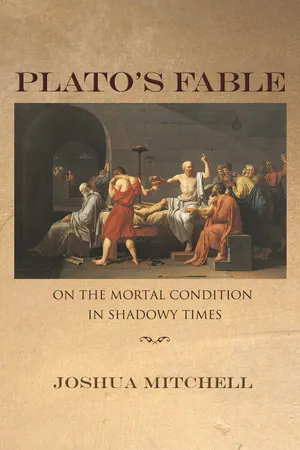
- 224 pages
- English
- ePUB (mobile friendly)
- Available on iOS & Android
eBook - ePub
About this book
Information
Chapter 1
INTRODUCTION

Unless philosophers become kings of our cities or unless those who now are kings and rulers become true philosophers, so that political power and philosophic intelligence converge . . . there can be no end to troubles, my dear Glaucon, in our cities or for all mankind.1
THE PREVAILING opinion about the character of reason renders this Platonic paradox quite unthinkable today. Philosophers, we learn in Plato’s fable, are ruled by reason; yet in what sense could it possibly be true that reason is necessary to save us? As a fantastic artifice we may perhaps be entertained by this bald assertion, but to understand it as something more useful requires resources that we scarcely possess. Why this is so, and what those resources might be, is the question that concerns me here.
Wishing to defer for a time even more vexing problems, and in order to begin to understand just what might be at issue in the claim that reason is necessary to save us, let me offer a few thoughts about what will turn out to be a central concern of my analysis here, namely, the significance of imitation in mortal life. By way of anticipation, I suggest here that the problem of imitation turns out to be what reason saves us from; and that we are well served by reading Plato’s fable in that light.
Imitation in Mortal Life
In light of the scant attention imitation receives today, and in light of the predominant contemporary understandings of Plato’s Republic, it may well be asked why imitation need be invoked at all in an exposition of this sort. Among most political scientists and many political theorists, for example, imitation is scarcely a subject of serious debate, because human beings are considered first and foremost to be rational beings, not imitative beings. Yet this prejudice is a relatively recent one, as a perusal of the writings of Plato, Aristotle, Augustine, and Tocqueville, to name only a few of the more prominent, attest. Reason is, of course, a central concern in all of their reflections; but whatever their conclusions may have been about it, fidelity to their subject matter as a whole entailed a consideration of the significance in imitation in mortal life as well. Today, the need for this conjoint attentiveness to reason and imitation has not been the starting point for political theorization. Indeed, the two most prominent devices in political theory during the past quarter-century—Rawls’s veil of ignorance2 and Habermas’s ideal speech situation3—deliberately rule out imitation altogether, since all things inherited purportedly sully reason’s acumen.
Fortunately, however, Rawls and Habermas are not our only resources. With a view to exploring the alternatives to this one-sided emphasis on reason, what I do in what follows immediately below is provide a synoptic historical overview of two contemporary tropes—namely, “socialization” and “identity politics”—that concern themselves with the theme of imitation. I should note right at the outset that my purpose in exploring these two tropes is specify how, as “ideal types,” socialization underestimates the problem of imitation, and “identity politics” overestimates the problem of imitation. Said otherwise: The former is too optimistic, and the latter is too pessimistic.
To be sure, there have been attempts, especially in the last decade, to invoke “identity politics” in such a way as to suggest that the difficulties implied by its typological expression are not fatal.4 It is not by accident, however, that such treatments of “identity politics” achieve the purchase they do largely within the Anglo-American world, which has a long history both with pluralism and with absorbing emigrants from different nations and which, consequently, invites the conclusion that “identity politics” need not be characterized in the stark way I describe it here. This dubious conclusion has given rise to a strategy, adopted largely by the Left, of leveraging an already intact pluralism, with a view to elaborating new criteria for political inclusion, since relying explicitly on the liberal paradigm of interest alone would render “this” or “that” political “identity” invisible. Historical good fortune, however, should not be confused with theoretical clarity. That pluralism may be leveraged through the invocation of “identity politics” for the purpose extending the franchise in novel ways is a tribute not to the happy implications of “identity politics,” but rather to the robustness of pluralism itself. If recent disaffection with the Democratic party platform of the 2004 election is any indicator, the attempt to leverage pluralism in this way may well have already reached its apogee; and the Left, in order to recapture its position of political prominence, may be better served, as Rorty has suggested,5 by returning to the category of rhetoric and thought that is native to the Anglo-American world and that underwrote the Progressive era, namely, pragmatism.
The Disappointments of Reason
Against the backdrop of what notion of reason can we understand the tropes of socialization and “identity politics”? A good place to begin is with the early progenitors of the liberal paradigm, who were usually nominally or once-removed Reformation Christians—a fact that will become relevant as our discussion proceeds. By the liberal paradigm I mean nothing more complicated here than the sort of thing elucidated by Madison,6 which persists under the rubric of pluralism. Most important for our purposes, reason is taken to be a faculty of preference formation,which deliberates among goods that are scalar—that are sufficiently commensurable so that by some evident or liminal calculus “this” can be preferred over “that.” Politics works because these preferences, when represented in elected assemblies, with the appropriate checks and balances, can be mediated without the sometimes enduring acrimony that arises when differences of language, race, ethnicity, religion, and, more recently, sexual orientation obtrude and overshadow the scalar logic of preferences.7
There has, of course, always been a measure of dissatisfaction with this pluralist model. In the last generation, this dubiety clustered in domains of research that sought to address the pressing domestic issues of the Cold War period. While the civil rights era might have been the occasion for the emergence of “identity politics,” at the time the idiom of preferences and interests largely prevailed, because there was optimism that if the federal government successfully supervened over the “coarser elements [in local communities],”8 as Tocqueville called them, then the pluralist model would be vindicated. Had this occurred, race would not have shown itself to be an intractable problem to which the scalar logic of preference had no answer. Needless to say, the subsumption of much of the contemporary research on the politics of race within the category of “identity politics” confirms that pluralism has, on this count, largely failed.
It was, however, feminism, rather than race, that raised the first serious philosophical questions about pluralism in mainstream, secular political science.9 If women were not just another interest group, with differing preferences, then the justification for this would have to be that the difference between men and women was not scalar, but rather incommensurable. Women would have to be different in a way that the deliberative faculty of reason could not mediate. The use of the term “sex” seems rather out of place, I recognize, but replacing it with “gender” specifies the problem in a much less contentious way, and indeed partially masks the difference, since a difference that is merely “socialized” is one that is much more readily altered—and subsequently mediable—than one that is always-already-there, as sex is.10 Feminism occupies the space between the always-already-there character of sex and the always-alterable character of gender. From the former, feminism derives its leverage against pluralism; from the later, it derives its leverage within pluralism. As such, feminism is located in the boundary between pluralism and “identity politics.” Because there are respects in which men and women are completely alike and respects in which they are completely different, this liminal position is inevitable. Feminism verges on “identity politics,” but does not wholly arrive there. It straddles two worlds.11
Hegel and the Origins of “Identity Politics”
“Identity politics” may not immediately seem to oppose Madisonian pluralism, but it bears no family resemblance to it, and that fact itself is telling. Madisonian pluralism emerges out of the Anglo-American tradition; “identity politics” is of Continental origin and can trace its proximal roots to Hegel’s claim that in the course of the march of world history, Absolute Knowledge subsumes all “difference.”12 Religiously expressed, this is a claim that God uses the oppositions between good and evil in order to redeem a fallen world,13 at the end of history. “Difference” and historical existence are coterminous here, though with the important addition that a promise of a final unification is held out as the substance of faith.14 Philosophy, however, has no place for either God’s providence or for faith, since such religious notions are merely the “picture-thinking” version of what unmediated thought can know by and in itself.15 In Hegel’s thought the insight about the relationship between historically inevitable difference and final unification that Christianity proffers is appropriated, though purportedly on the higher ground of pure philosophical thought. What Christians relegate to God, Hegel relates to Geist. At best, this is dubious theology; at worst, it is a theory of historical meaning that all but invited the response it received.
It would not be an exaggeration to say that “identity politics” is the response of the Hegelian Left to the notion that difference is subsumed by the Absolute. “Don’t be a chump” may be the highest ethical imperative of rational choice theorists; “let the different remain different” is the call of those who champion “identity politics.” Difference can never be subsumed; identity remains intransigently self-same.
We should not be confused about what this intransigence means for the prospect of mediation across the boundary that separates differing identities. “Identity politics” supposes not only difference, which pluralism acknowledges, but also difference of a sort that is not mediable through the scalar calculus of preference. Said otherwise, identity is not a preference. Preferences, because scalar, can be quantified; “identity” must be qualified.
By this I do not mean that identity can be comprehended by a constellation of empirical attributes which, taken in sum and properly configured, serve as a ready indicator of “this” or “that” identity. Quantitative research has certainly sought to proceed in this manner, but this method seems rather blind to what identity involves, since those who claim to be members of an identity group purport to speak authoritatively not on the basis of a constellation of empirical attributes, but rather on the basis of a constitutive experience that outsiders cannot know. The scalar preferences acknowledged by pluralism are, in principle, capable of being deliberated over by any...
Table of contents
- Table of Contents
- PREFACE
- A NOTE ON THE TRANSLATION
- Chapter 1
- Chapter 2
- Chapter 3
- BIBLIOGRAPHY
Trusted by 375,005 students
Access to over 1.5 million titles for a fair monthly price.
Study more efficiently using our study tools.
Frequently asked questions
Yes, you can cancel anytime from the Subscription tab in your account settings on the Perlego website. Your subscription will stay active until the end of your current billing period. Learn how to cancel your subscription
No, books cannot be downloaded as external files, such as PDFs, for use outside of Perlego. However, you can download books within the Perlego app for offline reading on mobile or tablet. Learn how to download books offline
Perlego offers two plans: Essential and Complete
- Essential is ideal for learners and professionals who enjoy exploring a wide range of subjects. Access the Essential Library with 800,000+ trusted titles and best-sellers across business, personal growth, and the humanities. Includes unlimited reading time and Standard Read Aloud voice.
- Complete: Perfect for advanced learners and researchers needing full, unrestricted access. Unlock 1.5M+ books across hundreds of subjects, including academic and specialized titles. The Complete Plan also includes advanced features like Premium Read Aloud and Research Assistant.
We are an online textbook subscription service, where you can get access to an entire online library for less than the price of a single book per month. With over 1.5 million books across 990+ topics, we’ve got you covered! Learn about our mission
Look out for the read-aloud symbol on your next book to see if you can listen to it. The read-aloud tool reads text aloud for you, highlighting the text as it is being read. You can pause it, speed it up and slow it down. Learn more about Read Aloud
Yes! You can use the Perlego app on both iOS and Android devices to read anytime, anywhere — even offline. Perfect for commutes or when you’re on the go.
Please note we cannot support devices running on iOS 13 and Android 7 or earlier. Learn more about using the app
Please note we cannot support devices running on iOS 13 and Android 7 or earlier. Learn more about using the app
Yes, you can access Plato's Fable by Joshua Mitchell in PDF and/or ePUB format, as well as other popular books in Politique et relations internationales & Philosophie politique. We have over 1.5 million books available in our catalogue for you to explore.