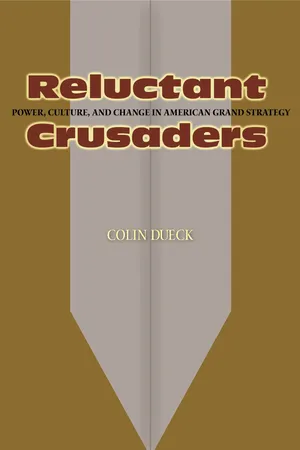
In Reluctant Crusaders, Colin Dueck examines patterns of change and continuity in American foreign policy strategy by looking at four major turning points: the periods following World War I, World War II, the Cold War, and the 9/11 terrorist attacks. He shows how American cultural assumptions regarding liberal foreign policy goals, together with international pressures, have acted to push and pull U.S. policy in competing directions over time. The result is a book that combines an appreciation for the role of both power and culture in international affairs.
The centerpiece of Dueck's book is his discussion of America's "grand strategy"--the identification and promotion of national goals overseas in the face of limited resources and potential resistance. One of the common criticisms of the Bush administration's grand strategy is that it has turned its back on a long-standing tradition of liberal internationalism in foreign affairs. But Dueck argues that these criticisms misinterpret America's liberal internationalist tradition. In reality, Bush's grand strategy since 9/11 has been heavily influenced by traditional American foreign policy assumptions.
While liberal internationalists argue that the United States should promote an international system characterized by democratic governments and open markets, Dueck contends, these same internationalists tend to define American interests in broad, expansive, and idealistic terms, without always admitting the necessary costs and risks of such a grand vision. The outcome is often sweeping goals, pursued by disproportionately limited means.
- 240 pages
- English
- ePUB (mobile friendly)
- Available on iOS & Android
eBook - ePub
About this book
Information
Publisher
Princeton University PressYear
2008Print ISBN
9780691136257
9780691124636
eBook ISBN
9781400827220
Chapter One
POWER, CULTURE, AND GRAND STRATEGY
THE FOLLOWING TWO CHAPTERS provide a conceptual basis for understanding patterns of U.S. strategic adjustment. In this first chapter I examine some of the most important potential sources of change and continuity in American grand strategy. I begin by defining the term “grand strategy,” and indicate the ways in which strategies can vary. Then I examine two potential explanations for changes in grand strategy: first, a domestic cultural explanation, and second, a power-based explanation, emphasizing international conditions. Finally, I outline an alternative “neoclassical realist” model of strategic adjustment, showing how cultural and powerbased variables interrelate in the formation of strategic choice.
GRAND STRATEGY
What exactly is “grand strategy”? The phrase was first used by British military theorist B. H. Liddell Hart to describe the “higher level” of wartime strategy above the strictly military, by which the nation’s policymakers coordinate all of the resources at their disposal—military, economic, diplomatic—toward the political ends of any given war.1 As such, grand strategy was considered by Liddell Hart to be an essentially political exercise, conducted by the highest state officials, and involving a broad range of policy instruments besides the military. Still, he thought of it as a wartime phenomenon.2 In recent years, there has been renewed interest in the concept of grand strategy, but the definition of it has been stretched to include periods of peace as well as war. In this new conception, not only the means of grand strategy, but also the ends have been expanded to include a broad range of peacetime goals—political, economic, and diplomatic. Recent definitions of grand strategy include the following:
Any broad-based policies that a state may adopt for the preservation and enhancement of its security.3
A polit
ical-military “means-ends” chain, a state’s theory about how it can best “cause” security for itself.4
A state
’s overall plan for providing national security by keeping national resources and external commitments in balance.5
The fu
ll package of domestic and international policies designed to increase national power and security.6
All of these definitions have certain key features in common, and point toward a new conception of grand strategy; that said, a number of them are rather broad. The danger with too general a definition of grand strategy is that it leaves the term without any distinct meaning or utility. If, for example, it is used to refer to the pursuit of all national ends in international relations by all available means, it is difficult to see what distinguishes grand strategy from foreign policy in general. In that case, the phrase is no longer of any particular use.7 What precise limits can we bring to the definition of grand strategy?
First, like all strategy, grand strategy is (1) a calculated relationship of ends and means, (2) in the face of one or more potential opponents. The task of identifying and reconciling goals and resources—of making difficult trade-offs and setting priorities in the face of potential resistance—is the essence of strategy.8 In a world of unlimited resources, without the possibility of conflict, there is no need for strategy. But in a world of scarce resources, in which leading actors may or may not cooperate, strategic decisions are inevitable. In this sense, not all foreign policy is “strategic.” But insofar as international relations involve scarcity and potential conflict, it is a realm of strategic interaction.
Second, it seems reasonable to suggest that grand strategy only exists when there is the possibility of the use of force internationally.9 This restriction conforms to common usage. Generally, we do not refer to any nation’s grand strategy, on a given issue or in a given region, when there is absolutely no possibility of armed conflict. If strategy refers to the balancing of ends and means in the face of potential resistance, then grand strategy refers to the same balancing act on the part of states, in the face of potential armed conflict with other international entities: states, terrorists, and so on. This means that military policy instruments will always be central to grand strategy—not exclusively so, but centrally. Foreign aid, diplomatic activity, even trade policy ought, under certain circumstances, to be considered crucial elements in a nation’s grand strategy. But they are elements of a grand strategy only insofar as they are meant to serve the overall pursuit of national goals in the face of potential armed conflict with potential opponents.
Having narrowed down our definition of grand strategy somewhat, let us specify what it still includes. It includes the pursuit of a wide variety of nonmilitary interests, ends, and objectives, whether political, economic, or ideological. It includes the use of nonmilitary means, subject to the restrictions already specified. It includes peacetime as well as wartime policymaking—in fact, this study will focus primarily on peacetime grand strategy. It thus conforms in many respects to calls for a more expansive definition of the subject.10 Grand strategy is a branch of foreign policy, and grand strategic outcomes are a subset of foreign policy outcomes. This means that the actors, causes, and processes involved in strategic adjustment will be similar to those of foreign policy decisionmaking. But grand strategy is not synonymous with foreign policy in general.
Any grand strategy involves the identification and prioritization of (1) national interests, goals, and objectives; (2) potential threats to such interests; and (3) resources and/or means with which to meet these threats and protect these interests.11 A grand strategy is both a conceptual road map, describing how to match identified resources to the promotion of identified interests, and a set of policy prescriptions. The road map addresses the crucial question of how to rank interests, assess threats, and adapt resources; its essence is the attempted reconciliation of ends and means.12 The specific policy prescriptions follow from the road map. In the final analysis, any grand strategy must provide concrete guidelines on the use of policy instruments such as: the form and level of defense spending; the nature and extent of strategic commitments abroad; the deployment of military forces abroad, peacefully or not; the use of foreign aid; the use of diplomacy with real or potential allies; and the diplomatic stance taken toward real or potential adversaries.
It might be asked whether or not most governments actually follow any sort of conscious, coherent, and intentional strategic “plan” over time. The United States, in particular, seems unlikely to do so, given its fragmented and decentralized political system.13 The short answer is that, for our purposes, it does not really matter. Whether or not national governments actually design and follow through on any overarching grand strategy, they act as if they do. Whether or not a strategic plan literally exists, nations must make difficult choices on matters of defense spending, alliance diplomacy, and military intervention. Decisions regarding trade-offs between ends and means are inevitable, even if they are neither coherent nor coordinated. This is as true for the United States as for any other country. We cannot assume the existence of a premeditated strategic design on the part of any administration, but it is not unreasonable to speak of governments being forced to make strategic decisions, whenever political and military ends and means must be reconciled amidst the possibility of armed conflict.
How, then, should we define change in grand strategy? There are a number of strategic typologies already in existence. Edward Luttwak contrasts “expansionist” strategies with “status quo” strategies.14 Charles Kupchan offers a slightly more refined typology, distinguishing between “compellent,” “deterrent,” and “accommodationist” strategies.15 Alastair Iain Johnston points out that states can follow defensive ends by aggressive means, and vice versa; he therefore leaves political ends out of his typology, but creates three categories of grand strategy otherwise similar to those of Kupchan: “accommodationist,” “defensive,” and “expansionist.” 16 It is not difficult to imagine a number of dimensions along which we might categorize grand strategies: conflictual as opposed to cooperative, realist as opposed to idealist, unilateral as opposed to multilateral, and so on.
While the typologies offered by Luttwak, Kupchan, and Johnston do provide useful guidelines, it seems unlikely that most states follow either a purely defensive-status quo, offensive-compellent, or accommodationist strategy.17 Nor is it likely that these three broad categories capture the subtle changes that characterize shifts between strategies, even at times of great upheaval. Presumably, it is quite rare that American grand strategy moves from one of these three categories to another, even assuming that it can be fitted into these three strategic archetypes.
A more fruitful approach might be to simply ask whether the United States has expanded, contracted, or in any way significantly changed its overall strategic capabilities and commitments: a process known as “strategic adjustment.”18 Referring back to the policy instruments typically associated with strategic decision making, we could measure such change along the following dimensions:
1. Is military spending raised or lowered?*
2. Are alliance commitments extended or withdrawn?
3. Are military deployments overseas expanded or reduced?
4. Is foreign aid increased or decreased?
5. Does the state engage in significant new diplomatic initiatives, or does it disengage from existing diplomatic activities?
6. Does the state adopt a more aggressive and confrontational stance toward its adversaries, or does it adopt a less confrontational stance?
Note that the United States might expand its commitments in one area while reducing them in another: for example, by extending new alliance commitments while reducing defense spending. It is nevertheless useful to ask whether the nation has expanded or contracted its strategic commitments as a whole, while keeping in mind the possibility of variation within each of these six categories. It is also useful to distinguish between major change and minor change in U.S. grand strategy. A massive shift in the extent of strategic commitments—as in the case of the adoption of containment—can be described as a first-order change. A less fundamental alteration—for example, Eisenhower’s introduction of the “New Look”—can be described as a second-order change. Most strategic adjustments are of the second order. And of course, a great deal of minor tinkering goes on within the framework of any given strategic approach, without qualifying as either a first- or second-order alteration.
In sum, variation in American grand strategy will be defined as a significant overall change in the nature and levels of: military spending, alliance commitments, foreign aid, diplomatic activism, and/or foreign policy stands toward potential adversaries. This gives us a concrete set of strategic outcomes that vary in a precise and observable manner. We now know what must be explained when we ask how and why grand strategy changes. What are some potential explanations for such change?
EXPLAINING STRATEGIC ADJUSTMENT
It is quite probable that both the causes and the processes of strategic adjustment differ from one country to the next. The concept of grand strategy can and has been fruitfully applied to a variety of countries.19 Our main concern in this book, however, is with the sources of American grand strategy. What theories and approaches might be helpful in focusing specifically on the sources of strategic adjustment within the United States?
Whenever attempting to explain the grand strategy of any country, it is always useful to begin with its position in the international system. The international system is a good place to start because it constitutes ...
Table of contents
- Table of Contents
- ACKNOWLEDGMENTS
- INTRODUCTION Change and Continuity in American Grand Strategy
- CHAPTER ONE Power, Culture, and Grand Strategy
- CHAPTER TWO Strategic Culture and Strategic Adjustment in the United States
- CHAPTER THREE The Lost Alliance: Ideas and Alternatives in American Grand Strategy, 1918ߞ1921
- CHAPTER FOUR Conceiving Containment: Ideas and Alternatives in American Grand Strategy, 1945ߞ1951
- CHAPTER FIVE Hegemony on the Cheap: Ideas and Alternatives in American Grand Strategy, 1992ߞ2000
- CONCLUSION The American Strategic Dilemma
- NOTES
Trusted by 375,005 students
Access to over 1.5 million titles for a fair monthly price.
Study more efficiently using our study tools.
Frequently asked questions
Yes, you can cancel anytime from the Subscription tab in your account settings on the Perlego website. Your subscription will stay active until the end of your current billing period. Learn how to cancel your subscription
No, books cannot be downloaded as external files, such as PDFs, for use outside of Perlego. However, you can download books within the Perlego app for offline reading on mobile or tablet. Learn how to download books offline
Perlego offers two plans: Essential and Complete
- Essential is ideal for learners and professionals who enjoy exploring a wide range of subjects. Access the Essential Library with 800,000+ trusted titles and best-sellers across business, personal growth, and the humanities. Includes unlimited reading time and Standard Read Aloud voice.
- Complete: Perfect for advanced learners and researchers needing full, unrestricted access. Unlock 1.5M+ books across hundreds of subjects, including academic and specialized titles. The Complete Plan also includes advanced features like Premium Read Aloud and Research Assistant.
We are an online textbook subscription service, where you can get access to an entire online library for less than the price of a single book per month. With over 1.5 million books across 990+ topics, we’ve got you covered! Learn about our mission
Look out for the read-aloud symbol on your next book to see if you can listen to it. The read-aloud tool reads text aloud for you, highlighting the text as it is being read. You can pause it, speed it up and slow it down. Learn more about Read Aloud
Yes! You can use the Perlego app on both iOS and Android devices to read anytime, anywhere — even offline. Perfect for commutes or when you’re on the go.
Please note we cannot support devices running on iOS 13 and Android 7 or earlier. Learn more about using the app
Please note we cannot support devices running on iOS 13 and Android 7 or earlier. Learn more about using the app
Yes, you can access Reluctant Crusaders by Colin Dueck in PDF and/or ePUB format, as well as other popular books in Politics & International Relations & North American History. We have over 1.5 million books available in our catalogue for you to explore.