No survey can capture the breadth and depth of the anti-Americanism that has swept Europe in recent years. From ultraconservative Bavarian grandmothers to thirty-year-old socialist activists in Greece, from globalization opponents to corporate executives--Europeans are joining in an ever louder chorus of disdain for America. For the first time, anti-Americanism has become a European lingua franca.
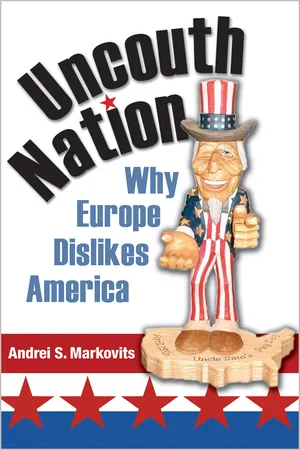
In this sweeping and provocative look at the history of European aversion to America, Andrei Markovits argues that understanding the ubiquity of anti-Americanism since September 11, 2001, requires an appreciation of such sentiments among European elites going back at least to July 4, 1776.
While George W. Bush's policies have catapulted anti-Americanism into overdrive, particularly in Western Europe, Markovits argues that this loathing has long been driven not by what America does, but by what it is. Focusing on seven Western European countries big and small, he shows how antipathies toward things American embrace aspects of everyday life--such as sports, language, work, education, media, health, and law--that remain far from the purview of the Bush administration's policies. Aggravating Europeans' antipathies toward America is their alleged helplessness in the face of an Americanization that they view as inexorably befalling them.
More troubling, Markovits argues, is that this anti-Americanism has cultivated a new strain of anti-Semitism. Above all, he shows that while Europeans are far apart in terms of their everyday lives and shared experiences, their not being American provides them with a powerful common identity--one that elites have already begun to harness in their quest to construct a unified Europe to rival America.
- 304 pages
- English
- ePUB (mobile friendly)
- Available on iOS & Android
eBook - ePub
About this book
Information
Publisher
Princeton University PressYear
2009Print ISBN
9780691173511
9780691122878
eBook ISBN
9781400827299
CHAPTER 1
Anti-Americanism as a European Lingua Franca
Anti-Americanism:
What AmericaIsvs. What AmericaDoes
Anti-Americanism is a particularly murky concept because it invariably merges antipathy toward what America does with what America is—or rather is projected to be in the eyes of its beholders.1 The difference between “does” and “is” corresponds well with Jon Elster’s distinction between “anger” and “hatred.” Elster writes: “In anger, my hostility is directed toward another’s action and can be extinguished by getting even—an action that reestablishes the equilibrium. In hatred, my hostility is directed toward another person or a category of individuals [Americans and/or Jews/Israelis in the case of this study, A.M.] who are seen as intrinsically and irremediably bad. For the world to be made whole, they have to disappear.”2 But even in hatred one needs to draw a difference between “I hate what you do” and “I hate you.” Joseph Joffe aptly differentiated between these two concepts in a lecture on anti-Americanism at Stanford University: “To attack particular policies—say, the refusal to sign on to Kyoto, the Complete Test Ban or the Landmine Ban—is not anti-American. These issues are amenable to rational discourse.. . . To argue that the U.S. defied international law by going to war against Iraq may be true or false. It is certainly not anti-American.”3
What, then, is the “real thing,” the real anti-Americanism? In his analysis, Joffe groups anti-Americanism with other forms of “anti-isms” that—for him—must satisfy the following five conditions:
1. Stereotypization (that is, statements of the type: “This is what they are all like.”)
2. Denigration (the ascription of a collective moral or cultural inferiority to the target group)
3. Omnipotence (e.g., “They control the media, the economy, the world.”)
4. Conspiracy (e.g., “This is what they want to do to us surreptitiously and stealthily—sully our racial purity, destroy our traditional, better, and morally superior ways.”)
5. Obsession (a constant preoccupation with the perceived and feared evil and powerful ways of the hated group)
Moreover, like all anti-isms, anti-Americanism constitutes “a ballet of shifting grounds and unfalsifiable denigrations whose main function, one must conclude, is to establish moral and cultural superiority vis-à-vis the Yahoos of America. In other words, it is not the facts that create the anti-ism, but anti-ism that creates and selects its own facts.”4
Thus, anti-Americanism has characteristics like any other prejudice in that its holder “prejudges” the object and its activities apart from what transpires in reality.5 Here I avail myself of Paul Snider-man’s pioneering work on prejudice. In a number of major studies, Sniderman and his colleagues demonstrate that prejudice has the following minimal characteristics:
• judging an individual not by her or his personal qualities but in reaction to her or his group membership, which is invariably seen in a pejorative light;
• seeing prejudice not as something “archaic” and retrograde but indeed as a social ordering that exists among all groups and social strata in allegedly modern and tolerant societies;
• the almost innate preference for those that are like us, even in the flimsiest way, as opposed to those that are not, a clear in-group preference over any out-group; and
• the formation of stereotypes, which, far from simplemindedness, irrationality, and retrograde thinking, has an important ordering function and thus seems to be ubiquitous.6
Just as in the case of any prejudice, anti-Americanism also says much more about those who hold it than about the object of its ire and contempt. But where it differs markedly from “classical” prejudices—such as anti-Semitism, homophobia, misogyny, and racism—is on the dimension of power. Jews, gays and lesbians, women, and ethnic minorities rarely if ever have any actual power in and over the majority populations or dominant gender of most countries. However, the real existing United States does have considerable power, which has increasingly assumed a global dimension since the end of the nineteenth century and which has, according to many scholarly analysts and now as a commonplace, become unparalleled in human history with the passing of the Cold War in the late 1980s and early 1990s. Because of this unique paradox, the separation between what America is—i.e., its way of life, its symbols, products, people—and what America does—its foreign policy writ large—will forever be jumbled and impossible to disentangle. Indeed, I see as one of this book’s main tasks—particularly through the “nonpolitical” examples assembled in chapter 3—to approximate just such a disentanglement as best one can.
While other public prejudices, particularly against the weak, have—in a fine testimony to progress and tolerance over the past forty years—become largely illegitimate in the public discourse of most advanced industrial democracies (the massive change in the accepted language about—and thus the legitimate behavior toward—women, gays, the physically challenged, minorities of all kinds, and animals, to name but a few, over the past three decades in the discourse of advanced industrial societies has been nothing short of fundamental), nothing of the sort pertains to the perceived and the actually strong. Thus, anti-Americanism not only remains acceptable in many circles but has even become commendable, indeed a badge of honor, and perhaps one of the most distinct icons of what it means to be a progressive these days precisely because it is directed against something that by no stretch of the imagination can be construed as weak. Therefore, by being anti-American, paradoxically, one adheres to a prejudice that, ipso facto, seems to confer on its bearer the stamp not of intolerance but of legitimate resister and opponent against a truly powerful force in the world. Power and its perception play—as I shall argue in this book—a parallel and highly related role as to how Jews and Israel fare in the world of accepted public opinion: While classic anti-Semitism still remains by and large illegitimate in the discourse of advanced industrial democracies because it constructs Jews as weak and victims, the position against Israel can be legitimately fraught with an unlimited number of invectives because Israel is perceived as a powerful agent victimizing Palestinians, who—not by chance—are often perceived as assuming the role of the Jews to Israel’s status as the new Nazis. Anti-Americanism, like any other prejudice, is an acquired set of beliefs, an attitude, an ideology, not an ascribed trait. Thus, it is completely independent of the national origins of its particular holder. Indeed, many Americans can be—and are—anti-American, just as Jews can be—and are—anti-Semitic, blacks can—and do—hold racist views, and women misogynist ones.7
The reason I am mentioning this is that often the very existence of anti-Americanism is denied by dint of Americans also adhering to such positions. It is not a matter of the holder’s citizenship or birthplace that ought to be the appropriate criterion but rather her/ his set of acquired beliefs about a particular collective. Indeed, as Linda Gordon and Andrew Ross argue, anti-Americanism became—often for understandable and justifiable reasons, though mostly flawed in substance and form—an integral part of the American Left’s discourse and world view.8 But here, too, context means everything. Delighting in Michael Moore’s Bowling for Columbine or Fahrenheit 9/11 in an artsy movie theater in Ann Arbor, Madison, Cambridge, or Berkeley is a completely different experience and has a vastly different meaning from having Michael Moore mutate into a veritable folk hero in Germany and much of Western Europe. To theWest European public, Moore has become a convenient shill for voicing one’s resentment toward America loudly and uninhibitedly since—after all—if Moore as a quintessential American, baseball cap and all, says all these derogatory things about Americans, so can Europeans without being accused of harboring anti-American sentiments. 9 Europeans delight in Moore regardless of whether he expresses justified criticisms of deplorable aspects of American politics and society or whether he sinks to the level of the crudest anti-Americanism imaginable, as he did, for example, during a lecture in Munich where he proclaimed to an audience roaring with jubilant laughter that Americans are stupid: “That’s why we’re smiling all the time. You can see us coming down the street. You know, ‘Hey! Hi! How’s it going?’We’ve got that big [expletive] grin on our face all the time because our brains aren’t loaded down.” To the English paper The Mirror, Moore proclaimed triumphantly that Americans “are possibly the dumbest people on the planet . . . in thrall to conniving, thieving smug [pieces of the human anatomy].”10 Statements like these, just a few of the many Moore has uttered, have nothing to do with justified criticism of policies but are merely expressions of injurious and demeaning prejudices. In the two mentioned here, Moore addresses two standard elements of traditional European anti-Americanism: first, the amicableness of Americans that always strikes Europeans as phony, superficial, and inauthentic; and second, Americans’ purported stupidity and simple-mindedness.11
Moore’s language fuels such enthusiastic approval in Europe because—on the one hand—it now seems legitimate, even laudable and progressive, to express prejudices and derogatory views concerning Americans publicly in a way that one may no longer do precisely because advances in the discourse and demeanor of tolerance over the past forty years have made the expressions of similar derogatory sentiments regarding other nationalities unacceptable;12 and because—on the other hand—these negative tropes are magnified and fortified by several degrees by Moore’s being so quintessentially American. With the exception of the British yellow press and the stands of European soccer stadiums, public expressions of humiliation like these are no longer acceptable in today’s Europe. In this context, a German friend quite correctly told me the following: “It would be unthinkable for books like Stupid White Men to hold leading positions for months at the top of Germany’s best-seller list if these stupid white men were anybody but Americans, say if they were Italians, Frenchmen, or Brits, let alone Germans. No German author would ever dream of publishing an equivalent book on Germans, and if he or she did, the book would surely not catapult to the top of the charts as it has in Moore’s case.” Racist lyrics by rappers do not become less racist by virtue of their being articulated by African American artists, but their very quality changes completely when the same lyrics are uttered by whites. Few people have a more deprecating sense of humor than Jews. Yet it makes a whale of a difference whether the jokester is Jewish or not. The content defines, but the context lends meaning.
The German proverb “Der Ton macht die Musik” (the tone makes the music) informs this study since it captures the important insight that form matters at least as much as substance, indeed that form is often the same as substance. Accordingly, this study is as much about the “how” as it is about the “what.” In particular, it holds that a steady—and growing—resentment of the United States (indeed, of most things American) has permeated European discourse and opinion since the fall of the Soviet Union in 1991 and thus the end of the bipolar Cold War world that dominated Europe since 1945. However, it also argues that the manifest nature of this antipathy hails from a very long and fertile history, and that it is only superficially related to the dislike of George W. Bush and his administrations’ policies. The latter have merely served as convenient caricatures for a much deeper structural disconnect between Europe as an emerging political entity and a new global player, on the one hand, and the United States, its main, perhaps only, genuine rival, on the other. Anti-Americanism in Europe long preceded George W. Bush and will persist long after his departure.
Anti-Americanism: Some Definitions
Lest there be any misunderstandings or conceptual uncertainties as to what exactly I mean by anti-Americanism, here is the definition offered by Paul Hollander:
Anti-Americanism is a predisposition to hostility toward the United States and American society, a relentless critical impulse toward American social, economic, and political institutions, traditions, and values; it entails an aversion to American culture in particular and its influence abroad, often also contempt for the American national character (or what is presumed to be such a character) and dislike of American people, manners, behavior, dress, and so on; rejection of...
Table of contents
- Table of Contents
- FOREWORD
- PREFACE
- INTRODUCTION
- CHAPTER 1 Anti-Americanism as a European Lingua Franca
- CHAPTER 2 European Anti-Americanism: A Brief Historical Overview
- CHAPTER 3 The Perceived “Americanization” of All Aspects of European Lives: A Discourse of Irritation and Condescension
- CHAPTER 4 The Massive Waning of America’s Image in the Eyes of Europe and the World 135
- CHAPTER 5 “T win Brothers”: European AntiߞSemitism and Anti-Americanism
- CHAPTER 6 AntiߞAmericanism: A Necessary and Welcomed Spark to Jump-start a European Identity?
- Notes
Trusted by 375,005 students
Access to over 1.5 million titles for a fair monthly price.
Study more efficiently using our study tools.
Frequently asked questions
Yes, you can cancel anytime from the Subscription tab in your account settings on the Perlego website. Your subscription will stay active until the end of your current billing period. Learn how to cancel your subscription
No, books cannot be downloaded as external files, such as PDFs, for use outside of Perlego. However, you can download books within the Perlego app for offline reading on mobile or tablet. Learn how to download books offline
Perlego offers two plans: Essential and Complete
- Essential is ideal for learners and professionals who enjoy exploring a wide range of subjects. Access the Essential Library with 800,000+ trusted titles and best-sellers across business, personal growth, and the humanities. Includes unlimited reading time and Standard Read Aloud voice.
- Complete: Perfect for advanced learners and researchers needing full, unrestricted access. Unlock 1.5M+ books across hundreds of subjects, including academic and specialized titles. The Complete Plan also includes advanced features like Premium Read Aloud and Research Assistant.
We are an online textbook subscription service, where you can get access to an entire online library for less than the price of a single book per month. With over 1.5 million books across 990+ topics, we’ve got you covered! Learn about our mission
Look out for the read-aloud symbol on your next book to see if you can listen to it. The read-aloud tool reads text aloud for you, highlighting the text as it is being read. You can pause it, speed it up and slow it down. Learn more about Read Aloud
Yes! You can use the Perlego app on both iOS and Android devices to read anytime, anywhere — even offline. Perfect for commutes or when you’re on the go.
Please note we cannot support devices running on iOS 13 and Android 7 or earlier. Learn more about using the app
Please note we cannot support devices running on iOS 13 and Android 7 or earlier. Learn more about using the app
Yes, you can access Uncouth Nation by Andrei S. Markovits in PDF and/or ePUB format, as well as other popular books in Politics & International Relations & Diplomacy & Treaties. We have over 1.5 million books available in our catalogue for you to explore.