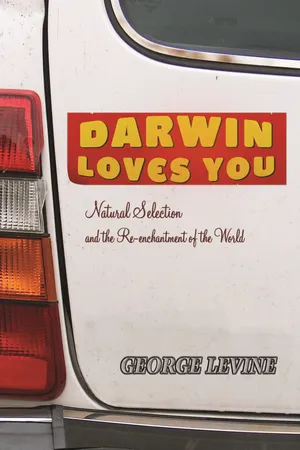
Jesus and Darwin do battle on car bumpers across America. Medallions of fish symbolizing Jesus are answered by ones of amphibians stamped "Darwin," and stickers proclaiming "Jesus Loves You" are countered by "Darwin Loves You." The bumper sticker debate might be trivial and the pronouncement that "Darwin Loves You" may seem merely ironic, but George Levine insists that the message contains an unintended truth. In fact, he argues, we can read it straight. Darwin, Levine shows, saw a world from which his theory had banished transcendence as still lovable and enchanted, and we can see it like that too--if we look at his writings and life in a new way.
Although Darwin could find sublimity even in ants or worms, the word "Darwinian" has largely been taken to signify a disenchanted world driven by chance and heartless competition. Countering the pervasive view that the facts of Darwin's world must lead to a disenchanting vision of it, Levine shows that Darwin's ideas and the language of his books offer an alternative form of enchantment, a world rich with meaning and value, and more wonderful and beautiful than ever before. Without minimizing or sentimentalizing the harsh qualities of life governed by natural selection, and without deifying Darwin, Levine makes a moving case for an enchanted secularism--a commitment to the value of the natural world and the human striving to understand it.
- 336 pages
- English
- ePUB (mobile friendly)
- Available on iOS & Android
eBook - ePub
About this book
Information
Publisher
Princeton University PressYear
2008Print ISBN
9780691136394
9780691126630
eBook ISBN
9781400827336
NOTES
PREFACE
1. In an interesting and impressive essay on the subject, Gregory Radick argues for what he calls the “inseparability thesis,” the thesis that the contingent conditions that drive the development of an argument are inseparable from that theory. So the Malthusian connection to Darwin’s theory of natural selection is intrinsic to it. Logically, the argument is very convincing, and in certain particular senses it has to be right. On the other hand, it is simply historical fact that many thinkers have in fact dissociated natural selection from Malthus. The undoubtedly correct reading of this is that in some important ways, these uses of natural selection are not truly Darwinian. But my point is that many of these thinkers claimed to be Darwinian nevertheless. Moreover, there is another problem. Radick rightly points out that as modern evolutionary theorists now understand the theory, “selection occurs whether or not resources are scarce. All that matters is that there are differences of fitness within a population.” The question for this book is whether the new understanding of natural selection could be called Darwinian. I would argue here—and much of this book is based on this view—that in any useful sense, it remains Darwinian, even if modified. It accepts the idea of natural selection and simply replaces the notion of Malthusian “struggle” with the notion of fitness differential, which remains based on a Malthusian model, though the emphasis on direct struggle is diminished. So while I understand and credit the argument of the constitutive nature of those contingent forces I emphasize, I insist that history changes the terms and complicates the issue. Much that may not be constitutive Darwinism has historically made its claim to be Darwinian. See “Is the Theory of Natural Selection Independent of Its History?” in The Cambridge Companion to Darwin, ed. Jonathan Hodge and Gregory Radick (Cambridge: Cambridge University Press, 2003), 143–67. See esp., 157–59.
2. Charles Taylor, “Modes of Secularism,” in Secularism and Its Critics, ed., Rajeev Bhargava (New Delhi: Oxford University Press, 1998), 53. In this important essay Taylor distinguishes several modes of secularism; he is concerned to work out ways in which fundamental and divergent religious beliefs may function within a politically coherent and peaceful polity. He argues that only a secularism that functions without the need of some fundamental “commonly held foundation” can any longer be expected to work. His conclusion is that to survive, secularism must function according to what he calls “overlapping consensus”; such a secularism, he asserts, and I entirely agree, is absolutely essential to the survival of modern democratic states: “either the civilized coexistence of diverse groups, or new forms of savagery. It is in this sense that secularism is not optional in the modern age” (48).
CHAPTER 1
1. William Hurrell Mallock, Is Life Worth Living? (London: Chatto and Windus, 1879), 17.
2. Stephen Pinker, How the Mind Works (New York: W. W. Norton, 1997), ix.
3. Max Weber, “Science as a Vocation,” in Max Weber: Essays in Sociology, trans. and ed. H. H. Gerth and C. Wright Mills (New York: Oxford University Press, 1946), 139.
4. William James, The Varieties of Religious Experience (1902; New York: Modern Library, 1994), 12.
5. Pinker is perhaps the most popular and yet the most unrelentingly disenchanting of current American popularizers of evolutionary psychology. On pages 306–407 of How the Mind Works he neatly summarizes the views in evolutionary psychology that read altruism into Darwin’s theory of natural selection. He fully accepts the dominant view that group selection virtually never operates in nature although it is “possible on paper” (397). To understand something of the triumphal rationalist rhetoric that marks the disenchanting view of the world, I quote here Pinker’s definition of “love”: “When an animal behaves to benefit another animal at a cost to itself biologists call it altruism. When altruism evolves because the altruist is related to the beneficiary so the altruism-causing gene benefits itself, they call it gene selection. But when we look into the psychology of the animal doing the behaving, we can give the phenomenon another name: love” (400).
6. When James defines “religion” as “feelings, acts, and experiences of individual men in their solitude, so far as they apprehend themselves to stand in relation to whatever they may consider the divine,” he leaves open (and quite intentionally) the possibility that religious experience might even be “atheistic,” as, for example, he describes both Buddhism and Emerson’s quite religious sense of life. “We must therefore, from the experiential point of view, call these godless or quasigodless creeds religion; . . . we must interpret the term ‘divine’ very broadly, as denoting any object that is godlike, whether it be a concrete deity or not” (39–40).
7. George Eliot, Middlemarch: A Study of Provincial Life (1872; Oxford: Oxford University Press, 1996), part 1, chapter 3, 24–25.
8. James Moore has shown how important it was to Darwin’s supporters and contemporaries to remove political implications from the theory. The language of “Darwinism” was laden with implications that, to ensure the full scientific acceptance of evolution, T. H. Huxley tried to avoid. Moore shows how Huxley achieved successes in part by convincing people that Darwinism was “neutral” on questions of “sociology and politics.” James Moore, “Deconstructing Darwinism: The Politics of Evolution in the 1860s.” Journal of the History of Biology 24/3 (Fall 1991): 353–408.
9. John Durant, introduction to Darwinism and Divinity: Essays on Evolution and Religious Belief, ed. John Durant (Oxford: Basil Blackwell, 1985), 2.
10. Mary Midgley, “The Religion of Evolution,” in Durant, 154.
11. Charles Darwin, On the Origin of Species by Means of Natural Selection, or the Preservation of Favoured Races in the Struggle for Life, a facsimile of the first edition (1859; Cambridge, MA: Harvard University Press, 1964), 79.
12. Diane B. Paul, “Darwin, Social Darwinism and Eugenics,” in Hodge and Radick, 214–15.
13. Stephen Shapin and Barry Barnes, “Darwin and Social Darwinism: Purity and History,” in Barry Barnes and Steven Shapin, Natural Order (Beverly Hills: Sage Publications, 1979), 125–39.
14. The Correspondence of Charles Darwin, ed. Frederick Burkhardt et al. (Cambridge: Cambridge University Press, 1985– ), 2:444.
15. Aside from the essay by Robert Young, cited below, there are many excellent essays and books making the case. Among others, see John C. Greene, Science, Ideology and World View: Essays in the History of Evolutionary Ideas (Berkeley: University of California Press, 1981); Sylvan Schweber, “Darwin and the Political Economist: Divergence of Character,” Journal of the History of Biology 13 (1980): 195–289.
16. For a full discussion and for references, see my Dying to Know: Narrative and Scientific Epistemology in Victorian England (Chicago: University of Chicago Press, 2002).
17. Adrian Desmond and James Moore, Charles Darwin: The Life of a Tormented Evolutionist (New York: Warner Books, 2001), 267.
18. Adrian Desmond and James Moore, eds., The Descent of Man, by Charles Darwin, 2d ed. (1874; London: Penguin Books, 2004), lvi.
19. Matt Ridley, The Origin of Virtue: Human Instincts and the Evolution of Cooperation (London: Penguin Books, 1996), 260.
20. It might be unfair at this point to invoke a later book by another and distinguished scientific author for “counterevidence” on the question of human interference in the processes of nature. But it is useful to notice what different sorts of ideological morals might be educed from the “facts” of nature and rigorously “Darwinian” thinking. Jared Diamond’s Collapse (New York: Viking, 2005) makes just the reverse political case from Ridley’s, condemning a pure ideology of laissez-faire as he demonstrates how twelve civilizations collapsed by virtue of following out their “natural” likes and dislikes, their “natural” desires for certain kinds of material objects.
21. Throughout this book I will have many occasions to allude to these two major biographies: Desmond and Moore, Charles Darwin (see note 17), and Janet Browne’s two-volume study, Charles Darwin: Voyaging (New York: Knopf, 1985) and Charles Darwin: The Power of Place (New York: Knopf, 2002).
22. Adrian Desmond, The Politics of Evolution: Morphology, Medicine, and Reform in Radical London (Chicago: University of Chicago Press, 1989), 412.
23. James Secord, Victorian Sensation: The Extraordinary Publication, Reception, and Secret Authorship of Vestiges of the Natural History of Creation (Chicago: University of Chicago Press, 2000).
24. Loren Eiseley, Darwin’s Century: Evolution and the Men Who Discovered It (1958; New York: Doubleday Anchor, 1961), 196.
25. See Dov Ospovat, The Development of Darwin’s Theory: Natural History, Natural Theology and Natural Selection, 1838–1859 (Cambridge: Cambridge University Press, 1981). Ospovat shows that “for many years, and in some respects throughout his life, Darwin shared his contemporaries’ belief in harmony and perfection” (3), but that between 1844 and 1859 Darwin began breaking with this natural-theological view of adaptation, until by the time the theory was fully formulated, “the idea of perfect adaptation played no role” (4). Nevertheless, the shape of the theory was largely determined by the questions a natural-theological view posed, and the centrality of the question of the “production of adaptation” is distinctly informed by natural theology.
26. James Secord, “Response,” Journal of Victorian Culture 8 (Spring 2003): 148.
27. Derek Attridge, The Singularity of Literature (London: Routledge, 2004), 22.
28. ...
Table of contents
- Table of Contents
- Preface
- Acknowledgments
- Chapter1 Secular Re-enchantment
- Chapter2 The Disenchanting Darwin
- Chapter3 Using Darwin
- Chapter4 A Modern Use Sociobiology
- Chapter5 Darwin and Pain Why Science Made Shakespeare Nauseating
- Chapter6 “And if it be a pretty woman all the better” Darwin and Sexual Selection
- Chapter7 A Kinder, Gentler, Darwin
- Epilogue What Does It Mean?
- Notes
Trusted by 375,005 students
Access to over 1.5 million titles for a fair monthly price.
Study more efficiently using our study tools.
Frequently asked questions
Yes, you can cancel anytime from the Subscription tab in your account settings on the Perlego website. Your subscription will stay active until the end of your current billing period. Learn how to cancel your subscription
No, books cannot be downloaded as external files, such as PDFs, for use outside of Perlego. However, you can download books within the Perlego app for offline reading on mobile or tablet. Learn how to download books offline
Perlego offers two plans: Essential and Complete
- Essential is ideal for learners and professionals who enjoy exploring a wide range of subjects. Access the Essential Library with 800,000+ trusted titles and best-sellers across business, personal growth, and the humanities. Includes unlimited reading time and Standard Read Aloud voice.
- Complete: Perfect for advanced learners and researchers needing full, unrestricted access. Unlock 1.5M+ books across hundreds of subjects, including academic and specialized titles. The Complete Plan also includes advanced features like Premium Read Aloud and Research Assistant.
We are an online textbook subscription service, where you can get access to an entire online library for less than the price of a single book per month. With over 1.5 million books across 990+ topics, we’ve got you covered! Learn about our mission
Look out for the read-aloud symbol on your next book to see if you can listen to it. The read-aloud tool reads text aloud for you, highlighting the text as it is being read. You can pause it, speed it up and slow it down. Learn more about Read Aloud
Yes! You can use the Perlego app on both iOS and Android devices to read anytime, anywhere — even offline. Perfect for commutes or when you’re on the go.
Please note we cannot support devices running on iOS 13 and Android 7 or earlier. Learn more about using the app
Please note we cannot support devices running on iOS 13 and Android 7 or earlier. Learn more about using the app
Yes, you can access Darwin Loves You by George Levine in PDF and/or ePUB format, as well as other popular books in Literature & European Literary Criticism. We have over 1.5 million books available in our catalogue for you to explore.