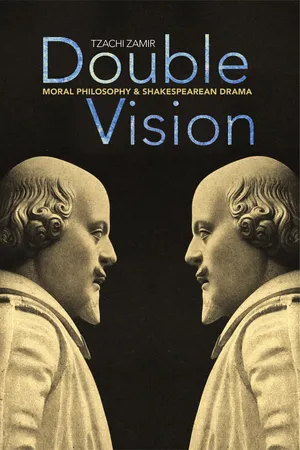
Hamlet tells Horatio that there are more things in heaven and earth than are dreamt of in his philosophy. In Double Vision, philosopher and literary critic Tzachi Zamir argues that there are more things in Hamlet than are dreamt of--or at least conceded--by most philosophers. Making an original and persuasive case for the philosophical value of literature, Zamir suggests that certain important philosophical insights can be gained only through literature. But such insights cannot be reached if literature is deployed merely as an aesthetic sugaring of a conceptual pill. Philosophical knowledge is not opposed to, but is consonant with, the literariness of literature. By focusing on the experience of reading literature as literature and not philosophy, Zamir sets a theoretical framework for a philosophically oriented literary criticism that will appeal both to philosophers and literary critics.
Double Vision is concerned with the philosophical understanding induced by the aesthetic experience of literature. Literary works can function as credible philosophical arguments--not ones in which claims are conclusively demonstrated, but in which claims are made plausible. Such claims, Zamir argues, are embedded within an experiential structure that is itself a crucial dimension of knowing. Developing an account of literature's relation to knowledge, morality, and rhetoric, and advancing philosophical-literary readings of Richard III, Macbeth, Romeo and Juliet, Othello, Antony and Cleopatra, Hamlet, and King Lear, Zamir shows how his approach can open up familiar texts in surprising and rewarding ways.
- 256 pages
- English
- ePUB (mobile friendly)
- Available on iOS & Android
eBook - ePub
About this book
Information
Publisher
Princeton University PressYear
2011Print ISBN
9780691155456
9780691125633
eBook ISBN
9781400827435
Topic
PhilosophyTable of contents
- Table of Contents
- Acknowledgments
- Introduction
- PART I PHILOSOPHICAL CRITICISM IN THEORY
- The Epistemological Basis of Philosophical Critici
- The Moral Basis of Philosophical Criticism
- Philosophical Criticism andContemporary Literary S
- PART II PHILOSOPHICAL CRITICISM IN PRACTICE
- A Case of Unfair Proportions
- Upon One Bank and Shoal of Time
- Love Stories
- Making Love
- On Being Too Deeply Loved
- Doing Nothing
- King Lear’s Hidden Tragedy
- Appendix A: A Note on Lear’s Motivation
- Appendix B: A Note on Shakespeare and Rhetoric
- Works Cited
Trusted by 375,005 students
Access to over 1.5 million titles for a fair monthly price.
Study more efficiently using our study tools.
Frequently asked questions
Yes, you can cancel anytime from the Subscription tab in your account settings on the Perlego website. Your subscription will stay active until the end of your current billing period. Learn how to cancel your subscription
No, books cannot be downloaded as external files, such as PDFs, for use outside of Perlego. However, you can download books within the Perlego app for offline reading on mobile or tablet. Learn how to download books offline
Perlego offers two plans: Essential and Complete
- Essential is ideal for learners and professionals who enjoy exploring a wide range of subjects. Access the Essential Library with 800,000+ trusted titles and best-sellers across business, personal growth, and the humanities. Includes unlimited reading time and Standard Read Aloud voice.
- Complete: Perfect for advanced learners and researchers needing full, unrestricted access. Unlock 1.5M+ books across hundreds of subjects, including academic and specialized titles. The Complete Plan also includes advanced features like Premium Read Aloud and Research Assistant.
We are an online textbook subscription service, where you can get access to an entire online library for less than the price of a single book per month. With over 1.5 million books across 990+ topics, we’ve got you covered! Learn about our mission
Look out for the read-aloud symbol on your next book to see if you can listen to it. The read-aloud tool reads text aloud for you, highlighting the text as it is being read. You can pause it, speed it up and slow it down. Learn more about Read Aloud
Yes! You can use the Perlego app on both iOS and Android devices to read anytime, anywhere — even offline. Perfect for commutes or when you’re on the go.
Please note we cannot support devices running on iOS 13 and Android 7 or earlier. Learn more about using the app
Please note we cannot support devices running on iOS 13 and Android 7 or earlier. Learn more about using the app
Yes, you can access Double Vision by Tzachi Zamir in PDF and/or ePUB format, as well as other popular books in Philosophy & Literary Criticism of Shakespeare. We have over 1.5 million books available in our catalogue for you to explore.