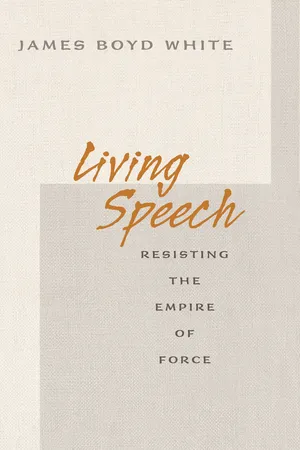
Language is our key to imagining the world, others, and ourselves. Yet sometimes our ways of talking dehumanize others and trivialize human experience. In war other people are imagined as enemies to be killed. The language of race objectifies those it touches, and propaganda disables democracy. Advertising reduces us to consumers, and clichés destroy the life of the imagination.
How are we to assert our humanity and that of others against the forces in the culture and in our own minds that would deny it? What kind of speech should the First Amendment protect? How should judges and justices themselves speak? These questions animate James Boyd White's Living Speech, a profound examination of the ethics of human expression--in the law and in the rest of life.
Drawing on examples from an unusual range of sources--judicial opinions, children's essays, literature, politics, and the speech-out-of-silence of Quaker worship--White offers a fascinating analysis of the force of our languages. Reminding us that every moment of speech is an occasion for gaining control of what we say and who we are, he shows us that we must practice the art of resisting the forces of inhumanity built into our habits of speech and thought if we are to become more capable of love and justice--in both law and life.
- 256 pages
- English
- ePUB (mobile friendly)
- Available on iOS & Android
eBook - ePub
About this book
Information
Publisher
Princeton University PressYear
2009Print ISBN
9780691138374
9780691125800
eBook ISBN
9781400827534
Topic
JuraSubtopic
Öffentliches RechtCHAPTER ONE

Speech in the Empire
Silence; valuable speech; Dante’s Divine Comedy; our world of public speech; advertising and propaganda; the “marketplace of ideas”; Robert Frost’s “The Road Not Taken”; Frankfurter and Jackson in the flag salute case; Abraham Lincoln’s letter to General Hooker.
ONE DAY WHEN I was a teenager I read about the monastic order of the Trappists and its rule of continual silence. As a highly voluble young person this seemed horrible to me, unimaginable really, and I said so to a friend and teacher, who suggested: “Perhaps a life of silence would teach us how pointless and empty almost everything we say actually is.” This struck me powerfully at the time and lives in my mind still. Later in life I happened to spend several years as an active participant in the life of the Society of Friends, or Quakers, whose meetings for worship are almost entirely silent. The idea is that this shared silence is profoundly valuable, to be interrupted only when someone feels that they simply must speak. When someone does speak, what they say is to be given deep attention, of a kind made possible by the silence.
The practices of the Trappists depend upon and make real a sense of the deep value of silence itself, of a life without spoken words; those of the Quakers stress both the value of silence and the value of a certain kind of speech—speech taking place against silence, speech made possible by silence. In both cases the silence is communal: people are together yet not speaking; they are sharing silence.
Though the practices of the Trappists and Quakers are in a sense at the edges of our social world, they invite us to think about silence and speech—about the activity of speech and the silence against which it works—in ways that may help us understand both the dangers and the opportunities that confront us whenever we speak or write.
SILENCE AND SPEECH
To begin with silence: in one sense silence is necessary to all meaningful expression. Think of the silence that precedes the concert in an orchestra hall, or the lesser silences, called rests, that make up an essential part of the music. In drama, too, silent pauses are part of the material of art, often full of significance that is expressible in no other way. Or recall how a poem looks, printed on the page, surrounded by an expanse of white—a sort of visual silence that makes the poem itself stand out where it can be seen and responded to. Much the same kind of spatial silence can be observed on museum walls where pictures are displayed, and we all know that some museums are simply too crowded to permit any picture to be seen, to be heard as it were. Silence is in fact necessary to any kind of speech, for without silence the words and phrases and syllables could not be distinguished from each other or from the noise that surrounds them; and silence is especially necessary to significant speech—speech that makes a real claim upon one’s attention and promises to reward it—for it is silence that makes attention possible and gives space for reflection.
Silence is a crucial element of speech in another way, for at least some utterances carry with them the shadows of other things: things that are not said but assumed, and which we must reconstruct or intuit or figure out from what is before us; and things that might have been said instead, other versions of what we hear, which we half-consciously construct as we proceed. Think of the way a lawyer listens to a good legal argument, for example: wondering about what is unstated but assumed as a premise, asking herself why the speaker did not make it explicit and whether he leaves himself open to attack at such a point; and at the same time contrasting what he does say, as his argument proceeds, with what she thinks that she or someone else might have said in his place.
In this kind of reading, or listening, we attend to what is before us partly by imagining what is not there, filling the spaces around the speech with our own thoughts and bringing them to bear upon it. This is an inherent part of the process by which we attend to what we read or hear. As we read we think we know what is coming next, though we are not sure; when it does come, it either confirms our judgment or surprises us by being different. And we look backwards as well as forwards, repeatedly going over in our minds what we have read or heard, tentatively putting it in retrospective order, an order that may change as new material is added to it. When we get to the end we find that in both directions what was said derives much of its meaning from what was not said.
In such ways the meaning of any expression worth real attention comes in part from silences, external and internal, silences that reflect both what is not said and what is not sayable at all. We cannot really imagine it, except as surrounded by silence; and if it invites and rewards the kind of attention I describe, it will seem to come not from the familiar part of the mind that is full of tags of remembered speech and gesture, rote pieces of speech that we assemble without thinking, but from some deep place within the self—silent, below the words, a place where language can be the subject of conscious attention and where it can be remade.
An essential feature of this kind of speech or writing is that its use of language is not automatic, but shaped or chosen. The speaker or writer tries to be aware of his language and its limits, and invites his audience to be so too; this requires of both of them an inner as well as outer silence. And this silence is not simply empty space or time, an absence of words; it is a state or condition that must be attained, by work and art and discipline, and it must be used, and used well. It is a crucial part of what we mean by the engagement of the whole mind.
Much of what we say and hear is of course not like this—not shaped by inner and outer silences—but is simply a stitching together of locutions in predictable and uninteresting ways, locutions that are not in any significant way made our own. On these occasions we speak or write as if our words and phrases were simply stored in an antechamber to the mind, ready for immediate use upon demand. Lawyers are all too familiar with this sort of speaking and writing, of which a certain kind of brief can be taken as an example: one that pieces together rules and quotations, makes distinctions, argues to conclusions, but without ever making it the work of the individual mind—as though the writer were trying to approximate a Platonic ideal of the brief that should be written in the particular case, an ideal that has its origins outside of his mind, which it is not his place to judge or shape but simply to approximate. His effort is not actually to think through the legal problem and express his thought in legal language—to say what he means in the language of the law—but to sound like someone doing those things: to sound like a lawyer, not to be one. The reader of such a brief is offered not the work of a mind with which he or she can engage, but something very different, a stitching together of phrases and formulas, none of which is truly meant.
These habits of mind and expression can of course be found outside the law as well, wherever one can find clichés and received ideas and formulas and slogans presented as though they could carry the work of thought and writing, wherever we see a system of thought applied without regard to what else can be said. As writers we fall into these habits often without knowing it. As readers we often simply acquiesce in them. Yet at some level we know that we simply cannot attend to such utterances, nor do we want to, certainly not in the same way in which we attend to expressions more deeply shaped by the internal processes I describe, of which silence is an essential element.
What I am saying then—and it is in one sense perfectly obvious—is that not all of our speech is of the same quality or nature, indeed not of the same value. What I mean by “value” here is not some instrumental effect on the world, but the real value of the speech as such, for the speaker and his or her audience: the value of speech that invites and deserves and rewards real attention, that makes possible the engagement of one mind with another. At one extreme we have the reiteration of clichés, formulas, slogans—dead language really; at the other, speech that is deeply meant and alive, coming from a place of inner silence, directed to a similar place in its audience. I assume that we all in a rough way recognize the difference between these two kinds of speech, and the kinds of thought and life they each reflect and invite, at least in their extreme forms; but how to put that recognition to work in our lives and judgments is another matter entirely, and a central subject of this book. Can we be confident that we perceive this difference accurately, as readers and hearers, when we are faced with the expressions that make up our world of speech and language? Can we protect ourselves against the appeal of the first kind of speech and resist our own desires to use and submit to it? Can we ourselves attain speech of the second kind—speech that comes from the center of the person, and is addressed to the center of its audience; speech worthy of real attention; speech upon which both individual and shared life can be built? These are our questions, and much is at stake. For it is only this kind of speech, which I call living speech, that can express the workings of the individual mind and imagination. It is what makes possible the real—if always imperfect—communication of mind with mind, person with person. Indeed it is what enables any of us to be a person in the first place.
SILENCE AND MEANING IN DANTE
Here and from time to time throughout this book I shall turn to Dante’s Divine Comedy as a work that addresses, often with astonishing success, certain central questions about language and power. At its heart it is a text that shows us both how to understand, and how not to respect, the empire of force. This may be at first a surprising claim: after all, Dante’s plainly stated political position is in favor of a vigorous and powerful empire; and in the course of the poem he elaborates a complex theological vision, drawn to a large degree from the Summa Theologica of Saint Thomas Aquinas, which it would be easy to regard also as a kind of empire—and one in which the element of “force” is beyond doubt, for Dante’s theological emperor, the Deity, is omnipotent and has used his power, especially in creating the Inferno, to define and maintain the moral coherence of the universe as he has imagined it into existence. Nonetheless—indeed partly by virtue of these commitments both to the temporal empire and the eternal rule of the Deity—this poem has much to teach us about the kind of speech and writing that understands the empire of force and how not to respect it.
In thinking about Dante’s poem, I shall pursue my themes of quality and silence, asking in particular how silence of various kinds is at work in it; how these silences shape our experience in reading it; and how that experience puts into question the various empires of force that Dante may seem on the surface to accept and promote.
Here is the famous opening of Dante’s Inferno:
Nel mezzo del cammin di nostra vita mi ritrovai per una selva oscura, che la diritta via era smarrita. (I, 1–3)
Or, much more flatly: “In the middle of the road of our life I found myself in a dark wood, because the straight way was lost.”
For most of us the most salient feature of this passage will necessarily be that it is written not in English but Italian; it must entirely depend upon the resources of that language for its effects, and we may not even understand it at all. This is an instance of the general truth that in every act of expression the speaker must choose one language or another, and whatever language he chooses to speak will silence other possibilities. To write in Italian is to be silent in every other language, and the consequences are real.
This poem is written, for example, in a verse form Dante invented for the purpose, the terza rima, which works well in Italian but not in English. This form consists of interlocking three-line stanzas, in which the first and third lines rhyme; the second line, unrhyming in one stanza, provides the rhyme for lines one and three of the next, and so on, indefinitely. In Italian this can work well, for that language has an enormous number of words that rhyme, but, as every translator discovers, terza rima does not work well in English, which does not have these resources.1This means that the most basic element of the verse cannot easily be carried over into English.
This is not a small matter: the hope of the poem to create an ordered and coherent poetic universe, mirroring God’s creation and running in imagination from the beginning of time to the day of judgment, is in a sense enacted or performed in the very structure of the verse, which runs through the whole thing. If this pattern of the verse were continued without interruption, it would connect every part of the poem and its imagined world in a seamless woven tapestry of language from beginning to end. But each Canto begins a new sequence, breaking the pattern established by its predecessor, a fact that works as a poetic admission either that the structure of the universe may not be totally coherent after all or, at least, that it cannot be represented as wholly comprehensible in human language. It would not I think be possible to use English rhymes to create such a sense of immense coherence threatened by incoherence.
The richness of Italian rhymes has more local consequences too, as these three lines reveal: its rhyme of vita and smarrita—echoed in diritta via—unites these terms to tell us that life, like the straight way, is lost, lost in confusion. The sound connects these words to establish the psychological and spiritual starting point of the entire poem. As we read a bit further we see the poem connect oscura (dark) with dura (hard) and paura (fear) to forge these words into a single set of associations.
Dante is aware of the resources of his written Italian—a language he is in fact doing m...
Table of contents
- Table of Contents
- Preface
- INTRODUCTION
- CHAPTER ONE Speech in the Empire
- CHAPTER TWO Living Speech and the Mind Behind It
- CHAPTER THREE The Desire for Meaning
- CHAPTER FOUR Writing That Calls the Reader to Life—or Death
- CHAPTER FIVE Human Dignity and the Claim of Meaning
- CHAPTER SIX Silence, Belief, and the Right to Speak
Trusted by 375,005 students
Access to over 1.5 million titles for a fair monthly price.
Study more efficiently using our study tools.
Frequently asked questions
Yes, you can cancel anytime from the Subscription tab in your account settings on the Perlego website. Your subscription will stay active until the end of your current billing period. Learn how to cancel your subscription
No, books cannot be downloaded as external files, such as PDFs, for use outside of Perlego. However, you can download books within the Perlego app for offline reading on mobile or tablet. Learn how to download books offline
Perlego offers two plans: Essential and Complete
- Essential is ideal for learners and professionals who enjoy exploring a wide range of subjects. Access the Essential Library with 800,000+ trusted titles and best-sellers across business, personal growth, and the humanities. Includes unlimited reading time and Standard Read Aloud voice.
- Complete: Perfect for advanced learners and researchers needing full, unrestricted access. Unlock 1.5M+ books across hundreds of subjects, including academic and specialized titles. The Complete Plan also includes advanced features like Premium Read Aloud and Research Assistant.
We are an online textbook subscription service, where you can get access to an entire online library for less than the price of a single book per month. With over 1.5 million books across 990+ topics, we’ve got you covered! Learn about our mission
Look out for the read-aloud symbol on your next book to see if you can listen to it. The read-aloud tool reads text aloud for you, highlighting the text as it is being read. You can pause it, speed it up and slow it down. Learn more about Read Aloud
Yes! You can use the Perlego app on both iOS and Android devices to read anytime, anywhere — even offline. Perfect for commutes or when you’re on the go.
Please note we cannot support devices running on iOS 13 and Android 7 or earlier. Learn more about using the app
Please note we cannot support devices running on iOS 13 and Android 7 or earlier. Learn more about using the app
Yes, you can access Living Speech by James Boyd White in PDF and/or ePUB format, as well as other popular books in Jura & Öffentliches Recht. We have over 1.5 million books available in our catalogue for you to explore.