This book challenges the standard conception of the Middle Ages as a time of persecution for Jews. Jonathan Elukin traces the experience of Jews in Europe from late antiquity through the Renaissance and Reformation, revealing how the pluralism of medieval society allowed Jews to feel part of their local communities despite recurrent expressions of hatred against them.
Elukin shows that Jews and Christians coexisted more or less peacefully for much of the Middle Ages, and that the violence directed at Jews was largely isolated and did not undermine their participation in the daily rhythms of European society. The extraordinary picture that emerges is one of Jews living comfortably among their Christian neighbors, working with Christians, and occasionally cultivating lasting friendships even as Christian culture often demonized Jews.
As Elukin makes clear, the expulsions of Jews from England, France, Spain, and elsewhere were not the inevitable culmination of persecution, but arose from the religious and political expediencies of particular rulers. He demonstrates that the history of successful Jewish-Christian interaction in the Middle Ages in fact laid the social foundations that gave rise to the Jewish communities of modern Europe.
Elukin compels us to rethink our assumptions about this fascinating period in history, offering us a new lens through which to appreciate the rich complexities of the Jewish experience in medieval Christendom.
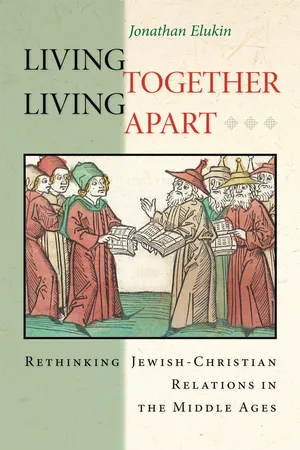
eBook - ePub
Living Together, Living Apart
Rethinking Jewish-Christian Relations in the Middle Ages
- 208 pages
- English
- ePUB (mobile friendly)
- Available on iOS & Android
eBook - ePub
Living Together, Living Apart
Rethinking Jewish-Christian Relations in the Middle Ages
About this book
Information
Publisher
Princeton University PressYear
2009Print ISBN
9780691162065
9780691114873
eBook ISBN
9781400827695

From Late Antiquity to the
Early Middle Ages
THE PERIOD from the fifth century and the first incursions of non-Roman peoples into the territories of the empire to the end of the Carolingian hegemony in the ninth century is usually seen as a period of relative security and tolerance for Jews.1 By trying to explain the tolerance, scholars have emphasized how unusual it is and how it degraded into more “normal” persecutorial relations after the year 1000. This division of medieval history between an early period of tolerance and a later period of persecution prevents us from seeing the dynamic nature of the Jewish experience before and after the year 1000. Moreover, asserting the tolerant quality of Christian treatment of Jews in early medieval Europe has had the unfortunate effect of setting in apparently higher relief the persecutions of Jews in the centuries following the First Crusade. The experience of Jews in the early years of the medieval period was certainly more complicated than any clear-cut opposition of tolerance or persecution. Jews and Christians of early medieval Europe engaged each other across a larger spectrum of relationships and experiences. Jews were deeply integrated into the rhythms of these local worlds, living as natural participants in the culture, politics, and societies of early medieval Europe.
Our search for usable evidence to illustrate the complicated dynamic between Christians and Jews will lead us quickly from the island of Minorca in the fifth century, to the towns of sixth and seventh century Gaul, to the divided society of Italy in the seventh century, and to Visigothic Spain of the same period. These variegated societies set the boundaries for the experiences of Jews in Europe until the eighth and ninth centuries, when the descendants of Charles martel—in particular—Charlemagne, gave some kind of unified religious and political identity to Western Europe.
The first “micro-Christendom” where we can see something of how Jews and Christians lived together is the island of Minorca in the early part of the fifth century. Jews could look back on centuries of continuous settlement in many of the towns and cities of Roman territory in Spain, France, and Italy.2 Even under the increasingly harsh decrees of Christianized imperial legislation, the Jews still had been guaranteed the protection of Roman laws to practice their religion.3 Early Christian theology, articulated by Augustine, reinforced this attitude in Christian terms by asserting that Jews must be allowed a place in Christian society since they helped prove the antiquity of Christianity and the authenticity of Scripture. The transition to a Christian empire did not radically alter the restrictive toleration of Jews.4 The laws emphasized the second-class status of Jews by prohibiting the conversion of Christians to Judaism. They limited contact between Jews and Christians by prohibiting mixed marriages and tried to prevent Christians from attending Jewish religious rituals. The social and physical sphere of Jews was restricted by the prohibition on the construction of new synagogues. At the same time, and this is the tension that would animate much of church law on Jews for the rest of the Middle Ages, Jews were guaranteed the freedom to practice their religion, even if that freedom was granted in denigrating and abusive language.5
The fifth century presented challenges to Jews and Christians alike. Christians were still struggling to shape their own religious identity. We are still not sure what being Christian meant to the mass of people of these largely agricultural societies.6 Moreover, those people who identified in some way as Christian were constantly subjecting their own religious identities to challenges and redefinitions. Catholics struggled violently among themselves and with Arians, Manichees, Donatists, Pelagians, and others as each group sought to define itself as orthodox and others as heretical.7 This was not an irenic, unified Christian world; it became even more complicated when the Roman Empire, increasingly Christianized after the conversion of Constantine in 337, was reshaped in the fifth century by massive incursions of ethnically non-Roman tribes from the north and east of Europe. These warrior groups, many already culturally Romanized, created new elites, ethnic identities, and sources of power in the lands of the empire.8 Even if the “fall” of Rome was really a “transformation,” the accompanying tragedies of wars, famines, and plagues shaped a fifth century in which Jews and Christians alike faced very uncertain futures.
It is against this background that we find the letter of a Christian cleric, Severus, describing the forced conversion of some members of the local Jewish community in Minorca to Christianity in 418, following the arrival of the relics of St. Stephen on the island.9 As we will see throughout the period, Jews maintained a range of personal relationships with Christians. And even under the open violence of radicalized Christians, Jews responded as fellow participants in a local culture rather than as an isolated and persecuted minority. Jews were firmly established in the local society of Minorca before the conflict with Christians began. In apparent opposition to or disregard of some of the provisions of the Theodosian Code, Jewish leaders dominated the political life of the island, with one serving as defens or—essentially governor—for the island. According to Severus,
the Jewish people relied particularly on the influence and knowledge of a certain Theodorus, who was pre-eminent in both wealth and worldly honor not only among the Jews, but also among the Christians of that town [Magona]. (2) Among the Jews he was a teacher of the Law and, if I may use their own phrase, the Father of Fathers.(3) In the town, on the other hand, he had already fulfilled all the duties of the town council and served as defensor, and even now he is considered the patronus of his fellow citizens.10
As Severus looked back to a time before the period of conflict, he recalls that relations between Jews and Christians had been marked by a warm civility. “In the end,” he writes, “even the obligation of greeting one another was suddenly broken off, and not only was our old habit of easy acquaintance disrupted, but the sinful appearance of our longstanding affection was transformed into temporary hatred, though for love of eternal salvation.”11 The bishop could not create a false history of the island where Christians had always been antagonistic toward Jews. Some kind of social peace had prevailed before the arrival of the relics. That was what was so galling to the radicalized cleric.
In addition to the normal bonds of neighbors, Jews and Christians shared a common liturgical culture based on Scripture. This connection was apparent even to Severus when he remembered the preliminaries to a debate between the two communities. As Jews and Christians marched together to a synagogue for a public debate, “along the way we began to sing a hymn to Christ in our abundance of joy. Moreover, the psalm was ‘Their memory has perished with a crash and the Lord endures forever’ [Ps. 9:7–8], and the throng of Jews also began to sing it with a wondrous sweetness.”12 Did the two groups use the same tune, or did Jews sing in Latin or Greek with the Christians? Or did the Jews recognize the psalm and begin a counter singing in Hebrew? Whatever the case, Severus recognized that the intimate sounds of liturgical music and a shared if contested Scripture connected the two communities.
As the letter opens, Severus’s attempts at converting Jews had been going on for well over a year when the relics of Stephen arrived.13 Nevertheless, Severus remembered the appearance of the relics as the event that galvanized his followers. The physical reminders of holy men and women had become the focus of Christian religiosity during the past two centuries. They provided Christians with a locus for prayers and miracles of healing. Moreover, early Christian bishops cemented their control over local communities by orchestrating the discovery and translation of the relics of local holy men and women.14
The relics may have inspired Severus, but at least in Minorca, there was no sudden conversion of the mass of Jews; it took an enormous amount of pressure to bring Jews to the baptismal font. Jews had to make difficult choices when faced with radicalized Christian violence. Some Jews followed the great men of the community into the Christian fold.15 Their leadership was not enough to persuade all the Jews. Severus describes stubborn resistance: some individuals took to the caves or held out in small groups.16 Severus remembers that Jews invoked the Maccabees as models for their struggles against the Christians.17 Individual actions under these conditions could never be predicted. Severus records that “a certain Jewish woman (by God’s arrangement, I suppose) acted recklessly, and doubtless to rouse our people from their gentleness, began to throw huge stones down on us from a higher spot.”18 An unknown number seemed to wait out the explosion of Christian radicalism and perhaps later returned to a more openly Jewish identity. The Jewish response reinforces the impression that this was a dynamic situation where individual actions and perceptions of Jewish power and security affected the outcome of the confrontation.
Whether by miracles or intimidation, some significant number (more than five hundred if we believe Severus’s account) of Jews ultimately converted. The editor’s scholarly detective work has revealed, however, that Severus’s victory was not as absolute as he wished to present it. In fact, even in 419—after the conversions—the Christians were still faced with a resilient Jewish community.19 The Jews of Minorca had not been destroyed. Their great men still occupied positions of influence and power—albeit some as newly converted Christians.20 Perhaps Severus had exaggerated the number of conversions in the first place. More likely, some conversions had been temporary measures, and part of the Jewish community reconstituted itself after the first wave of Christian intimidation.
It is important to remember that what Jews faced in Minorca was not unusual for other people throughout the Romanized world of the early fifth century. As the Huns, Vandals, Goths, and then other migrant peoples disrupted the societies of the empire, many localities would have seen groups persecuted or relocated. In this new environment when the reach of the central authorities in Rome and Constantinople had begun to weaken, many populations had to negotiate for their security and survival with local leaders. Under these conditions, traditional definitions of identity and loyalty would have come under great pressure. Jews of Minorca, at least, could weather flashes of Christian violence and extremism because their roots in the locality went very deep.
In addition, their connections to neighboring communities gave Jews refuges in towns that had not seen such outbreaks of Christian violence. As Severus recalled,
there still remained two women who refused to race to the fragrance of Christ’s unguents: the wife of that Innocentius whom we mentioned above, along with her sister, a widow of excellent reputation. (2) Yet the moment she learned that her sister’s husband, Innocentius, had been converted, she boarded ship. We not only permitted her to do this, we even encouraged her, because she could not be turned to faith in Christ by either words or miracles.21
The Mediterranean world still offered many safe harbors for Jews.

We can see many of the same patterns in Jewish-Christian relations slightly later in Merovingian Gaul. By the fifth century, the barbarian people known to the Romans as Franks had come to dominate these territories after many years of jockeying for power with local Roman leaders as well as other non-Roman peoples. By the end of the fifth century, a more or less unified kingdom was established when the great king Clovis, who had embraced Christianity (Catholicism) before a crucial battle, founded his own dynasty. At least that is the image we have from Gregory of Tours who recounts Clovis’s exploits ...
Table of contents
- Table of Contents
- Acknowledgments
- Introduction
- Chapter One From Late Antiquity to the Early Middle Ages
- Chapter Two From the Carolingians to the Twelfth Century
- Chapter Three Cultural Integration in the High Middle Ages
- Chapter Four Social Integration
- Chapter Five Violence
- Chapter Six Expulsion and Continuity
- Conclusion
- Notes
- Bibliography
Trusted by 375,005 students
Access to over 1.5 million titles for a fair monthly price.
Study more efficiently using our study tools.
Frequently asked questions
Yes, you can cancel anytime from the Subscription tab in your account settings on the Perlego website. Your subscription will stay active until the end of your current billing period. Learn how to cancel your subscription
No, books cannot be downloaded as external files, such as PDFs, for use outside of Perlego. However, you can download books within the Perlego app for offline reading on mobile or tablet. Learn how to download books offline
Perlego offers two plans: Essential and Complete
- Essential is ideal for learners and professionals who enjoy exploring a wide range of subjects. Access the Essential Library with 800,000+ trusted titles and best-sellers across business, personal growth, and the humanities. Includes unlimited reading time and Standard Read Aloud voice.
- Complete: Perfect for advanced learners and researchers needing full, unrestricted access. Unlock 1.5M+ books across hundreds of subjects, including academic and specialized titles. The Complete Plan also includes advanced features like Premium Read Aloud and Research Assistant.
We are an online textbook subscription service, where you can get access to an entire online library for less than the price of a single book per month. With over 1.5 million books across 990+ topics, we’ve got you covered! Learn about our mission
Look out for the read-aloud symbol on your next book to see if you can listen to it. The read-aloud tool reads text aloud for you, highlighting the text as it is being read. You can pause it, speed it up and slow it down. Learn more about Read Aloud
Yes! You can use the Perlego app on both iOS and Android devices to read anytime, anywhere — even offline. Perfect for commutes or when you’re on the go.
Please note we cannot support devices running on iOS 13 and Android 7 or earlier. Learn more about using the app
Please note we cannot support devices running on iOS 13 and Android 7 or earlier. Learn more about using the app
Yes, you can access Living Together, Living Apart by Jonathan Elukin in PDF and/or ePUB format, as well as other popular books in History & European Medieval History. We have over 1.5 million books available in our catalogue for you to explore.