The sign outside the conservative, white church in the small southern U.S. town announces that the church is part of the Episcopal Church--of Rwanda. In Anglican Communion in Crisis, Miranda Hassett tells the fascinating story of how a new alliance between conservative American Episcopalians and African Anglicans is transforming conflicts between American Episcopalians--especially over homosexuality--into global conflicts within the Anglican church.
In the mid-1990s, conservative American Episcopalians and Anglican leaders from Africa and other parts of the Southern Hemisphere began to forge ties in opposition to the American Episcopal Church's perceived liberalism and growing toleration of homosexuality. This resulted in dozens of American Episcopal churches submitting to the authority of African bishops.
Based on wide research, interviews with key participants and observers, and months Hassett spent in a southern U.S. parish of the Episcopal Church of Rwanda and in Anglican communities in Uganda, Anglican Communion in Crisis is the first anthropological examination of the coalition between American Episcopalians and African Anglicans. The book challenges common views--that the relationship between the Americans and Africans is merely one of convenience or even that the Americans bought the support of the Africans. Instead, Hassett argues that their partnership is a deliberate and committed movement that has tapped the power and language of globalization in an effort to move both the American Episcopal Church and the worldwide Anglican Communion to the right.
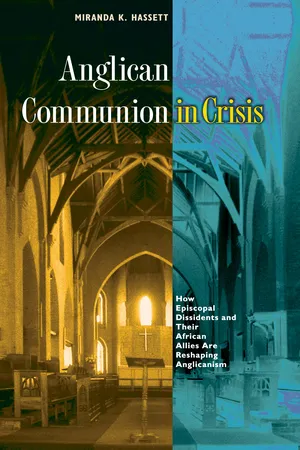
eBook - ePub
Anglican Communion in Crisis
How Episcopal Dissidents and Their African Allies Are Reshaping Anglicanism
- 320 pages
- English
- ePUB (mobile friendly)
- Available on iOS & Android
eBook - ePub
Anglican Communion in Crisis
How Episcopal Dissidents and Their African Allies Are Reshaping Anglicanism
About this book
Information
CHAPTER ONE
Renewal and Conflict: The Episcopal Church and the Province of Uganda
A YOUNG ADULT praise team kicks off the English-language Sunday service at Mukono Cathedral, the church near our home in Uganda. Today one young man fires up the synthesizer, while another takes up a micro-phone and reminds us all to praise God for the day and for all our blessings. The keyboardist plays quietly behind his words and picks up the tune immediately when the man at the microphone begins to sing: “What a mighty God we serve, what a mighty God we serve . . . .” A young woman shakes a tambourine, and two little boys keep the rhythm on traditional drums. The congregation sings and claps enthusiastically along with the music.
Praise music is one of the biggest draws of this particular service, an example of the lively, English-language, less Prayer-Book–bound services that are becoming common in Ugandan Anglican churches. Such services, described to me by one young clergyman as the “renewed Charismatic Anglican” style, appeal to many young people (and some adults) more than traditional Ugandan Anglican worship, which is based on the seventeenth- century English prayer book and nineteenth-century English hymnal, translated into local languages during the colonial period. Anglicans who attend traditional services defend the solemn tone of the traditional worship, often remarking, “Our God is a God of order.” But many young people describe the older style as boring, preferring the freedom in prayer and music that they find in the “renewed” English services.
“What a mighty God we serve . . . ” Standing in a pew among Ugandan worshipers, I sing along gamely, recalling that I learned this song in praise and worship sessions at my American fieldsite, St. Timothy’s Church. Finding myself singing the same traditional Anglican hymns in Ugandan churches and at St. Timothy’s would not be particularly surprising. After all, both American and Ugandan Anglicanism are offshoots of the Church of England, and both the Luganda hymnal and the Episcopal hymnal have roots in English hymnody. But this song is not in either hymnal. “What a mighty God we serve” is an example of contemporary praise music, a genre of Christian music that is pop-influenced in melodies, rhythms, and instrumentation, is usually lyrically simple, and stresses themes like submission to God and personal faith experiences. Praise music has entered both American and Ugandan Anglicanisms in the relatively recent past.
Even without the development of the alliances I examine here, Mukono Cathedral and St. Timothy’s would be connected through certain global networks. Both are member parishes of provinces of the worldwide Anglican Communion; both owe their identity to the historical global formations of British colonialism; and both are influenced by the global circulation of praise music and other Northern evangelical cultural products. Yet such connections link these sites only as points in a complex net-work, with no direct links or mutual awareness. And if these sites share features in common, they differ in many ways as well. True, in both American and Ugandan Anglican contexts, praise music helps define a “renewed” Anglicanism over against traditional Anglican liturgy and hymnody. The implications of this renewal, however, differ significantly between these Northern and Southern contexts. Singing the same song may carry quite different meanings, depending on one’s location within global Anglicanism.
CONTEMPORARY ANGLICANISMS: ROOTS OF A TRADITION
The Episcopal Church in the United States of America and the Church of Uganda are both branches of the worldwide Communion of Anglican churches. The Anglican Church, or Church of England, was founded when the English church broke from Roman Catholicism in 1534. The Anglican reformation made the liturgy more accessible to the laity through the development of an English-language liturgy and prayer book, while retaining much of the Catholic pattern of worship.1 Anglicans also carried on the Catholic understanding of Christian identity as rooted in participation in the sacramental rites of the church, rather than viewing church membership as primarily a matter of doctrinal belief, as in most Protestant traditions. The Church of England also maintained the doctrine of apostolic succession. Each bishop is consecrated by bishops who are part of an unbroken succession of ordinations traced back to the first Christian bishops.2 The Anglican tradition shares this sense of the sacredness of church polity with the Orthodox and Roman Catholic traditions.
Anglicanism spread around the globe with British colonialism. English missionaries planted churches wherever British political or economic involvement opened a path, and sometimes even beyond. As colonialism waned, these Anglican missions grew into independent Anglican churches and provinces. The Anglican Communion today is a worldwide communion of national or regional provinces united by their roots in the Church of England; their common loyalty to the Archbishop of Canterbury; their common faith and practice embodied in their prayer books; and their common participation in the decennial Lambeth Conference of bishops from throughout the Communion. Yet despite this shared heritage, Anglicanism today is far from a globally uniform tradition. Local cultural, political, and economic factors, and particular histories of missionization and revival, have created significant diversity among Anglican provinces.
Anglicanism possesses a dual character as both a tradition and a polity. As a tradition, Anglicanism consists of an interrelated set of meaningful elements: institutions (such as parishes and dioceses), practices (baptism, consecration, Lambeth Conferences), artifacts (prayer books, albs), roles (primate, rector), and discourses (of Anglican tradition, of liturgical order). Identification with the Anglican tradition indicates that (at least some of) these elements are held as essential aspects of a person or group’s spiritual, social, or ecclesiastical identity. Nevertheless, there is no guarantee that any two individuals or groups who hold to the Anglican tradition will be alike in practice or conviction. I define Anglicanism as a tradition because it is an indigenous terminology—Anglicans often cite the “Anglican tradition” in argumentation and explanation. I also apply, by analogy, Talal Asad’s argument for the term tradition as the most useful and flexible way to conceptualize Islam, which encompasses a tremendous variety of doctrines and practices.3
A person or group who identifies with the Anglican tradition, however, is not necessarily “officially” Anglican in terms of worldwide Anglican polity. In a 2003 interview, Episcopal priest and scholar Ian Douglas described the Anglican provinces as “autonomous . . . sibling churches,” and offered this explanation of their relationship:
Our organizational structure stands somewhere between . . . Protestant churches as federations [and] a strong, centralized church like the Roman Catholic Church. . . . The Archbishop of Canterbury does not have canonical authority or the power to tell any one church of the 38 churches in the Anglican Communion what to do, [but] who’s in or who’s out of the Anglican Communion depends on who the Archbishop of Canterbury wants to recognize as being in communion with him.4
The distinction between belonging to the Anglican tradition and belonging to the official Anglican polity (that is, being recognized by the Archbishop of Canterbury and included in gatherings of the global church) is significant in understanding the contemporary Episcopal dissident movement. Unlike earlier dissident groups, who identified strongly with the Anglican tradition but, in breaking away from the Episcopal Church, broke (albeit unwillingly) from the global Anglican polity, the dissidents of the 1990s have sought ways to leave the Episcopal Church while maintaining a defensible claim to membership in the global body through their ties with African and Asian provinces.
ANGLICANISM IN UGANDA
The first Anglican missionaries to Uganda, from the Church Missionary Society, arrived in Buganda, a kingdom in what is today central Uganda, in 1877. These British Anglicans came in response to explorer Henry Morton Stanley’s call for missionaries to come convert the Baganda people. 5 Roman Catholic missionaries from France arrived in 1879; Islam had entered Buganda in the 1840s. Two decades of struggle ensued between Christian converts and a coalition of Baganda Muslims and adherents of traditional religions; when the Christians triumphed, conflicts between Anglicans and Catholics followed. The dominance of Anglicanism was assured when British troops arrived in 1891 to claim Buganda and surrounding regions as the British protectorate of Uganda.6 Ugandan Christianity continued to grow in the wake of these conflicts. Louise Pirouet, a scholar of Ugandan Christianity, observes, “Probably in few areas [of Africa] was there an indigenous expansion of Christianity comparable to that in Uganda between 1890 and 1914.”7
Although British colonial officials refused to treat Anglicanism as an established religion in the colonial state, Anglicanism has from the start served as the de facto established church, as even the church’s name suggests: simply “the Church of Uganda.” The Church of Uganda has been both helped and hurt by its association with governmental power and especially with the Baganda people, who, favored by the British, were educated and sent to neighboring peoples to help spread British rule and British religion throughout Uganda. These Baganda leaders were resented by those they were sent to instruct or rule, and the resultant taint of domination associated with Anglicanism may account for the slight but consistent majority held by Roman Catholicism in Uganda from the early twentieth century onward.8 Today members of the Church of Uganda come from all regions, ethnic groups, and socioeconomic positions. Figures from the 1990s suggest that approximately 35 percent of Uganda’s population were Roman Catholic, about 25 percent Anglican, 8 percent other Protestants, 15 percent Muslim, and the rest nonreligious or adherents of indigenous or minority religions like Hinduism.
The Church of Uganda was founded on evangelical theology and a low-church liturgical style of relatively simple worship.9 Much of East Africa was missionized by the Church Missionary Society, which had been strongly influenced by evangelical revivalism in the Church of England that stressed spreading the gospel and encouraging all to seek a relation-ship with Jesus Christ as Savior. Pirouet describes the society:
Its members, as well as distrusting ritual, set less store by the sacraments [and] the apostolic succession in the episcopacy. . . . For evangelicals, the distinguishing mark of a true, as opposed to a nominal Christian, is not good works or habits of devotion, but the ability to look back to some definite moment in life when the person became overwhelmingly aware of himself as a sinner and of God’s complete and undeserved forgiveness.10
A low-church approach to liturgy was reinforced by the African context. As one Ugandan priest pointed out to me, austere and simple worship becomes a practical necessity for a poor parish that cannot afford many liturgical accoutrements. Further, British missionaries at times restricted access to the sacraments in order to encourage Ugandans to conform to British cultural practices. For example, communion was denied to couples who had not had church weddings, which were expensive and inaccessible for many. Under such circumstances, the Church of Uganda grew to see Christian identity as based less on sacramental participation than on knowledge of scripture and personal piety.
The evangelicalism of the nascent Church of Uganda was strengthened by the East African Revival of the 1930s and 1940s, which began in Rwanda and rapidly spread into Uganda. The East African Revival emphasized conviction of one’s sins and conversion from being a “nominal” Christian or non-Christian. Revivalists stressed seeking to correct one’s past sins, sharing one’s ongoing struggles with sin with a fellowship group, and clean living. In spite of clashes with Anglican leaders, the Balokole or “saved ones,” as those affected by the Revival were called, have staunchly remained within the Church of Uganda, devoting their energies to its revival.11 This loyalty has been rewarded; East African Revival spirituality has by now thoroughly permeated the Church of Uganda as well as the Rwandan church. Kevin Ward, a British historian and former professor at Bishop Tucker College (now Uganda Christian University), writes, “While only a minority of Church people actually belong to [Balokole] fellowship[s], the Balokole movement has tended to provide the criteria by which all Ugandan Anglicans judge themselves as faithful Christians.” 12 Many clergy and lay members of the Church of Uganda told me the East African Revival is the key to understanding today’s Church of Uganda and the strength and vitality it has to offer the world.
One significant feature of the Church of Uganda (and of many African churches) is its involvement with its members’ well-being. The Episcopal Church in the United States, an affluent church in an affluent society, carries no particular burden for the health and material development of its members. The context and obligations of the Church of Uganda are markedly different. Christian churches in Uganda have been involved from the early colonial period with the education, health, and general welfare of the Ugandan people—people who were, from the start, both members of these churches and beneficiaries of their services. Colonial-era underdevelopment, international debt, periods of active strife, and the regulations imposed on government operations by agencies like the IMF and World Bank have produced a nation with very little in the way of social, health, or development programs to serve its population.13 Non-governmental organizations (NGOs), including churches, have filled in the gaps as best they can in Uganda and in many other countries in the same predicament. The Church of Uganda, itself seriously underfunded, works for the physical welfare of its members both on its own and in partnership with other NGOs and outside church organizations (such as sister parishes or mission teams). Lay and clergy leaders, in describing their church, often stressed to me the importance of “developmentalism” and “holistic ministry,” meaning the church should improve people’s situations as well as sharing the gospel with them. Michael, a young northern Ugandan priest studying at UCU, shared his concern for his church with me as we chatted under a spreading mango tree on campus one sunny afternoon: “It is very difficult for a person to be happy, even if the person is saved, if there are no medical facilities, if there are no schools for literacy, if there are no developmental programs.”
In addition to greater involvement in the welfare of its members com-pared with the Episcopal Church, the Church of Uganda also has a much greater public role as one of the country’s largest faith bodies. The Episcopal Church appears in the secular press only when some conflict or major change of leadership takes place, but Church of Uganda leaders and events are regularly covered in Ugandan national media. As might be expected of an institution as numerically strong and nationally visible as the Church of Uganda, the church is neither particularly conservative nor particularly liberal vis-à-vis the surrounding society; in fact, the American categories of “liberal” and “conservative” do not readily apply t...
Table of contents
- Table of Contents
- Acknowledgments
- Abbreviations
- INTRODUCTION
- CHAPTER ONE Renewal and Conflict: The Episcopal Church and the Province of Uganda
- CHAPTER TWO Taking Africa Seriously: The Globalization of Conservative Episcopalians
- CHAPTER THREE “White Hands Up!” Lambeth 1998 and the Global Politics of Homosexuality
- CHAPTER FOUR From African/Asian Juggernaut to Global Orthodox Majority
- CHAPTER FIVE “At Home in Kigali”: Transnational Relationships and Domestic Dissent
- CHAPTER SIX “Who Wants to Be in the Ugandan Communion?” Perceptions of African and American Christianity
- CHAPTER SEVEN Integrity for Sale? Money and Asymmetry in Transnational Anglican Alliances
- CHAPTER EIGHT The Next Anglicanism? Conclusions and Implications
- Notes
Trusted by 375,005 students
Access to over 1.5 million titles for a fair monthly price.
Study more efficiently using our study tools.
Frequently asked questions
Yes, you can cancel anytime from the Subscription tab in your account settings on the Perlego website. Your subscription will stay active until the end of your current billing period. Learn how to cancel your subscription
No, books cannot be downloaded as external files, such as PDFs, for use outside of Perlego. However, you can download books within the Perlego app for offline reading on mobile or tablet. Learn how to download books offline
Perlego offers two plans: Essential and Complete
- Essential is ideal for learners and professionals who enjoy exploring a wide range of subjects. Access the Essential Library with 800,000+ trusted titles and best-sellers across business, personal growth, and the humanities. Includes unlimited reading time and Standard Read Aloud voice.
- Complete: Perfect for advanced learners and researchers needing full, unrestricted access. Unlock 1.5M+ books across hundreds of subjects, including academic and specialized titles. The Complete Plan also includes advanced features like Premium Read Aloud and Research Assistant.
We are an online textbook subscription service, where you can get access to an entire online library for less than the price of a single book per month. With over 1.5 million books across 990+ topics, we’ve got you covered! Learn about our mission
Look out for the read-aloud symbol on your next book to see if you can listen to it. The read-aloud tool reads text aloud for you, highlighting the text as it is being read. You can pause it, speed it up and slow it down. Learn more about Read Aloud
Yes! You can use the Perlego app on both iOS and Android devices to read anytime, anywhere — even offline. Perfect for commutes or when you’re on the go.
Please note we cannot support devices running on iOS 13 and Android 7 or earlier. Learn more about using the app
Please note we cannot support devices running on iOS 13 and Android 7 or earlier. Learn more about using the app
Yes, you can access Anglican Communion in Crisis by Miranda Hassett in PDF and/or ePUB format, as well as other popular books in Social Sciences & Christian Denominations. We have over 1.5 million books available in our catalogue for you to explore.