In the 1990s, large insurance companies failed in virtually every major market, prompting a fierce and ongoing debate about how to better protect policyholders. Drawing lessons from the failures of four insurance companies, When Insurers Go Bust dramatically advances this debate by arguing that the current approach to insurance regulation should be replaced with mechanisms that replicate the governance of non-financial firms.
Rather than immediately addressing the minutiae of supervision, Guillaume Plantin and Jean-Charles Rochet first identify a fundamental economic rationale for supervising the solvency of insurance companies: policyholders are the "bankers" of insurance companies. But because policyholders are too dispersed to effectively monitor insurers, it might be efficient to delegate monitoring to an institution--a prudential authority. Applying recent developments in corporate finance theory and the economic theory of organizations, the authors describe in practical terms how such authorities could be created and given the incentives to behave exactly like bankers behave toward borrowers, as "tough" claimholders.
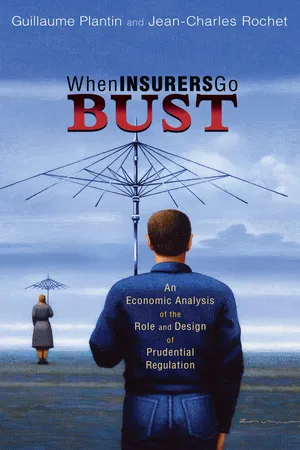
eBook - ePub
When Insurers Go Bust
An Economic Analysis of the Role and Design of Prudential Regulation
- 112 pages
- English
- ePUB (mobile friendly)
- Available on iOS & Android
eBook - ePub
When Insurers Go Bust
An Economic Analysis of the Role and Design of Prudential Regulation
About this book
Information
Publisher
Princeton University PressYear
2009Print ISBN
9780691170985
9780691129358
eBook ISBN
9781400827770
Table of contents
- Table of Contents
- Foreword
- Acknowledgements
- 1 Introduction
- 2 Four Recent Cases of Financially Distressed Insu
- 3 The State of the Art in Prudential Regulation
- 4 Inversion of the Production Cycle and Capital St
- 5 Absence of a Tough Claimholder in the Financial
- 6 How to Organize the Regulation of Insurance Comp
- 7 The Role of Reinsurance
- 8 How Does Insurance Regulation Fit within Other F
- 9 Conclusion: Prudential Regulation as a Substitut
- References
Trusted by 375,005 students
Access to over 1.5 million titles for a fair monthly price.
Study more efficiently using our study tools.
Frequently asked questions
Yes, you can cancel anytime from the Subscription tab in your account settings on the Perlego website. Your subscription will stay active until the end of your current billing period. Learn how to cancel your subscription
No, books cannot be downloaded as external files, such as PDFs, for use outside of Perlego. However, you can download books within the Perlego app for offline reading on mobile or tablet. Learn how to download books offline
Perlego offers two plans: Essential and Complete
- Essential is ideal for learners and professionals who enjoy exploring a wide range of subjects. Access the Essential Library with 800,000+ trusted titles and best-sellers across business, personal growth, and the humanities. Includes unlimited reading time and Standard Read Aloud voice.
- Complete: Perfect for advanced learners and researchers needing full, unrestricted access. Unlock 1.5M+ books across hundreds of subjects, including academic and specialized titles. The Complete Plan also includes advanced features like Premium Read Aloud and Research Assistant.
We are an online textbook subscription service, where you can get access to an entire online library for less than the price of a single book per month. With over 1.5 million books across 990+ topics, we’ve got you covered! Learn about our mission
Look out for the read-aloud symbol on your next book to see if you can listen to it. The read-aloud tool reads text aloud for you, highlighting the text as it is being read. You can pause it, speed it up and slow it down. Learn more about Read Aloud
Yes! You can use the Perlego app on both iOS and Android devices to read anytime, anywhere — even offline. Perfect for commutes or when you’re on the go.
Please note we cannot support devices running on iOS 13 and Android 7 or earlier. Learn more about using the app
Please note we cannot support devices running on iOS 13 and Android 7 or earlier. Learn more about using the app
Yes, you can access When Insurers Go Bust by Guillaume Plantin,Jean-Charles Rochet in PDF and/or ePUB format, as well as other popular books in Economics & Finance. We have over 1.5 million books available in our catalogue for you to explore.