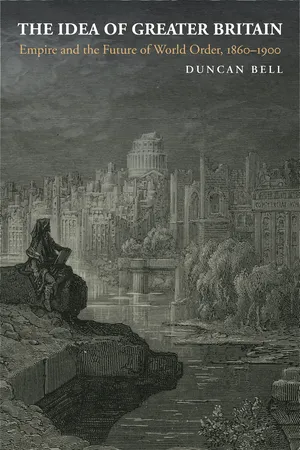
During the tumultuous closing decades of the nineteenth century, as the prospect of democracy loomed and as intensified global economic and strategic competition reshaped the political imagination, British thinkers grappled with the question of how best to organize the empire. Many found an answer to the anxieties of the age in the idea of Greater Britain, a union of the United Kingdom and its settler colonies in Australia, Canada, New Zealand, and southern Africa. In The Idea of Greater Britain, Duncan Bell analyzes this fertile yet neglected debate, examining how a wide range of thinkers conceived of this vast "Anglo-Saxon" political community. Their proposals ranged from the fantastically ambitious--creating a globe-spanning nation-state--to the practical and mundane--reinforcing existing ties between the colonies and Britain. But all of these ideas were motivated by the disquiet generated by democracy, by challenges to British global supremacy, and by new possibilities for global cooperation and communication that anticipated today's globalization debates. Exploring attitudes toward the state, race, space, nationality, and empire, as well as highlighting the vital theoretical functions played by visions of Greece, Rome, and the United States, Bell illuminates important aspects of late-Victorian political thought and intellectual life.
- 336 pages
- English
- ePUB (mobile friendly)
- Available on iOS & Android
eBook - ePub
About this book
Information
Publisher
Princeton University PressYear
2009Print ISBN
9780691151168
9780691128658
eBook ISBN
9781400827978
1
Introduction: Building Greater Britain
When we have accustomed ourselves to contemplate the whole Empire together and call it England, we shall see that here too is a United States. Here too is a homogeneous people, one in blood, language, religion, and laws, but dispersed over a boundless space.
—J. R. Seeley, The Expansion of England (1883)
A firm and well-compacted union of all the British lands would form a state that might control the whole world.
—Charles Oman, England in the Nineteenth Century (1899)
THE HISTORY of modern political thought is partly the history of the attempt to confront increasing global interdependence and competition. The Idea of Greater Britain focuses on an important but neglected aspect of this chronicle: the debate over the potential union of the United Kingdom with its so-called settler colonies—the lands we know now as Australia, Canada, New Zealand, as well as parts of South Africa—during the late Victorian age. Straddling oceans and spanning continents, this polity was to act, so its advocates proclaimed, as a guarantor of British strength and of a just and stable world. I explore the languages employed in imagining the settler empire as a single transcontinental political community, even as a global federal state, with the intention of contributing to the history of imperial thought and Victorian intellectual life. I seek to shed light on the ways in which the future of world order—the configuration and dynamics of economic and geopolitical power, and the normative architecture justifying this patterning—was perceived in an age of vital importance for the development of politics in the twentieth century and beyond.
The quest for Greater Britain was both a reaction to and a product of the complex evolution of nineteenth-century international politics. The turbulent economic and political conditions of the era engendered profound anxiety, leading to the belief that a colossal polity was indispensable for preserving strength in a world in flux. In this sense it was reactive.But it was a product in the sense that the communications technologies facilitating increasing levels of economic interdependence also generated the cognitive shift that was necessary for people to conceive of the scattered elements of the colonial empire as a coherent and unified political unit, and even as a state.1 In the last three decades of the century, a significant number of commentators responded to the widespread perception that the world was both shrinking and becoming increasingly competitive, and that this was a world in which Britain was losing (or had already lost) its midcentury preeminence.2 A strong and vibrant Greater Britain was one of the most prominent solutions offered to the crisis of confidence in national supremacy. The debate signaled an important moment in the reconfiguration of national consciousness in a late Victorian world subject to the vicissitudes of international relations and a transfiguration of the prevailing norms of domestic political culture. It was driven in part by the perceived need to theorize and construct a bulwark against the encroachment of a powerful set of global challengers, most notably Germany, the United States, and Russia. As such it illustrates the disquieting effect that the impending loss of great power status had on a generation of thinkers. But the debate also constitutes a chapter in the intricate story charting the advent of democracy. Seen by many in Britain as a world-historical development, the emergence and spread of democracy (at least among the so-called civilized) was regarded as inevitable, as the culmination, whether intended or not, of many of the social, economic, and political trends of the previous two centuries, and it spawned a constantly mutating blend of optimism and anxiety. Imperial commentators reacted in divergent ways. For some, the spread of the Anglo-Saxon peoples across the face of the earth was the main engine of global progress; Greater Britain was, as such, a virtuous agent of democratic transformation. It foreshadowed the future. The majority, however, were more skeptical, and more nervous: the arrival of democracy prompted apprehension, and sometimes even fear. It was unclear what sort of path it would carve through the modern world, and in particular how both empire and state would be reconfigured. This group often saw Greater Britain as a counterrevolutionary response, capable of taming the transition to democracy. These concerns provided the fertile soil in which ideas about Greater Britain blossomed, flourished, and finally wilted.
The dates that I have chosen for the title of the book—namely c.1860–1900—act as a rough guide rather than a precise measure for the range of materials covered. In some chapters I reach further back in time, exploring dimensions of late eighteenth-and early nineteenth-century imperial thought, while in the conclusion I discuss some developments in the early twentieth century. The bulk of the text, however, focuses on the closing decades of Victoria’s reign. Both the proximate cause of the explosion of interest in Greater Britain, and the shifts in the perception of the planet that helped underpin the idea of an integrated global polity, can be traced principally to the 1860s. The early 1870s saw a surge in proposals for an imperial federal system; during the 1880s this turned into a flood. From the mid-1890s confidence in the project of transforming the constitutional structures of the empire began to decline, as legislative success eluded the imperialists, as the leaders of the colonies displayed limited enthusiasm for such ideas, and as imperial priorities were increasingly focused on southern Africa. The war in South Africa (1899–1902) redirected imperial political thought in numerous ways, and it is for this reason that I stop at the turn of the century. Tracing the changes, as well as the various lines of continuity, would require another book.
The remainder of this introduction sets the scene for the following chapters. In the next section I explore some of the meanings of the term “Greater Britain.” I then examine the role of the imperial federation movement within the wider discourse of Greater Britain and locate the book in relation to recent work in the history of political thought and imperial history. The final section provides an outline of the arguments presented, and a breakdown of the individual chapters.
THE BOUNDARIES OF IMPERIAL DISCOURSE: IMAGINING GREATER BRITAIN
During the 1830s and 1840s the relationship between the rapidly expanding settler colonies and London came under increasing scrutiny. The Canadian rebellions (1837–38) marked a watershed, catalyzing interest in conceding limited self-government to the settlers. The late 1840s and 1850s saw many of them granted “responsible government,” which meant, in essence, the creation of limited representative institutions. 3 It was generally assumed that such changes would eventually result in the independence of the colonies; the point of reform was to push such a moment far into the future and to make sure that when it came the terms of separation would be amicable. “Every colony,” argued the radical politician J. A. Roebuck in 1849, “ought by us to be looked upon as a country destined, at some period of its existence, to govern itself,” a point echoed in 1856 by Arthur Mills, an esteemed Tory colonial commentator, who stated that “to ripen those communities to the earliest possible maturity—social, political, and commercial—to qualify them, by all the appliances within the reach of a parent State, for present self-government, and eventual independence, is now the universally admitted object and aim of our Colonial policy.” 4 During the 1860s, however, many watchful observers perceived an imminent threat to the empire. This trepidation resonated throughout sections of the British elite for the remainder of the century, shaping the debate over the aims and the structure of Greater Britain.
Two distinct but related fears helped to generate and sustain the debate. From the 1860s onward many imperial thinkers were concerned with the potential impact of a socially and morally corrosive “materialism” on the population as a whole, and on the Liberal party in particular. While this fear was sharpened by a growing awareness of the constraints on British global power, the chief source of alarm was domestic.5 It was widely thought that under the pernicious influence of Cobdenite “Manchesterism” (as well as the rigor of Gladstonian fiscal prudence), the newly enfranchised middle and working classes would become increasingly selfish and introverted. Their sense of patriotism would evaporate. To such people, the empire would seem a burden rather than a source of greatness. Had not Adam Smith and many of his disciples derided the value of the colonies? Claiming to follow in his footsteps, the radical polemicist Goldwin Smith made a strident intervention in political debate with The Empire (1863), a collection of essays demanding the emancipation of the colonies. Gesturing in his direction, one exasperated imperialist complained that there “have been springing up of late years a number of half-politi-cal charlatans, half ignoramuses, who are contending that the colonies are of no use to the mother country.” 6 It was feared that this attitude would lead invariably to either benign neglect or explicitly “anti-imperial” legislation. In either case, the empire faced a dangerous challenge. Then, secondly, during the 1880s apprehension was heightened by further turmoil over democracy, Irish Home Rule, and mounting economic and geopolitical competition. This was the decade in which “socialism” came to be seen as an imminent threat to the body politic and in which the global political horizon darkened perceptibly. The two fears inspired intense disquiet about the future stability and greatness of the polity.
A number of options were canvassed, and the period witnessed rivalry between diverse conceptions of empire.7 During the 1870s Benjamin Disraeli propounded a vision of a military empire focused on Asia, stressing the value of India, the danger of Russia, and the imperative of bringing “civilization” to “backward” peoples. It was this particular rendition of a long-standing theme in British imperial thought and practice that served as the target of Gladstone’s successful Midlothian campaign (1879–80).8 Throughout the last three decades of the century, however, the focus increasingly shifted to the “Anglo-Saxon” empire. Grandiose visions of colonial unity found emotive and symbolic expression in poetry, prayer, song, and major architectural projects, as well as through the more conventional media of political thought.9 A small minority continued to advocate independence for the settler colonies, most notably Cobden, Bright, and Goldwin Smith;10 others recommended limiting reform to minor tinkering, such as conferring more honors on colonial statesmen. Many still believed, even if they did not seek to support, an argument that since self-government had been awarded to the settler communities, it was inevitable that they would eventually become independent. Decreed by fate, this process should be left to follow its natural course.11 The most persistent, ambitious, and from the perspective of political thought, the most interesting response, however, was the demand for a united Greater Britain.
During the late nineteenth century political theorizing was, as Jose Harris has observed, “virtually a national sport of British intellectuals of all ideological and professional complexions.”12 Debate over the empire was no exception and it drew in a wide range of participants. Who were the proponents of Greater Britain, and what was their intended audience? Most of the figures examined in this book can be classified, to employ Stefan Collini’s felicitous phrase, as “public moralists.”13 They formed part of the elite class of academics, businessmen, lawyers, politicians, and journalists—often combining several of these roles simultaneously—who shaped public debate in London, the imperial metropolis. Some were prominent colonial politicians who entered the metropolitan intellectual fray only occasionally. A further category comprised the stalwarts of the organizations central to imperial debate—in particular the Colonial Society (founded in 1868)14 and the Imperial Federation League (1884–1893)—who served as propagandists and prophets of a new world. Virtually all of the high-profile advocates were men; this was a heavily gendered discourse. The colonial unionists generated a vast amount of material, penning hundreds of books, pamphlets, speeches, and essays published in the leading periodicals of the day.15 It is on these sources that I mainly focus. Although the movement itself stretched around the globe, with outposts located in the towns and cities of the empire, the debate centered on London, for it was consid...
Table of contents
- Table of Contents
- Acknowledgments
- Abbreviations
- Chapter 1 Introduction: Building Greater Britain
- Chapter 2 Global Competition and Democracy
- Chapter 3 Time, Space, Empire
- Chapter 4 Empire, Nation, State
- Chapter 5 The Politics of the Constitution
- Chapter 6 The Apostle of Unity
- Chapter 7 The Prophet of Righteousness
- Chapter 8 From Ancient to Modern
- Chapter 9 Envisioning America
- Chapter 10 Conclusion: Lineages of Greater Britain
- Select Bibliography
Trusted by 375,005 students
Access to over 1.5 million titles for a fair monthly price.
Study more efficiently using our study tools.
Frequently asked questions
Yes, you can cancel anytime from the Subscription tab in your account settings on the Perlego website. Your subscription will stay active until the end of your current billing period. Learn how to cancel your subscription
No, books cannot be downloaded as external files, such as PDFs, for use outside of Perlego. However, you can download books within the Perlego app for offline reading on mobile or tablet. Learn how to download books offline
Perlego offers two plans: Essential and Complete
- Essential is ideal for learners and professionals who enjoy exploring a wide range of subjects. Access the Essential Library with 800,000+ trusted titles and best-sellers across business, personal growth, and the humanities. Includes unlimited reading time and Standard Read Aloud voice.
- Complete: Perfect for advanced learners and researchers needing full, unrestricted access. Unlock 1.5M+ books across hundreds of subjects, including academic and specialized titles. The Complete Plan also includes advanced features like Premium Read Aloud and Research Assistant.
We are an online textbook subscription service, where you can get access to an entire online library for less than the price of a single book per month. With over 1.5 million books across 990+ topics, we’ve got you covered! Learn about our mission
Look out for the read-aloud symbol on your next book to see if you can listen to it. The read-aloud tool reads text aloud for you, highlighting the text as it is being read. You can pause it, speed it up and slow it down. Learn more about Read Aloud
Yes! You can use the Perlego app on both iOS and Android devices to read anytime, anywhere — even offline. Perfect for commutes or when you’re on the go.
Please note we cannot support devices running on iOS 13 and Android 7 or earlier. Learn more about using the app
Please note we cannot support devices running on iOS 13 and Android 7 or earlier. Learn more about using the app
Yes, you can access The Idea of Greater Britain by Duncan Bell in PDF and/or ePUB format, as well as other popular books in Politics & International Relations & British History. We have over 1.5 million books available in our catalogue for you to explore.