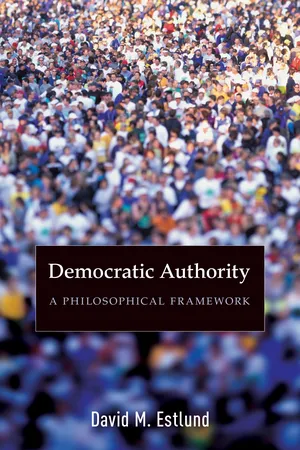
Democracy is not naturally plausible. Why turn such important matters over to masses of people who have no expertise? Many theories of democracy answer by appealing to the intrinsic value of democratic procedure, leaving aside whether it makes good decisions. In Democratic Authority, David Estlund offers a groundbreaking alternative based on the idea that democratic authority and legitimacy must depend partly on democracy's tendency to make good decisions.
Just as with verdicts in jury trials, Estlund argues, the authority and legitimacy of a political decision does not depend on the particular decision being good or correct. But the "epistemic value" of the procedure--the degree to which it can generally be accepted as tending toward a good decision--is nevertheless crucial. Yet if good decisions were all that mattered, one might wonder why those who know best shouldn't simply rule.
Estlund's theory--which he calls "epistemic proceduralism"--avoids epistocracy, or the rule of those who know. He argues that while some few people probably do know best, this can be used in political justification only if their expertise is acceptable from all reasonable points of view. If we seek the best epistemic arrangement in this respect, it will be recognizably democratic--with laws and policies actually authorized by the people subject to them.
- 324 pages
- English
- PDF
- Available on iOS & Android
eBook - PDF
About this book
Information
Publisher
Princeton University PressYear
2009Print ISBN
9780691143248
9780691124179
eBook ISBN
9781400831548
Table of contents
- Cover
- Title
- Copyright
- Contents
- Preface
- CHAPTER I: Democratic Authority
- CHAPTER II: Truth and Despotism
- CHAPTER III: An Acceptability Requirement
- CHAPTER IV: The Limits of Fair Procedure
- CHAPTER V: The Flight from Substance
- CHAPTER VI: Epistemic Proceduralism
- CHAPTER VII: Authority and Normative Consent
- CHAPTER VIII: Original Authority and the Democracy/Jury Analogy
- CHAPTER IX: How Would Democracy Know?
- CHAPTER X: The Real Speech Situation
- CHAPTER XI: Why Not an Epistocracy of the Educated?
- CHAPTER XII: The Irrelevance of the Jury Theorem
- CHAPTER XIII: Rejecting the Democracy/Contractualism Analogy
- CHAPTER XIV: Utopophobia: Concession and Aspiration in Democratic Theory
- Notes
- Bibliography
- Index
Trusted by 375,005 students
Access to over 1.5 million titles for a fair monthly price.
Study more efficiently using our study tools.
Frequently asked questions
Yes, you can cancel anytime from the Subscription tab in your account settings on the Perlego website. Your subscription will stay active until the end of your current billing period. Learn how to cancel your subscription
No, books cannot be downloaded as external files, such as PDFs, for use outside of Perlego. However, you can download books within the Perlego app for offline reading on mobile or tablet. Learn how to download books offline
Perlego offers two plans: Essential and Complete
- Essential is ideal for learners and professionals who enjoy exploring a wide range of subjects. Access the Essential Library with 800,000+ trusted titles and best-sellers across business, personal growth, and the humanities. Includes unlimited reading time and Standard Read Aloud voice.
- Complete: Perfect for advanced learners and researchers needing full, unrestricted access. Unlock 1.5M+ books across hundreds of subjects, including academic and specialized titles. The Complete Plan also includes advanced features like Premium Read Aloud and Research Assistant.
We are an online textbook subscription service, where you can get access to an entire online library for less than the price of a single book per month. With over 1.5 million books across 990+ topics, we’ve got you covered! Learn about our mission
Look out for the read-aloud symbol on your next book to see if you can listen to it. The read-aloud tool reads text aloud for you, highlighting the text as it is being read. You can pause it, speed it up and slow it down. Learn more about Read Aloud
Yes! You can use the Perlego app on both iOS and Android devices to read anytime, anywhere — even offline. Perfect for commutes or when you’re on the go.
Please note we cannot support devices running on iOS 13 and Android 7 or earlier. Learn more about using the app
Please note we cannot support devices running on iOS 13 and Android 7 or earlier. Learn more about using the app
Yes, you can access Democratic Authority by David Estlund in PDF and/or ePUB format, as well as other popular books in Política y relaciones internacionales & Gobierno estadounidense. We have over 1.5 million books available in our catalogue for you to explore.