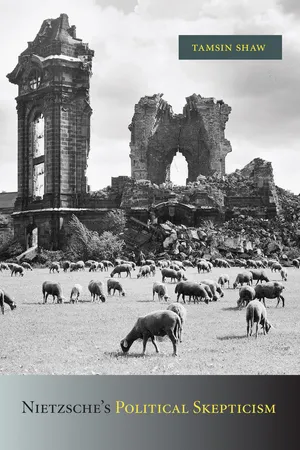
Political theorists have long been frustrated by Nietzsche's work. Although he develops profound critiques of morality, culture, and religion, it is very difficult to spell out the precise political implications of his insights. He himself never did so in any systematic way. In this book, Tamsin Shaw claims that there is a reason for this: Nietzsche's insights entail a distinctive form of political skepticism.
Shaw argues that the modern political predicament, for Nietzsche, is shaped by two important historical phenomena. The first is secularization, or the erosion of religious belief, and the fragmentation of moral life that it entails. The second is the unparalleled ideological power of the modern state. The promotion of Nietzsche's own values, Shaw insists, requires resistance to state ideology. But Nietzsche cannot envisage how these values might themselves provide a stable basis for political authority; this is because secular societies, lacking recognized normative expertise, also lack a reliable mechanism for making moral insight politically effective.
In grappling with this predicament, Shaw claims, Nietzsche raises profound questions about political legitimacy and political authority in the modern world.
- 192 pages
- English
- ePUB (mobile friendly)
- Available on iOS & Android
eBook - ePub
Nietzsche's Political Skepticism
About this book
Information
Publisher
Princeton University PressYear
2009Print ISBN
9780691146539
9780691133225
eBook ISBN
9781400828128
CHAPTER 1
The Predatory State
INTRODUCTION
In a speech to the Prussian Chamber of Peers, in 1873, Bismarck defended his Kulturkampf, the battle that he had lately been so vehemently waging against the political power of the Catholic Church in Germany. He insisted that it was not “a matter of a struggle between faith and unbelief.” Rather “it is a matter,” he declared, “of the age-old struggle for power, as old as the human race itself, between kingship and the priestly caste, a struggle for power that goes back far beyond the coming of our Saviour to this world.”1 The conflict between the secular state and religious authority was given the stamp of inevitability and Protestants across the Reich hurriedly aligned themselves with the secular cause.
Nietzsche had, by this time, already come to the conclusion that religious belief had been discredited and was destined to die out. But we do not find in his work any celebration of victory on behalf of the secular political powers. Instead we find an increasingly cautious and even hostile attitude to the state and its ideological reach. His wariness arises from an interesting analysis of the nature of political authority in the modern world.
In his early work, he identifies two important features of the modern world. The first is secularization. In The Birth of Tragedy, he describes to us the way in which rational reflection eroded the horizons of myth that bounded Greek culture of the Tragic Age.2 And in the Untimely Meditations he describes the “whirlpool of secularization [Verweltlichung]” that occurs as Christian faith recedes.3 The loss of a shared worldview entails a breakdown of previous forms of normative consensus.
The second is the rise of the modern state. Political power, in the modern world, must be accepted as legitimate.4 So the modern state, which cannot rule through force alone, requires allegiance rooted in some degree of normative consensus. It also has the capacity to manufacture this consensus. Nietzsche is struck by the spell-binding charisma of political leaders, but also (as we shall see) by the more insidious means that the state employs, through control of education, to establish its ideological grip.5
It is these two phenomena that define, for Nietzsche, the political predicament of the modern world. He paints a vivid picture for us. It is one that will later find echoes in Max Weber’s vision of the rise of the modern state and the simultaneous fragmentation of moral life through secularization.6
In his On the Genealogy of Morality, Nietzsche presents us with a particularly striking image of the state. In its essential, original form, he says, the state was a “pack of blond beasts of prey” that sank its claws into a vulnerable populace.7 This vision of the predatory state has deep roots in his thought. It dates back to the 1870s, when the founding of the new German Reich made him vividly aware of the state as an abstract agent, aggressively pursuing power and doing so, in particular, through ideological control. As we shall see, in that period, his Basel colleague, Jacob Burckhardt, provided him with a view of politics that emphasized the perpetual potential conflict between coercive political power and the realm of culture, governed by the noncoercive authority of norms.
For both Burckhardt and Nietzsche, we will see, the modern state must establish its authority by promoting the acceptance of laws, norms, and obligations. It must aim for “legitimacy” in the merely descriptive sense. But the state’s end in promoting such consensus is the maintenance of its own power. In its very essence, the state seeks to control. In its modern historical form it has acquired an especially acute ideological need. Traditional and religious legitimations are being eroded.8 The maintenance of ideological control becomes the object of an explicit form of calculation, governed by reasons of state.
I shall use the term ideology to denote beliefs that are manufactured by the state for the purposes of sustaining its own power. The relevant claim is not that they are all bound to be false. Some of them may adventitiously coincide with the truth. Rather, it is that they do not aim at the truth. The aim in producing them is to support and legitimate the authority of states.9
Nietzsche does not advocate the overthrow of the state.10 In fact, we will see that stable political authority is a necessary precondition for the kinds of human achievements that he values. But he cannot concede to the state the kind of ideological power that maintenance of its authority seems to require. In this chapter, I will argue that Nietzsche is strongly committed to the view that our values should be determined by an independent form of normative authority, and that this should shape political life rather than vice versa. The problem, as we will see in later chapters, is that he cannot envisage how such an independent source of normative authority might provide a bulwark against the ideological power of the state.
POLITICAL REALISM
The merely descriptive view of the state’s ideological need and capacity is perfectly compatible with political realism. But Nietzsche is no political realist, and it is important to distinguish his skeptical view from this position.11 He, of course, expresses vehement opposition to Bismarckian realpolitik. But he also has deeper, philosophical reasons for rejecting political realism.
Many recent theorists of the state have been political realists of various kinds, who reject the view that questions about normative truths or objective values can play any helpful role in thinking about political legitimacy.12 According to such a view, the functioning of states requires their legitimacy in the sense of conformity to established positive law. But although we might ask descriptive questions about what kind of ethical context promotes acceptance of these laws, we need not (and cannot practicably) require that this acceptance be justified in any higher normative sense.13 I shall claim that Nietzsche wants to make at least some normative demands on state power, for he holds that our capacity to recognize independent criteria for beliefs and values must be preserved.
Political realism in relation to legitimacy (we will set aside the better-known connotations that the term has acquired as a theory of international relations) can take several different forms. First of all, what I shall call scientific realism is concerned with descriptive claims about the nature of political life. Insofar as this involves confronting salient facts about political reality it seems uncontroversial to say that Nietzsche, like most political thinkers, was a realist in at least this sense. In its most influential form, now associated with Weber, scientific realism stresses the fact that politics inevitably involves the pursuit of power. Nietzsche certainly shares this concern.14 But some scientific realists might further wish to suspend normative questions about politics altogether, and in this sense Nietzsche is not a pure scientific realist. As we shall see, his concern with the state is normatively driven.15
Second, one might be a skeptical political realist. By this I shall mean a position that (unlike the view that I am calling “political skepticism”) is derived from a more general normative skepticism. On such a view, there is no meaningful distinction between normative beliefs and mere ideology; on the most reductive reading, both could only ever be assertions and hence expressions of power. So whereas the scientific realist claims that politics involves the pursuit of power, the skeptical realist makes the further claim that politics cannot involve anything but the pursuit of power.16 But I shall argue that Nietzsche’s attitude to the state could not be accounted for by such a view. His desire to preserve independence from state ideology rules out this position.
Third, one might be a normative political realist. This would involve making the normative claim that politics should not involve anything but the pursuit of power. It is a view that has been widely attributed to Nietzsche, in the form of a politics of “will to power.”17 This would allow us to locate him in the reason-of-state tradition that had come to dominate German political thought. But I shall argue that he is not a normative political realist in this sense. He clearly values things that are threatened by the state’s encroaching authority. He does not take state power to be his supreme value.
NORMATIVE POLITICAL REALISM AND REALPOLITIK
In Nietzsche’s early and middle writings he clearly aligns himself with the cr...
Table of contents
- Table of Contents
- Abbreviations
- Introduction
- CHAPTER 1 The Predatory State
- CHAPTER 2 The SelfߞDestruction of Secular Religions
- CHAPTER 3 Laws of Agreement
- CHAPTER 4 Nietzsche as a Moral Antirealist
- CHAPTER 5 Nietzsche as a Moral Realist
- CHAPTER 6 Nietzsche as a Skeptic about Liberalism
- Acknowledgments
Trusted by 375,005 students
Access to over 1.5 million titles for a fair monthly price.
Study more efficiently using our study tools.
Frequently asked questions
Yes, you can cancel anytime from the Subscription tab in your account settings on the Perlego website. Your subscription will stay active until the end of your current billing period. Learn how to cancel your subscription
No, books cannot be downloaded as external files, such as PDFs, for use outside of Perlego. However, you can download books within the Perlego app for offline reading on mobile or tablet. Learn how to download books offline
Perlego offers two plans: Essential and Complete
- Essential is ideal for learners and professionals who enjoy exploring a wide range of subjects. Access the Essential Library with 800,000+ trusted titles and best-sellers across business, personal growth, and the humanities. Includes unlimited reading time and Standard Read Aloud voice.
- Complete: Perfect for advanced learners and researchers needing full, unrestricted access. Unlock 1.5M+ books across hundreds of subjects, including academic and specialized titles. The Complete Plan also includes advanced features like Premium Read Aloud and Research Assistant.
We are an online textbook subscription service, where you can get access to an entire online library for less than the price of a single book per month. With over 1.5 million books across 990+ topics, we’ve got you covered! Learn about our mission
Look out for the read-aloud symbol on your next book to see if you can listen to it. The read-aloud tool reads text aloud for you, highlighting the text as it is being read. You can pause it, speed it up and slow it down. Learn more about Read Aloud
Yes! You can use the Perlego app on both iOS and Android devices to read anytime, anywhere — even offline. Perfect for commutes or when you’re on the go.
Please note we cannot support devices running on iOS 13 and Android 7 or earlier. Learn more about using the app
Please note we cannot support devices running on iOS 13 and Android 7 or earlier. Learn more about using the app
Yes, you can access Nietzsche's Political Skepticism by Tamsin Shaw in PDF and/or ePUB format, as well as other popular books in Politics & International Relations & Ethics & Moral Philosophy. We have over 1.5 million books available in our catalogue for you to explore.