Not since the 1960s have U.S. politicians, Republican or Democrat, campaigned on platforms defending big government, much less the use of regulation to help solve social ills. And since the late 1970s, "deregulation" has become perhaps the most ubiquitous political catchword of all. This book takes on the critics of government regulation. Providing the first major alternative to conventional arguments grounded in public choice theory, it demonstrates that regulatory government can, and on important occasions does, advance general interests.
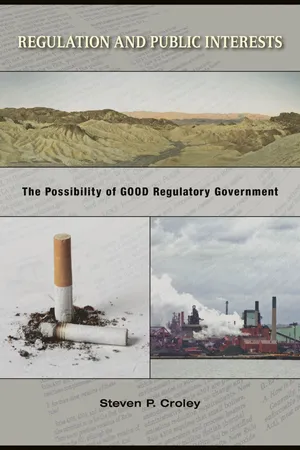
Unlike previous accounts, Regulation and Public Interests takes agencies' decision-making rules rather than legislative incentives as a central determinant of regulatory outcomes. Drawing from both political science and law, Steven Croley argues that such rules, together with agencies' larger decision-making environments, enhance agency autonomy. Agency personnel inclined to undertake regulatory initiatives that generate large but diffuse benefits (while imposing smaller but more concentrated costs) can use decision-making rules to develop socially beneficial regulations even over the objections of Congress and influential interest groups. This book thus provides a qualified defense of regulatory government. Its illustrative case studies include the development of tobacco rulemaking by the Food and Drug Administration, ozone and particulate matter rules by the Environmental Protection Agency, the Forest Service's "roadless" policy for national forests, and regulatory initiatives by the Securities and Exchange Commission and the Federal Trade Commission.
eBook - ePub
Regulation and Public Interests
The Possibility of Good Regulatory Government
- 392 pages
- English
- ePUB (mobile friendly)
- Available on iOS & Android
eBook - ePub
About this book
Information
Publisher
Princeton University PressYear
2009Print ISBN
9780691134642
9780691130859
eBook ISBN
9781400828142
Table of contents
- Table of Contents
- Acknowledgments
- Introduction
- PART I THE CYNICAL VIEW OF REGULATORY GOVERNMENT, AND ITS ALTERNATIVES
- Chapter One The Basic Project
- Chapter Two The Cynical View of Regulation
- Chapter Three Is Regulatory Capture Inevitable?
- Chapter Four Alternative Visions of Regulatory Government
- PART II THE ADMINISTRATIVE REGULATORY STATE
- Chapter Five Opening the Black Box: Regulatory Decisionmaking in Legal Context
- Chapter Six Regulatory Government as Administrative Government
- Chapter Seven Participation in Administrative Decisionmaking
- Chapter Eight The AdministrativeߞProcess Approach Expanded: A More Developed Picture
- PART III PUBLIC INTERESTED REGULATION
- Chapter Nine The Environmental Protection Agencys Ozone and Particulate Matter Rules
- Chapter Ten The Food and Drug Administrations Tobacco Initiative
- Chapter Eleven The Forest Services Roadless Policy for National Forests
- Chapter Twelve Socially Beneficial Administrative Decisionmaking:Additional Evidence
- PART IV PUBLIC CHOICE AND ADMINISTRATIVE PROCESS
- Chapter Thirteen The Public Choice Theory Revisited
- Chapter Fourteen The Promise of an AdministrativeߞProcess Orientation
- Chapter Fifteen Regulatory Rents, Regulatory Failures, and Other Objections
- Conclusion The Regulatory State and Social Welfare
- Notes
Trusted by 375,005 students
Access to over 1.5 million titles for a fair monthly price.
Study more efficiently using our study tools.
Frequently asked questions
Yes, you can cancel anytime from the Subscription tab in your account settings on the Perlego website. Your subscription will stay active until the end of your current billing period. Learn how to cancel your subscription
No, books cannot be downloaded as external files, such as PDFs, for use outside of Perlego. However, you can download books within the Perlego app for offline reading on mobile or tablet. Learn how to download books offline
Perlego offers two plans: Essential and Complete
- Essential is ideal for learners and professionals who enjoy exploring a wide range of subjects. Access the Essential Library with 800,000+ trusted titles and best-sellers across business, personal growth, and the humanities. Includes unlimited reading time and Standard Read Aloud voice.
- Complete: Perfect for advanced learners and researchers needing full, unrestricted access. Unlock 1.5M+ books across hundreds of subjects, including academic and specialized titles. The Complete Plan also includes advanced features like Premium Read Aloud and Research Assistant.
We are an online textbook subscription service, where you can get access to an entire online library for less than the price of a single book per month. With over 1.5 million books across 990+ topics, we’ve got you covered! Learn about our mission
Look out for the read-aloud symbol on your next book to see if you can listen to it. The read-aloud tool reads text aloud for you, highlighting the text as it is being read. You can pause it, speed it up and slow it down. Learn more about Read Aloud
Yes! You can use the Perlego app on both iOS and Android devices to read anytime, anywhere — even offline. Perfect for commutes or when you’re on the go.
Please note we cannot support devices running on iOS 13 and Android 7 or earlier. Learn more about using the app
Please note we cannot support devices running on iOS 13 and Android 7 or earlier. Learn more about using the app
Yes, you can access Regulation and Public Interests by Steven P. Croley in PDF and/or ePUB format, as well as other popular books in Law & Administrative Law. We have over 1.5 million books available in our catalogue for you to explore.