Unlike many other countries, the United States has few constitutional guarantees of social welfare rights such as income, housing, or healthcare. In part this is because many Americans believe that the courts cannot possibly enforce such guarantees. However, recent innovations in constitutional design in other countries suggest that such rights can be judicially enforced--not by increasing the power of the courts but by decreasing it. In Weak Courts, Strong Rights, Mark Tushnet uses a comparative legal perspective to show how creating weaker forms of judicial review may actually allow for stronger social welfare rights under American constitutional law.
Under "strong-form" judicial review, as in the United States, judicial interpretations of the constitution are binding on other branches of government. In contrast, "weak-form" review allows the legislature and executive to reject constitutional rulings by the judiciary--as long as they do so publicly. Tushnet describes how weak-form review works in Great Britain and Canada and discusses the extent to which legislatures can be expected to enforce constitutional norms on their own. With that background, he turns to social welfare rights, explaining the connection between the "state action" or "horizontal effect" doctrine and the enforcement of social welfare rights. Tushnet then draws together the analysis of weak-form review and that of social welfare rights, explaining how weak-form review could be used to enforce those rights. He demonstrates that there is a clear judicial path--not an insurmountable judicial hurdle--to better enforcement of constitutional social welfare rights.
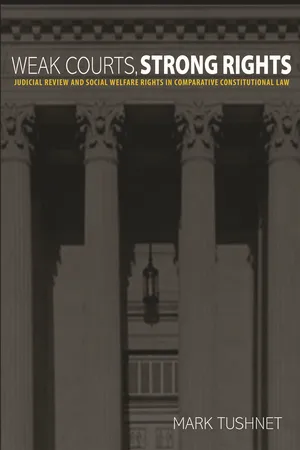
eBook - ePub
Weak Courts, Strong Rights
Judicial Review and Social Welfare Rights in Comparative Constitutional Law
- 312 pages
- English
- ePUB (mobile friendly)
- Available on iOS & Android
eBook - ePub
Weak Courts, Strong Rights
Judicial Review and Social Welfare Rights in Comparative Constitutional Law
About this book
Information
Publisher
Princeton University PressYear
2009Print ISBN
9780691143200
9780691130927
eBook ISBN
9781400828159
Table of contents
- Table of Contents
- Preface
- Acknowledgments
- PART I: Strong-Form and Weak-Form Judicial Review
- CHAPTER 1 Why Comparative Constitutional Law?
- CHAPTER 2 Alternative Forms of Judicial Review
- CHAPTER 3 The Possible Instability of Weak-Form Review and Its Implications
- PART II: Legislative Responsibility for Enforcing the Constitution
- CHAPTER 4 Why and How to Evaluate Constitutional Performance
- CHAPTER 5 Constitutional Decision Making Outside the Courts
- PART III: Judicial Enforcement of Social and Economic Rights
- CHAPTER 6 The State Action Doctrine and Social and Economic Rights
- CHAPTER 7 Structures of Judicial Review, Horizontal Effect, and Social Welfare Rights
- CHAPTER 8 Enforcing Social and Economic Rights
- Table of Cases
Trusted by 375,005 students
Access to over 1.5 million titles for a fair monthly price.
Study more efficiently using our study tools.
Frequently asked questions
Yes, you can cancel anytime from the Subscription tab in your account settings on the Perlego website. Your subscription will stay active until the end of your current billing period. Learn how to cancel your subscription
No, books cannot be downloaded as external files, such as PDFs, for use outside of Perlego. However, you can download books within the Perlego app for offline reading on mobile or tablet. Learn how to download books offline
Perlego offers two plans: Essential and Complete
- Essential is ideal for learners and professionals who enjoy exploring a wide range of subjects. Access the Essential Library with 800,000+ trusted titles and best-sellers across business, personal growth, and the humanities. Includes unlimited reading time and Standard Read Aloud voice.
- Complete: Perfect for advanced learners and researchers needing full, unrestricted access. Unlock 1.5M+ books across hundreds of subjects, including academic and specialized titles. The Complete Plan also includes advanced features like Premium Read Aloud and Research Assistant.
We are an online textbook subscription service, where you can get access to an entire online library for less than the price of a single book per month. With over 1.5 million books across 990+ topics, we’ve got you covered! Learn about our mission
Look out for the read-aloud symbol on your next book to see if you can listen to it. The read-aloud tool reads text aloud for you, highlighting the text as it is being read. You can pause it, speed it up and slow it down. Learn more about Read Aloud
Yes! You can use the Perlego app on both iOS and Android devices to read anytime, anywhere — even offline. Perfect for commutes or when you’re on the go.
Please note we cannot support devices running on iOS 13 and Android 7 or earlier. Learn more about using the app
Please note we cannot support devices running on iOS 13 and Android 7 or earlier. Learn more about using the app
Yes, you can access Weak Courts, Strong Rights by Mark Tushnet in PDF and/or ePUB format, as well as other popular books in Politics & International Relations & Comparative Law. We have over 1.5 million books available in our catalogue for you to explore.