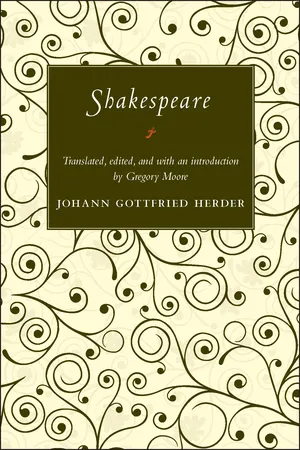
Without Johann Gottfried Herder (1744–1803), we simply would not understand Shakespeare in the way we do. In fact, much literature and art besides Shakespeare would neither look the same nor be the same without the influence of Herder's "Shakespeare" (1773). One of the most important and original works in the history of literary criticism, this passionate essay pioneered a new, historicist approach to cultural artifacts by arguing that they should be judged not by their conformity to a set of conventions imported from another time and place, but by the effectiveness of their response to their own historical and cultural context. Rejecting the authority of a dominant and stifling French neoclassicism that judged eighteenth-century plays by the criteria of Aristotle, Herder's "Shakespeare" signaled a break with the Enlightenment, the approach of Romanticism, and the arrival of a distinctly modern form of aesthetic appreciation.
With a vivid new translation and a fascinating introduction by Gregory Moore, this edition of Herder's classic will speak to today's readers with undiminished power and persuasiveness.
- 128 pages
- English
- ePUB (mobile friendly)
- Available on iOS & Android
eBook - ePub
Shakespeare
About this book
Information
Publisher
Princeton University PressYear
2011Print ISBN
9780691242163
9780691135359
eBook ISBN
9781400828258
Topic
LittératureShakespeare
If any man brings to mind that tremendous image of one “seated high atop some craggy eminence, whirlwinds, tempest, and the roaring sea at his feet, but with the flashing skies about his head,” that man is Shakespeare! Only we might add that below him, at the very base of his rocky throne, there murmur the multitudes who explain, defend, condemn, excuse, worship, slander, translate, and traduce him—and all of whom he cannot hear!
What a library has already been written about, for, and against him! And I have no mind to add to it in any way. It is my wish instead that no one in the small circle of those who read these pages would ever again think to write about, for, or against him, either to excuse or to slander him; but that they explain him, feel him as he is, use him, and—where possible—bring him to life for us Germans. If only this essay can help in some small way to realize this goal!
Shakespeare’s boldest enemies—in how many different guises—have accused and mocked him, claiming that though he may be a great poet, he is not a good dramatist; or if he is a good dramatist, then he is not a classical tragedian equal in rank to men such as Sophocles, Euripides, Corneille, and Voltaire, who raised this art to the highest pinnacle of perfection. And Shakespeare’s boldest friends have mostly been content to excuse, to defend him from such attacks; to weigh his beauties against his transgressions of the rules and see the former as compensation for the latter; to utter the absolvo over the accused; and then to deify his greatness all the more immoderately, the more they were compelled to shrug their shoulders at his faults. That is how things stand even with the most recent editors and commentators—my hope is that these pages can change the prevailing point of view so that our image of him may emerge into a fuller light.
But is this hope not too bold? Too presumptuous, when so many great men have already written about him? I think not. If I can show that both sides have built their case merely on prejudice, on an illusion that does not really exist; if, therefore, I have merely to dispel a cloud from their eyes or at most adjust the image without in the least altering anything in eye or image, then perhaps it is down to my time or even to chance that I should have discovered the spot where I now detain the reader: “Stand here, otherwise you will see nothing but caricature!” If all we ever did was wind and unwind the tangled threads of learning without ever getting any further—then what an unhappy fate we would weave!
It is from Greece that we have inherited the words drama, tragedy, and comedy; and just as the lettered culture of the human race has, on a narrow strip of the earth’s surface, made its way only through tradition, so a certain stock of rules, which seemed inseparable from its teaching, has naturally accompanied it everywhere in its womb and its language. Since a child cannot be and is not educated by means of reason but by means of authority, impression, and the divinity of example and of habit, so entire nations are to an even greater extent children in everything that they learn. The kernel would not grow without the husk, and they will never get the kernel without the husk, even if they could find no use for the latter. That is the case with Greek and northern drama.
In Greece the drama developed in a way that it could not in the north. In Greece it was what it can never be in the north. In the north it is not and cannot be what it was in Greece. Thus Sophocles’ drama and Shakespeare’s drama are two things that in a certain respect have scarcely their name in common. I believe I can demonstrate these propositions from Greece itself and in doing so decipher a great deal of the nature of the northern drama and of the greatest northern dramatist, Shakespeare. We shall observe the genesis of the one by means of the other, but at the same time see it transformed, so that it does not remain the same thing at all.
Greek tragedy developed, as it were, out of a single scene, out of the impromptu dithyramb, the mimed dance, the chorus. This was enlarged, recast: Aeschylus put two actors onto the stage instead of one, invented the concept of the protagonist, and reduced the choral part. Sophocles added a third actor and introduced scene painting—from such origins, though belatedly, Greek tragedy rose to greatness, became a masterpiece of the human spirit, the summit of poetry, which Aristotle esteems so highly and we, in Sophocles and Euripides, cannot admire deeply enough.
At the same time, however, we see that certain things can be explained in terms of these origins, which, were we to regard them as dead rules, we would be bound to misconstrue dreadfully. That simplicity of the Greek plot, that sobriety of Greek manners, that sustained, buskined style of expression, song making, spectacle, unity of time and place—all these things lay so naturally and inherently, without any artifice and magic, in the origins of Greek tragedy that it was made possible only as a consequence of their refinement. They were the husk in which the fruit grew.
Step back into the infancy of that age: simplicity of plot really was so steeped in what was called the deeds of olden times, in republican, patriotic, religious, heroic action, that the poet had more trouble distinguishing parts in this simple whole, introducing a dramatic beginning, middle, and end, than in forcibly separating them, truncating them, or kneading them into a whole out of many discrete events. This ought to be perfectly understandable to anyone who has read Aeschylus or Sophocles. In Aeschylus, what is tragedy often but an allegorical, mythological, semiepic painting, almost without a succession of scenes, story, sensations? Or is it not even, as the ancients said, nothing but chorus into which a certain amount of story has been squeezed? Did the simplicity of his plots demand the least effort and art? And was it any different in the majority of Sophocles’ plays? His Philoctetes, Ajax, Oedipus Coloneus, and so on, are still very close to the uniformity of their origin, the dramatic picture framed by the chorus. No doubt about it! This is the genesis of Greek drama!
Now let us see how much follows from this simple observation. Nothing less than this: “the artificiality of the rules of Greek drama was—not artifice at all! It was Nature!” Unity of plot—was the unity of the action that lay before the Greeks; which according to the circumstances of their time, country, religion, and manners could be nothing but this oneness. Unity of place was just that, unity of place; for the one brief, solemn action occurred only in a single locality, in the temple, in the palace, as it were in the market square of the nation; to begin with, this action was only mimed and narrated and interposed; then finally the entrances of the characters, the scenes were added—but of course it was all still but one scene, where the chorus bound everything together, where in the nature of things the stage could never remain empty, and so on. And even a child could see that unity of time now ensued from and naturally accompanied all this. In those days all these things lay in Nature, so that the poet, for all his art, could achieve nothing without them!
It is also evident that the art of the Greek poets took the very opposite path to the one that we nowadays ascribe to them. They did not simplify, it seems to me, but rather elaborated: Aeschylus expanded the chorus and Sophocles enlarged upon Aeschylus, and we need only compare the most sophisticated plays of Sophocles and his great masterpiece Oedipus in Thebes with Prometheus or with accounts of the ancient dithyramb to see the astonishing artistry with which he successfully endowed his works. But his was never an art of making a simple plot out of a complex one, but rather of making a complex plot out of a simple one, a beautiful labyrinth of scenes. His greatest concern remained, at the most intricate point in the labyrinth, to foster in his audience the illusion of the earlier simplicity, to unwind the knot of their feelings so gently and gradually as to make them believe they had never lost it, the previous dithyrambic feeling. To this end he expanded each scene, retained the choruses, and turned them into staging posts for the action; their every word ensured that his audience never lost sight of the whole, kept them in expectation, in the illusion of development, of familiarity with the action (all of which the didactic Euripides, when the drama had scarcely reached maturity, promptly neglected to do!). In short, he gave action grandeur (something that has been terribly misunderstood).
It ought to be clear to anyone who reads him without prejudice and from the standpoint of his own time that this is the art which Aristotle values in Sophocles, that in everything he took almost the opposite view to the spin that modern times have chosen to put on him. The very fact that he let Thespis and Aeschylus alone and stuck to the variety of Sophocles’ poetry; that he took precisely Sophocles’ innovation as his point of departure and viewed it as the essence of this new poetic genre; that it became his dearest wish to develop a new Homer and to compare him favorably with the original; that he did not ...
Table of contents
- Cover
- Halftitle
- Title
- Copyright
- Contents
- Introduction
- Shakespeare Johann Gottfried Herder
- Editor’s Notes
- Index
Trusted by 375,005 students
Access to over 1.5 million titles for a fair monthly price.
Study more efficiently using our study tools.
Frequently asked questions
Yes, you can cancel anytime from the Subscription tab in your account settings on the Perlego website. Your subscription will stay active until the end of your current billing period. Learn how to cancel your subscription
No, books cannot be downloaded as external files, such as PDFs, for use outside of Perlego. However, you can download books within the Perlego app for offline reading on mobile or tablet. Learn how to download books offline
Perlego offers two plans: Essential and Complete
- Essential is ideal for learners and professionals who enjoy exploring a wide range of subjects. Access the Essential Library with 800,000+ trusted titles and best-sellers across business, personal growth, and the humanities. Includes unlimited reading time and Standard Read Aloud voice.
- Complete: Perfect for advanced learners and researchers needing full, unrestricted access. Unlock 1.5M+ books across hundreds of subjects, including academic and specialized titles. The Complete Plan also includes advanced features like Premium Read Aloud and Research Assistant.
We are an online textbook subscription service, where you can get access to an entire online library for less than the price of a single book per month. With over 1.5 million books across 990+ topics, we’ve got you covered! Learn about our mission
Look out for the read-aloud symbol on your next book to see if you can listen to it. The read-aloud tool reads text aloud for you, highlighting the text as it is being read. You can pause it, speed it up and slow it down. Learn more about Read Aloud
Yes! You can use the Perlego app on both iOS and Android devices to read anytime, anywhere — even offline. Perfect for commutes or when you’re on the go.
Please note we cannot support devices running on iOS 13 and Android 7 or earlier. Learn more about using the app
Please note we cannot support devices running on iOS 13 and Android 7 or earlier. Learn more about using the app
Yes, you can access Shakespeare by Johann Gottfried Herder, Gregory Martin Moore in PDF and/or ePUB format, as well as other popular books in Littérature & Critique littéraire de Shakespeare. We have over 1.5 million books available in our catalogue for you to explore.