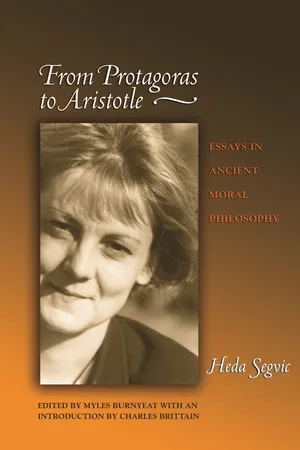
This is a collection of the late Heda Segvic's papers in ancient moral philosophy. At the time of her death at age forty-five in 2003, Segvic had already established herself as an important figure in ancient philosophy, making bold new arguments about the nature of Socratic intellectualism and the intellectual influences that shaped Aristotle's ideas. Segvic had been working for some time on a monograph on practical knowledge that would interpret Aristotle's ethical theory as a response to Protagoras. The essays collected here are those on which her reputation rests, including some that were intended to form the backbone of her projected monograph. The papers range from a literary study of Homer's influence on Plato's Protagoras to analytic studies of Aristotle's metaphysics and his ideas about deliberation. Most of the papers reflect directly or indirectly Segvic's idea that both Socrates' and Aristotle's universalism and objectivism in ethics could be traced back to their opposition to Protagorean relativism. The book represents the considerable achievements of one of the most talented scholars of ancient philosophy of her generation.
In a number of Plato’s dialogues Socrates is shown eager to create the impression that he is not in the same business as the Sophists. Yet there are some striking overlaps. Socrates goes around Athens discussing the nature of virtue and the question of how best to live one’s life, while the Sophists—most notably, Protagoras—go all over Greece discussing, among other things, the same topics. In Plato’s Protagoras Protagoras makes a point of saying that he does not, like the other Sophists, burden his student with subjects such as arithmetic, geometry, astronomy, or music. He will teach Hippocrates precisely what he has come to learn, how to deliberate well in both his private and his public life (Prot. 318d 7–319a 2). It is practical matters concerning the conduct of life that Protagoras focuses upon—much like Socrates.
When Protagoras says that those who associate themselves with him will become better (Prot. 316c 9–d 1, 318a 6–9), this is really another way of saying that his concern is with virtue,
ρετ
.1 Apart from the focus on human virtue, Socrates and Protagoras seem to share the following, more specific, views. To begin with, they both appear to assume that there is such a thing as doing well or ill in life, and that humans generally want to do well in life. As far as Socrates is concerned, see for instance his words at Prot. 313a 6–9: ‘…but when it comes to something you value more than your body, namely your soul, and when everything concerning whether you do well or ill in your life depends on whether this becomes worthy or worthless….’. ‘Doing well’ translates ε
πρ
ττειν. To do well in life is the same thing as to attain ε
δαιμον
α—, rendered usually as ‘happiness’ or ‘the good life’. Protagoras for his part acknowledges, for instance at 351b 3–4, in response to Socrates, that some people live badly and others well. It seems to go without saying that he thinks that they all want to live well. (The discussion that follows upon 351b presupposes this.) Socrates and Protagoras are thus in agreement that there is such a thing as ε
δαιμον
α, and that humans in general want to attain it. Further, they agree that having
ρετ
leads to doing well in life. Given how far-ranging the term
ρετ
is, this second claim is more open-ended than it might at first sight appear to be. If one can hit upon the good life by one’s own effort, it is some combination of admirable qualities called ‘virtue’, whatever this may turn out to be, that enables one to do so.
In addition, Socrates and Protagoras both use the term τ
χνη in order to throw light on the connection they envisage between virtue and the good life. The role played by Socrates’ frequent references to τ
χνη in the early dialogues is the following. A particular art or craft leads to success in some specific domain of practice: for instance, the knowledge of medicine enables this particular person, a doctor, to be reliably successful in curing people. Now if it is possible to achieve success, or some measure of success, in restricted domains of practice—in curing people, sailing, building houses or tables—by employing a relevant body of practical knowledge, might it not be possible to achieve success, or some measure of success, in living one’s life by employing an appropriate body of practical knowledge? The question thus is whether there exists a counterpart to the established arts and crafts (carpentry, architecture, medicine, navigation) which, if one had it, would enable one to live well. This art, if it existed or if it could be developed, would appropriately be called an art of living.2
A τ
χνη is practical knowledge or expertise. For Plato, as for Aristotle (EN VI. 3 1139b 14–7, 1140a 23) and Greek philosophers generally, this is in the first place a set of capacities a person has. It is something that belongs to the person’s soul; only secondarily is it a set of abstract rules, or a set of established practices that constitute the exercise of a profession. The human soul is what makes us live; if the soul had the art of living, it would be in good shape and well-equipped to make us live well.
As we shall see shortly, when Protagoras comes to formulate his own μ
ϑημα, teaching, his words on the face of it suggest that such an art is possible. Under one reading of his formulation at any rate, what he professes to teach is, precisely, an art that enables his students ...
Table of contents
Cover Page
Title Page
Copyright Page
Contents
Acknowledgments
Introduction-Charles Brittain
Part I
Part II
Part III
Indices
Trusted by 375,005 students
Access to over 1.5 million titles for a fair monthly price.
Study more efficiently using our study tools.
Frequently asked questions
Yes, you can cancel anytime from the Subscription tab in your account settings on the Perlego website. Your subscription will stay active until the end of your current billing period. Learn how to cancel your subscription
No, books cannot be downloaded as external files, such as PDFs, for use outside of Perlego. However, you can download books within the Perlego app for offline reading on mobile or tablet. Learn how to download books offline
Perlego offers two plans: Essential and Complete
Essential is ideal for learners and professionals who enjoy exploring a wide range of subjects. Access the Essential Library with 800,000+ trusted titles and best-sellers across business, personal growth, and the humanities. Includes unlimited reading time and Standard Read Aloud voice.
Complete: Perfect for advanced learners and researchers needing full, unrestricted access. Unlock 1.5M+ books across hundreds of subjects, including academic and specialized titles. The Complete Plan also includes advanced features like Premium Read Aloud and Research Assistant.
Both plans are available with monthly, semester, or annual billing cycles.
We are an online textbook subscription service, where you can get access to an entire online library for less than the price of a single book per month. With over 1.5 million books across 990+ topics, we’ve got you covered! Learn about our mission
Look out for the read-aloud symbol on your next book to see if you can listen to it. The read-aloud tool reads text aloud for you, highlighting the text as it is being read. You can pause it, speed it up and slow it down. Learn more about Read Aloud
Yes! You can use the Perlego app on both iOS and Android devices to read anytime, anywhere — even offline. Perfect for commutes or when you’re on the go. Please note we cannot support devices running on iOS 13 and Android 7 or earlier. Learn more about using the app
Yes, you can access From Protagoras to Aristotle by Heda Segvic, Myles Burnyeat in PDF and/or ePUB format, as well as other popular books in Philosophy & Ancient & Classical Philosophy. We have over 1.5 million books available in our catalogue for you to explore.