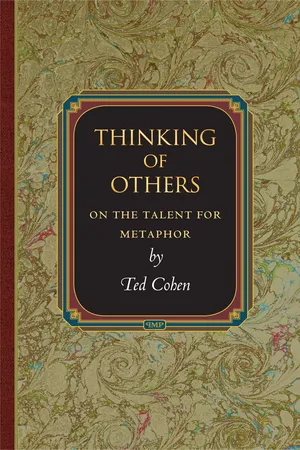
In Thinking of Others, Ted Cohen argues that the ability to imagine oneself as another person is an indispensable human capacity--as essential to moral awareness as it is to literary appreciation--and that this talent for identification is the same as the talent for metaphor. To be able to see oneself as someone else, whether the someone else is a real person or a fictional character, is to exercise the ability to deal with metaphor and other figurative language. The underlying faculty, Cohen argues, is the same--simply the ability to think of one thing as another when it plainly is not.
In an engaging style, Cohen explores this idea by examining various occasions for identifying with others, including reading fiction, enjoying sports, making moral arguments, estimating one's future self, and imagining how one appears to others. Using many literary examples, Cohen argues that we can engage with fictional characters just as intensely as we do with real people, and he looks at some of the ways literature itself takes up the question of interpersonal identification and understanding.
An original meditation on the necessity of imagination to moral and aesthetic life, Thinking of Others is an important contribution to philosophy and literary theory.
- 104 pages
- English
- ePUB (mobile friendly)
- Available on iOS & Android
eBook - ePub
About this book
Information
Publisher
Princeton University PressYear
2009Print ISBN
9780691154466
9780691137469
eBook ISBN
9781400828951
Topic
PhilosophieSubtopic
LiteraturkritikTable of contents
- Cover
- Title
- Copyright
- Contents
- Acknowledgments
- Chapter One: The Talent for Metaphor
- Chapter Two: Being a Good Sport
- Chapter Three: From the Bible: Nathan and David
- Chapter Four: Real Feelings, Unreal People
- Chapter Five: More from the Bible: Abraham and God
- Chapter Six: More Lessons from Sports
- Chapter Seven: Oneself Seen by Others
- Chapter Eight: Oneself as Oneself
- Chapter Nine: Lessons from Art
- Chapter Ten: The Possibility of Conversation, Moral and Otherwise
- Chapter Eleven: Conclusion: In Praise of Metaphor
- Index
Trusted by 375,005 students
Access to over 1.5 million titles for a fair monthly price.
Study more efficiently using our study tools.
Frequently asked questions
Yes, you can cancel anytime from the Subscription tab in your account settings on the Perlego website. Your subscription will stay active until the end of your current billing period. Learn how to cancel your subscription
No, books cannot be downloaded as external files, such as PDFs, for use outside of Perlego. However, you can download books within the Perlego app for offline reading on mobile or tablet. Learn how to download books offline
We are an online textbook subscription service, where you can get access to an entire online library for less than the price of a single book per month. With over 1.5 million books across 990+ topics, we’ve got you covered! Learn about our mission
Look out for the read-aloud symbol on your next book to see if you can listen to it. The read-aloud tool reads text aloud for you, highlighting the text as it is being read. You can pause it, speed it up and slow it down. Learn more about Read Aloud
Yes! You can use the Perlego app on both iOS and Android devices to read anytime, anywhere — even offline. Perfect for commutes or when you’re on the go.
Please note we cannot support devices running on iOS 13 and Android 7 or earlier. Learn more about using the app
Please note we cannot support devices running on iOS 13 and Android 7 or earlier. Learn more about using the app
Yes, you can access Thinking of Others by Ted Cohen in PDF and/or ePUB format, as well as other popular books in Philosophie & Literaturkritik. We have over 1.5 million books available in our catalogue for you to explore.