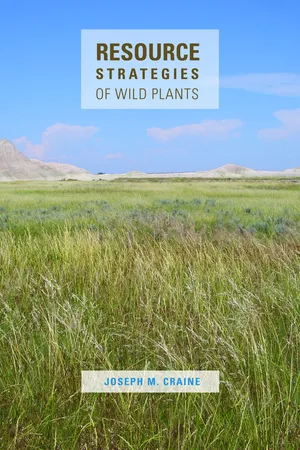
Over millions of years, terrestrial plants have competed for limited resources, defended themselves against herbivores, and resisted a myriad of environmental stresses. These struggles have helped generate more than a quarter million terrestrial plant species, each possessing a unique strategy for success. Yet, as Resource Strategies of Wild Plants demonstrates, the constraints on plant growth are universal enough that a few survival strategies hold true for all seed-producing plants. This book describes the five major strategies of growth for terrestrial plants, details how plants succeed when resources are scarce, delves into the history of research into plant strategies, and resets the foundational understanding of ecological processes.
Drawing from recent findings in plant-herbivore interactions, ecosystem ecology, and evolutionary ecology, Joseph Craine explains how plants attain available nutrients, withstand the immense stresses of drying soils, and flourish in the race for light. He shows that the competition for resources has shaped plant evolution in newly discovered ways, while the scarcity of such resources has affected how plants interact with herbivores, wind, fire, and frost. An understanding of the major resource strategies of wild plants remains central to learning about the ecology of plant communities, global changes in the biosphere, methods for species conservation, and the evolution of life on earth.
- 344 pages
- English
- ePUB (mobile friendly)
- Available on iOS & Android
eBook - ePub
Resource Strategies of Wild Plants
About this book
Information
Publisher
Princeton University PressYear
2009Print ISBN
9780691139128
9780691139111
eBook ISBN
9781400830640
Topic
BiowissenschaftenSubtopic
ÖkologieTable of contents
- Cover
- Half title
- Title
- Copyright
- Dedication
- Contents
- Preface
- Acknowledgments
- Abbreviations
- Chapter 1 The Basis for Plant Strategies
- Chapter 2 The History of Plant Strategies
- Chapter 3 Stress and Disturbance
- Chapter 4 Resource Limitation
- Chapter 5 Competition for Nutrients and Light
- Chapter 6 Comparing Negative Effects
- Chapter 7 The Low-Nutrient Strategy
- Chapter 8 The High-Resource Strategy
- Chapter 9 The Low-Light Strategy
- Chapter 10 The Low-Water and Low-CO2 Strategies
- Chapter 11 A Synthesis of Plant Strategies
- Bibliography
- Index
Trusted by 375,005 students
Access to over 1.5 million titles for a fair monthly price.
Study more efficiently using our study tools.
Frequently asked questions
Yes, you can cancel anytime from the Subscription tab in your account settings on the Perlego website. Your subscription will stay active until the end of your current billing period. Learn how to cancel your subscription
No, books cannot be downloaded as external files, such as PDFs, for use outside of Perlego. However, you can download books within the Perlego app for offline reading on mobile or tablet. Learn how to download books offline
Perlego offers two plans: Essential and Complete
- Essential is ideal for learners and professionals who enjoy exploring a wide range of subjects. Access the Essential Library with 800,000+ trusted titles and best-sellers across business, personal growth, and the humanities. Includes unlimited reading time and Standard Read Aloud voice.
- Complete: Perfect for advanced learners and researchers needing full, unrestricted access. Unlock 1.5M+ books across hundreds of subjects, including academic and specialized titles. The Complete Plan also includes advanced features like Premium Read Aloud and Research Assistant.
We are an online textbook subscription service, where you can get access to an entire online library for less than the price of a single book per month. With over 1.5 million books across 990+ topics, we’ve got you covered! Learn about our mission
Look out for the read-aloud symbol on your next book to see if you can listen to it. The read-aloud tool reads text aloud for you, highlighting the text as it is being read. You can pause it, speed it up and slow it down. Learn more about Read Aloud
Yes! You can use the Perlego app on both iOS and Android devices to read anytime, anywhere — even offline. Perfect for commutes or when you’re on the go.
Please note we cannot support devices running on iOS 13 and Android 7 or earlier. Learn more about using the app
Please note we cannot support devices running on iOS 13 and Android 7 or earlier. Learn more about using the app
Yes, you can access Resource Strategies of Wild Plants by Joseph M. Craine in PDF and/or ePUB format, as well as other popular books in Biowissenschaften & Ökologie. We have over 1.5 million books available in our catalogue for you to explore.