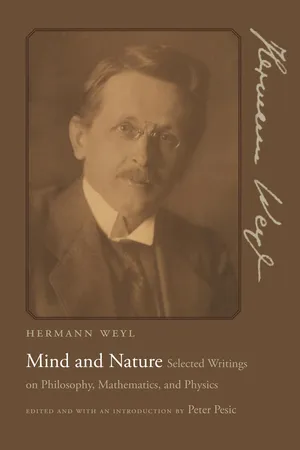
Hermann Weyl (1885-1955) was one of the twentieth century's most important mathematicians, as well as a seminal figure in the development of quantum physics and general relativity. He was also an eloquent writer with a lifelong interest in the philosophical implications of the startling new scientific developments with which he was so involved. Mind and Nature is a collection of Weyl's most important general writings on philosophy, mathematics, and physics, including pieces that have never before been published in any language or translated into English, or that have long been out of print. Complete with Peter Pesic's introduction, notes, and bibliography, these writings reveal an unjustly neglected dimension of a complex and fascinating thinker. In addition, the book includes more than twenty photographs of Weyl and his family and colleagues, many of which are previously unpublished.
Included here are Weyl's exposition of his important synthesis of electromagnetism and gravitation, which Einstein at first hailed as "a first-class stroke of genius"; two little-known letters by Weyl and Einstein from 1922 that give their contrasting views on the philosophical implications of modern physics; and an essay on time that contains Weyl's argument that the past is never completed and the present is not a point. Also included are two book-length series of lectures, The Open World (1932) and Mind and Nature (1934), each a masterly exposition of Weyl's views on a range of topics from modern physics and mathematics. Finally, four retrospective essays from Weyl's last decade give his final thoughts on the interrelations among mathematics, philosophy, and physics, intertwined with reflections on the course of his rich life.
Modern physics renders it probable that the only fundamental forces in Nature are those which have their origin in gravitation and in the electromagnetic field. After the effects proceeding from the electromagnetic field had been coordinated by Faraday and Maxwell into laws of striking simplicity and clearness, it became necessary to attempt to explain gravitation also on the basis of electromagnetism, or at least to fit it into its proper place in the scheme of electromagnetic laws, in order to arrive at a unification of ideas. This was actually done by H. A. Lorentz, G. Mie, and others, although the success of their work was not wholly convincing.1 At the present time, however, in virtue of Einstein’s general theory of relativity, we understand in principle the nature of gravitation, and the problem is reversed. It is necessary to regard electromagnetic phenomena, as well as gravitation, as an outcome of the geometry of the universe. I believe that this is possible when we liberate the world-geometry (on which Einstein based his theory) from an inherent inconsistency, which is still associated with it as a consequence of our previous Euclidean conceptions.
The great accomplishment of the theory of relativity was that it brought the obvious problem of the relativity of motion into harmony with the existence of inertial forces. The Galilean law of inertia shows that there is a kind of obligatory guidance in the universe, which constrains a body left to itself to move with a perfectly definite motion, once it has been set in motion in a particular direction in the world. The body does this in virtue of a tendency of persistence, which carries on this direction at each instant “parallel to itself.” At every position P in the universe, this tendency of persistence (the “guiding field”) thus determines the infinitesimal parallel displacement of vectors from P to world-points indefinitely near to P. Such a continuum, in which this idea of infinitesimal parallel displacement is determinate, I have designated as “affinely connected.”2 According to the ideas of Galileo and Newton, the “affine connection” of the universe (the difference between straight and curved) is given by its geometrical structure. A vector at any position in the universe determines directly and without ambiguity, at every other position, and by itself (i.e., independently of the material content of the universe), a vector “equal” to itself. According to Einstein, however, the guiding field is a physical reality which is dependent on the state of matter, and manifests itself only infinitesimally (as a tendency of persistence which carries over the vectors from one point to “indefinitely neighboring” ones). The immense success of Einstein’s theory is based on the fact that the effects of gravitation also belong to the guiding field, as we should expect a priori from our experience of the equality of gravitational and inertial mass. The planets follow exactly the orbit destined to them by the guiding field; there is no special “gravitational force” necessary, as in Newton’s theory, to cause them to deviate from their Galilean orbit. In general, the parallel displacement is “non-integrable,” i.e., if we transfer a vector at P along two different paths to a point P′ at a finite distance from P, then the vectors, which were coincident at P, arrive at P′ in two different end-positions after traveling these two paths.
The “affine connection” is not an original characteristic of the universe, but arises from a more deeply lying condition of things—the “metrical field.”3 There exists an infinitesimal “light cone” at every position P in the world, which separates past and future in the immediate vicinity of the point P. In other words, this light cone separates those world-points which can receive action from P from those from which an “action” can arrive at P. This “cone of light” renders it possible to compare two line-elements at P with each other by measurement; all vectors of equal measure represent one and the same distance at P.4 In addition to the determination of measure at a point P (the “relation of action” of P with its surroundings), we have now the “metrical relation,” which determines the congruent transference of an arbitrary distance at P to all points indefinitely near to P.5
Just as the point of view of Einstein leads back to that of Galileo and Newton when we assume the transference of vectors by parallel displacement to be integrable, so we fall back on Einstein when the transference of distances by congruent transference is integrable. But this particular assumption does not appear to me to be in the least justified (apart from the progress of the historical development). It appears to me rather as a gross inconsistency. For the “distances,” the old point of view of a determination of magnitudes in terms of each other is maintained, this being independent of matter and taking place directly at a distance. This is just as much in conflict with the principle of the relativity of magnitude as the point of view of Newton and Galileo is with the principle of the relativity of motion. If, in the case in point, we proceed in earnest with the idea of the continuity of action, then “magnitudes of condition” occur in the mathematical description of the world-metrics in just sufficient number and in such a combination as is necessary for the description of the electromagnetic and of the gravitational field. We saw above that, besides inertia (the retention of the vector-direction), gravitation was also included in the guiding field, as a slight variation of this, as a whole, constant inertia. So in the present case, in addition to the force which conserves space-and timelengths, electro-magnetism is also included in the metrical relation. Unfortunately, this cannot be made clear so readily as in the case of gravitation. For the phenomena of gravitation are easily obtained from the Galilean principle, according to which the world-direction of a mass-point in motion follows at every instant the parallel displacement. Now it is by no means the case that the ponderomotive force of the electromagnetic field should be included in our Galilean law of motion, as well as gravitation, for a charged mass-point does not follow the guiding field. On the contrary, the correct equations of motion are obtained only by the establishment of a definite and concrete law of Nature, which is possible within the framework of the theory, and not from the general principles of the theory.
The form of the law of Nature on which the condition of the metrical field is dependent is limited by our conception of the nature of gravitation and electricity in still greater measure than it is by Einstein’s general principle of relativity.6 When the metrical connection alone is virtually varied, the most simple of the assumptions possible leads exactly to the theory of Maxwell. Thus, whereas Einstein’s theory of gravitation gave certain inappreciable deviations from the Newtonian theory, such as could be tested by experiment, our interpretation of electricity—one is almost tempted to say unfortunately—results in the complete confirmation of Maxwell’s laws. If we supplement Maxwell’s “magnitude of action” by the simplest additional term which also allows of the virtual variation of the “relation of action,” 7 we then arrive at Einstein’s laws of the gravitational field, from which, however, there are two small deviations:
1. The cosmological term appears, which Einstein appended later to his equations and which results in the spatial closure of the universe. A hypothesis conceived ad hoc by Einstein to explain the generally prevailing equilibrium of masses results here of necessity. Whereas Einstein has to assume a pre-established harmony between the “cosmological constant” which is characteristic for his modified law of gravitation and the total mass fortuitously present in the universe, in our case, where no such constant occurs, the world-mass determines the curvature of the universe in virtue of the laws of equilibrium. Only in this way, it appears to me, is Einstein’s cosmology at all possible from a physical point of view.
2. In the case where an electromagnetic field is present, Einstein’s cosmological term must be supplemented by an additional term of similar character. This renders the existence of charged material particles possible without requiring an immense mass-horizon as in Einstein’s cosmology.
At first the non-integrability of the transference of distances aroused much antipathy.8 Does not this mean that two measuring-rods which coincide at one position in the universe no longer need to coincide in the event of a subsequent encounter? Or that two clocks which set out from one world-position with the same period will possess different periods should they happen to encounter at a subsequent position in space? Such a behavior of “atomic clocks” obviously stands in opposition to the fact that atoms emit spectral lines of a definite frequency, independently of their past history. Neither does a measuring-rod at rest in a static field experience a congruent transference from moment to moment.
What is the cause of this discrepancy between the idea of congruent transfer and the behavior of measuring-rods and clocks? I differentiate between the determination of a magnitude in Nature by “persistence” (Beharrung) and by “adjustment” (Einstellung).9 I shall make the difference clear by the following illustration: We can give to the axis of a rotating top any arbitrary direction in space. This arbitrary original direction then determines for all time the direction of the axis of the top when left to itself, by means of a tendency of persistence which operates from moment to moment; the axis experiences at every instant a parallel displacement. The exact opposite is the case for a magnetic needle in a magnetic field. Its direction is determined at each instant independently of the condition of the system at other instants by the fact that, in virtue of its constitution, the system adjusts itself in an unequivocally determined manner to the field in which it is situated. A priori we have no ground for assuming as integrable a transfer which results purely from the tendency of persistence. Even if that is the case, as, for instance, for the rotation of the top in Euclidean space, we should find that two tops that start out from the same point with the same axial positions and meet again after the lapse of a very long time would show arbitrary deviations of their axial positions, for they can never be completely isolated from every influence. Thus, although, for example, Maxwell’s equations demand the conservation equation de/dt = 0 for the charge e of electron, we are unable to understand from this fact why an electron, even after an indefinitely long time, always posseses an unaltered charge, and why the same charge is associated with all electrons. This circumstance shows that the charge is not determined by persistence, but by adjustment, and that there can exist only one state of equilibrium of the negative electricity, to which the corpuscle adjusts itself afresh at every instant. For the same reason we can conclude the same thing for the spectral lines of atoms. The one thing common to atoms emitting the same frequency is their constitution and not the agreement of their frequencies on the occasion of an encounter in the distant past. Similarly, the length of a measuring-rod is obviously determined by adjustment, for I could not give this measuring-rod in this field-position any other length arbitrarily (say double or triple length) in place of the length that it now possesses, in the manner in which I can at will predetermine its direction. The theoretical possibility of a determination of length by adjustment is given as a consequence of the world-curvature, which arises from the metrical field according to a complicated mathematical law. As a result of its constitution, the measuring-rod assumes a length which possesses this or that value, in relation to the radius of curvature of the field. In point of fact, and taking the laws of Nature indicated above as a basis, it can be made plausible that measuring-rods and clocks adjust themselves exactly in this way, although this assumption—which, in the neighborhood of large masses, involves the displacement of spectral lines toward the red upheld by Einstein—does not appear anything like so conclusive in our theory as it does in that of Einstein.
2
Two Letters by Einstein and Weyl on a Metaphysical Question
1922
[In May 1922 the French physicist Paul Langevin gave three lectures in Zurich on Einstein’s relativity theory, the first of which was such a thunderous success that the journalist E. Bovet posed an “easy question” to Langevin: “How can we explain the enthusiasm of the public, which—apart from a few exceptions—surely understood no more of relativity theory than I? Is this pure snobbery? Courtesy to a foreign scholar? Or is it explained through the surmise of a fundamental alteration in our view of the world? Would such a surmise be legitimate? If so, in what sense? Does relativity theory perhaps signify liberation from the mechanistic, materialistic view of the world, under whose pressure our modern culture is breaking up?” Though Langevin did not answer Bovet’s personal appeal, Einstein and Weyl did reply.]
Berlin, June 7, 1922 Haberlandstrasse 5
Dear Sir,
Your “Question to Mr. Langevin” provokes me to give an answer. Regarding the general questions that interest you, relativity theory changes nothing at all in the state of affairs because it signifies nothing but an improvement and modification of the basis of the physical-causal world-picture without a change in its fundamental point of view. This is a kind of logical system for representing space-time events in which mental essences (will, feeling, etc.) do not apply directly. To avoid a collision between the various sorts of “realities” that physics and psychology deal with, Spinoza and Fechner respectively founded the theory of psychophysical parallelism, which, quite frankly, completely pleases me.1 Physics signifies one possible way among others equally justified to put experience in a certain order. The foundations of this system are freely chosen by us, namely from the point of view that at any given time satisfies known facts with a minimum of hypotheses. Thus, this is not a matter of “believing,” but rather of free choice from the point of view of logical completeness and adaptability to experience, as indeed is so beautifully shown in the cited passages from Henri Poincaré.2
The question “what is the use?” only means something—if it is really supposed to h...
Table of contents
Cover
Title Page
Copyright
Contents
Introduction
Chapter 1 - Electricity and Gravitation
Chapter 2 - Two Letters by Einstein and Weyl on a Metaphysical Question
Chapter 3 - Time Relations in the Cosmos, Proper Time, Lived Time, and Metaphysical Time
Chapter 4 - The Open World: Three Lectures on the Metaphysical Implications of Science
Chapter 5 - Mind and Nature
Chapter 6 - Address at the Princeton Bicentennial Conference
Chapter 7 - Man and the Foundations of Science
Chapter 8 - The Unity of Knowledge
Chapter 9 - Insight and Reflection
Notes
References
Acknowledgments
Index
Trusted by 375,005 students
Access to over 1.5 million titles for a fair monthly price.
Study more efficiently using our study tools.
Frequently asked questions
Yes, you can cancel anytime from the Subscription tab in your account settings on the Perlego website. Your subscription will stay active until the end of your current billing period. Learn how to cancel your subscription
No, books cannot be downloaded as external files, such as PDFs, for use outside of Perlego. However, you can download books within the Perlego app for offline reading on mobile or tablet. Learn how to download books offline
Perlego offers two plans: Essential and Complete
Essential is ideal for learners and professionals who enjoy exploring a wide range of subjects. Access the Essential Library with 800,000+ trusted titles and best-sellers across business, personal growth, and the humanities. Includes unlimited reading time and Standard Read Aloud voice.
Complete: Perfect for advanced learners and researchers needing full, unrestricted access. Unlock 1.5M+ books across hundreds of subjects, including academic and specialized titles. The Complete Plan also includes advanced features like Premium Read Aloud and Research Assistant.
Both plans are available with monthly, semester, or annual billing cycles.
We are an online textbook subscription service, where you can get access to an entire online library for less than the price of a single book per month. With over 1.5 million books across 990+ topics, we’ve got you covered! Learn about our mission
Look out for the read-aloud symbol on your next book to see if you can listen to it. The read-aloud tool reads text aloud for you, highlighting the text as it is being read. You can pause it, speed it up and slow it down. Learn more about Read Aloud
Yes! You can use the Perlego app on both iOS and Android devices to read anytime, anywhere — even offline. Perfect for commutes or when you’re on the go. Please note we cannot support devices running on iOS 13 and Android 7 or earlier. Learn more about using the app
Yes, you can access Mind and Nature by Hermann Weyl, Peter Pesic in PDF and/or ePUB format, as well as other popular books in Mathematics & History & Philosophy of Mathematics. We have over 1.5 million books available in our catalogue for you to explore.